
If you go to this article from the Washington Examiner, you’ll see why yet again the brilliance and erudition of university professors leaves me speechless. Not a Leicester University archaeologist this time, but a Senior Lecturer in the Department of Anthropology and Managing Faculty Director for the Center for Civil Rights and Racial Justice in the Law School at the University Pittsburgh, name of Gabby Yearwood. According to this site “His research interests include the social constructions of race and racism, masculinity, gender, sex, Black Feminist and Black Queer theory, anthropology of sport and Black Diaspora.”
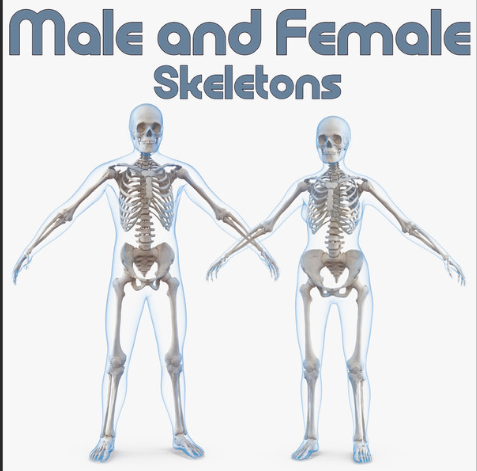
The letters w.o.k.e. begin to loom ominously on my horizon. But presumably he, more than the rest of us, knows the difference between the shape of males and females. Oh, perhaps I shouldn’t even express it that way. I’m afraid I don’t know how to refer to what I’m about to write without offending someone, but as it concerns two hypothetical 100-year-old skeletons, therefore from a golden era when we were just men or women, I’ll write of these hypothetical skeletons accordingly. One is male, the other female.
The prof was asked, if such skeletons were dug up, would it be possible for anthropologists to tell by looking at them which one was male and which female. It seems that Prof Yearwood is either being super-duper-woke, or just hasn’t got a clue, because he said no, an anthropologist couldn’t tell the difference.
What? If skeletons are that of adults (which the ones in questions definitely are) the difference is usually plain enough. A male skeleton isn’t constructed for childbirth, full stop. So if a baby couldn’t be accommodated by the pelvis, the skeleton is that of a man. Right? Whether or not that in life that man identified as a woman is beside the point. He might also have only eaten grass, but bones is bones. However Prof Yearwood would clearly not know the skeleton’s biological sex. All I can say is thank God he didn’t choose obstetrics!
The above article from the Washington Examiner, then goes on to give Richard III as an example of identifying the sex of a very real skeleton that was much older than 100 years. For once Leicester University archaeologists are due some laurels, because they “could immediately identify that the body [sic] was an adult human man between his late 20s and his late 30s” and that “it did have severe scoliosis, which ‘would have probably lifted his right shoulder higher than his left’”. What Leicester archaeologists could not do at a glance was conclusively identify the remains as those of Richard III. This required testing the mitochondrial DNA. Through this the remains were fully identified. They were those of King Richard III of England.
The Washington Examiner article ends with “In conclusion, not only are scientists able almost immediately to identify the gender of a 500-year-old corpse. For the most reliable confirmation of the corpse’s identity, they must rely on DNA that can only be passed from women. However much activists may wish to complicate gender as a social construct, biology as a science refuses to break from the binary.”
And they should also take a teensy look at the skeleton’s hips! It’s not rocket science. But if you’re woke, you have to be sooo careful, don’t you? Otherwise you’ll offend all the other wokes. They are the monstrous army!


 The New Murrey and Blue blog
Leave a reply to aschalmers Cancel reply