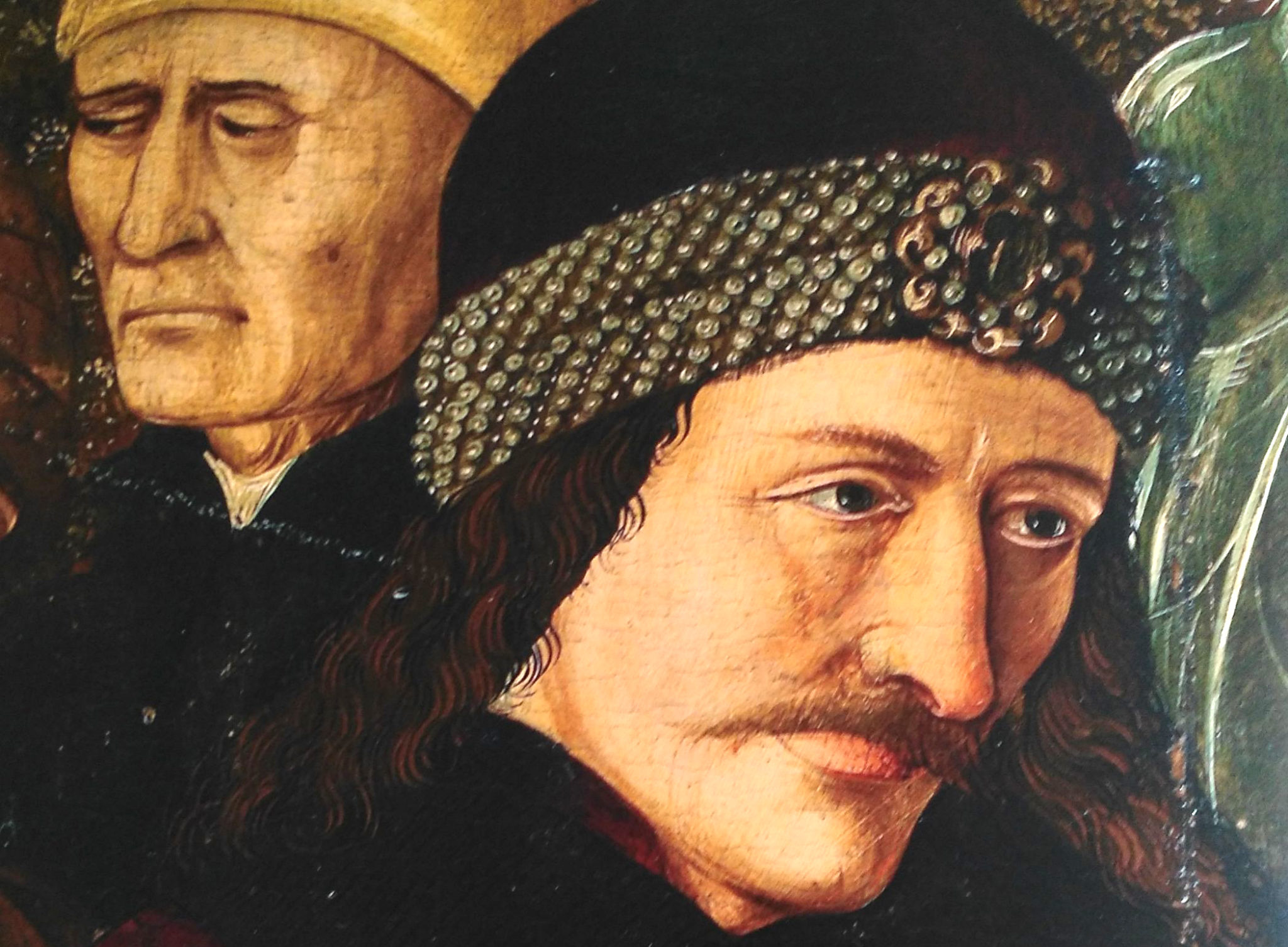
There I was on the road to Damascus when there was a great roll of thunder and suddenly I was confronted by Vlad the Impaler.
I jest of course, but I did see a TV documentary about Vlad’s curse and did have a flash of inspiration for an article for the blog. Except….right now I can’t remember exactly what the inspiration entailed. All I do know is that it involved Richard III. And before you throw your hands up in fury and righteous indignation, no, I didn’t look at Vlad and think “Ah, Romania’s Richard III!”
So this is a post without a punchline. I’m hoping that between writing and publication I remember what the heck it was.
As I watched the documentary I made notes, not thinking I’d forget such a thing as my own stroke of genius. And believe me it doesn’t always do to sleep on something, because this morning this very important point had still skipped bail, jumped ship and, like a certain Norwegian Blue, shuffled off its mortal coil.
But the story of Vlad and his curse is interesting enough to write about anyway. I will start by saying that the documentary was from a National Geographic series called Atlas of Cursed Places. It was Series 1, Episode 3, “The Curse of Vlad the Impaler”.
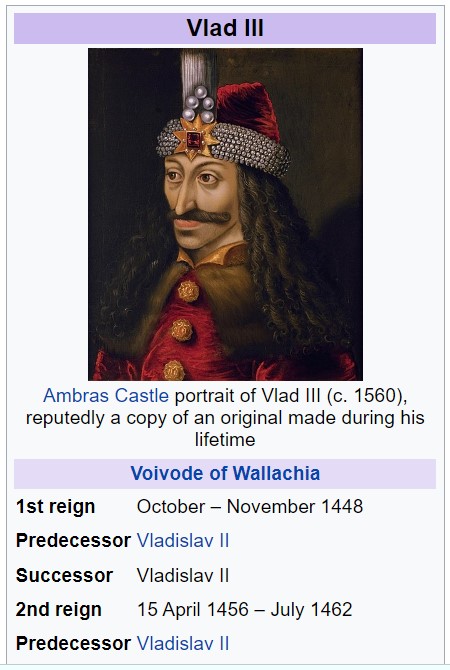
Vlad’s second reign began today 15 April in 1456. He lived between between 1428-31 and 1476-77, so his life overlapped Richard’s. Both men had a terrible reputation, of course, but in Vlad’s case, it really was deserved. We know him for his gruesome activities, torturing and murdering thousands of enemies by skewering them on stakes and leaving them to die. It would be about three days before his victims finally and thankfully breathed their last. Vlad is also believed to be the inspiration for Bram Stoker’s Dracula. So most of us regard him as an appalling tyrant and mass murderer of incredible cruelly, capable of thinking up many novel new ways of inflicting terrible deaths.
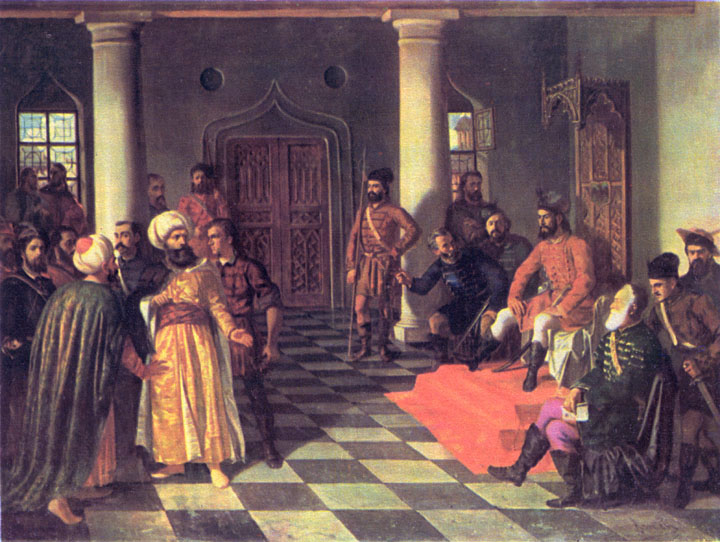
by Theodor Aman (1831-1891)
But in Romania he is often spoken of as a national hero who brought stability, law and order to the nation (in whatever form the nation took in the 15th century). If he resorted to such cruelty, they say he did it for the good of Romania. But he left a curse behind and according to the documentary it’s a scourge that lies heavily over the nation to this day.
Romania’s geographic position has always meant being caught in conflict and disaster, but the documentary claims that it’s Vlad’s curse that is to blame for all that has befallen the land since his death. There has even been a terrible plague, far more deadly than the Black Death and which affected only Romania. It happened between 1813-14 and was called Caragea’s Plague. It isn’t without reason that witchcraft has such a hold there, so that even its politicians pay heed to witches. It’s all Vlad’s fault.
The trials through which Romania has managed to endure have changed the nature of its people, or so the documentary said. They have become stronger, calmer and more resilient than the rest of us, seldom giving in to fear and always able to think clearly, no matter what the situation. They aren’t afraid of anything. Again, this is according to the documentary. As a result of centuries of warfare, political upheaval, invasion and plague, they have developed a coping mechanism, undergoing an epigenetic change in their genes.
One of the definitions of epigenetic is “relating to, being, or involving changes in gene function that do not involve changes in DNA sequence”. It seems genes can indeed change due to stress, and Romanians have had a lot of stress since Vlad’s time. So, do Romanians have his curse to “thank” for their stoicism in the face of adversity? (I am not acquainted with any Romanians, so cannot say whether or not this claimed aspect of their national character is true.)
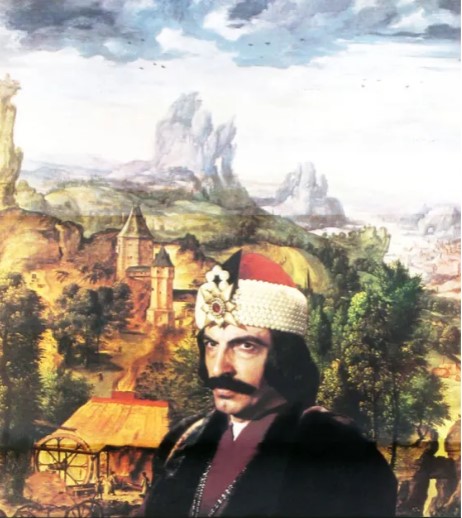
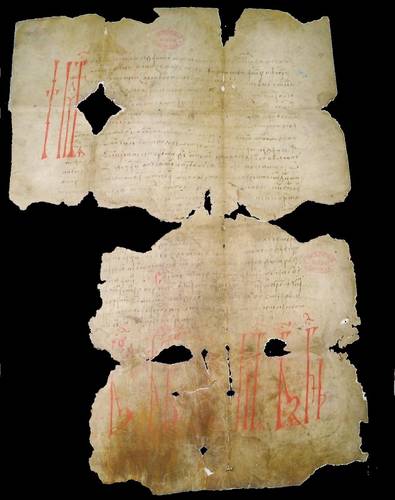
I tried to find out more about the curse, and happened upon this site. Vlad wrote the curse at the end of a contract (illustrated below): “….’And he and his flesh shall be destroyed by the word of the good Lord and in the afterlife his soul shall be with Judas and Arius and with others that said: his blood over them and over their children, what it is and it will always be forever, amen’….”
“…. Historians say that ending a contract with a curse was pretty common in those days. We could almost call it a trend. People were fascinated with curses and the spell books trade was flourishing….Ending a document with a curse was a way to compel people to honour the terms of the contract….Many also say that this curse at the end of the first document mentioning Bucharest is an inauspicious omen for the Capital of Romania and it has brought only bad luck to the city and its people….”
You can read more about Vlad and Romania here and here.
But all this still leaves me without a trace of my Richard III inspiration. Oh, there’s another curse, believe me, it’s those senior moments that sometimes become senior black holes! What I’ve written above describes how I came to write this post….so if you can see/guess what exceedingly tenuous point may have stirred my grey cells into action, please let me know!
Because here, in the cold light of day, I can’t for the life of me think how I managed to make a connection between Vlad the Impaler and Richard III. I was sober too, before you leap to an obvious conclusion! 😊
PS: I think we had better treat King Charles III with infinite care. To see why, go here.


 The New Murrey and Blue blog
Leave a reply to Cyuen G. Cancel reply