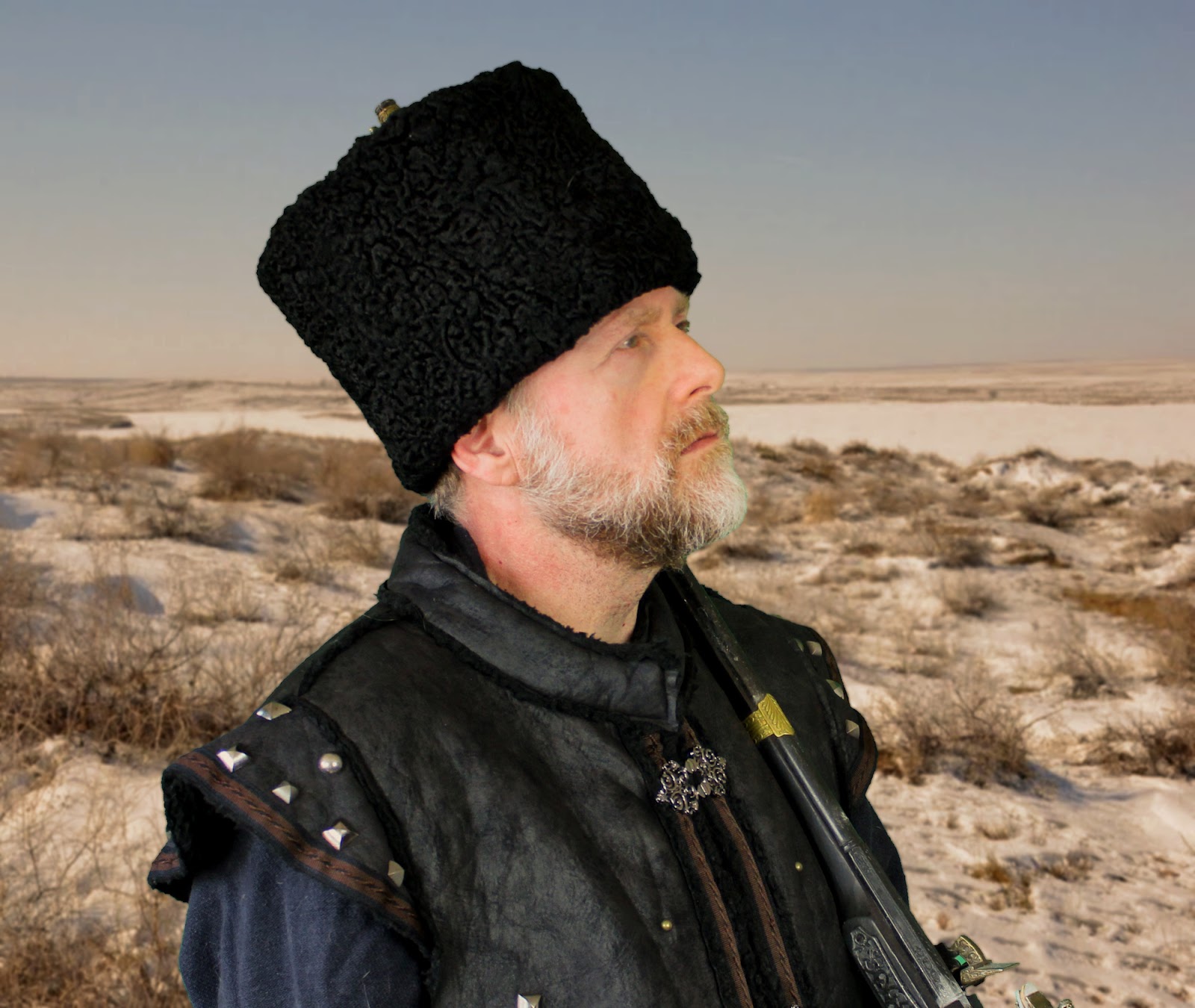
from https://richardhat.blogspot.com/2019/04/cossack-hat.html

I know that I have written before about the tall black hat that is worn by Henry of Bolingbroke, Duke of Lancaster, future Henry IV, in the illustrations of the deposition, death and funeral of his murdered cousin, Richard II. The illustrations are from Creton’s La Prinse et Mort du roy Richart.  

from illuminated manuscript of Jean Creton’s La Prinse et Mort du roy Richart (“The Capture and Death of King Richard”), w:Harleian Collectionw:British Library, once in the collection of Jean de Valois, Duc de Berry

The hat has always fascinated me because it is unlike any other illustration of English medieval headwear. And, to be frank, in the illustrations I think they make him look a little ridiculous. I have looked online, trying to find other examples of this style of hat, but no, although black turns up a lot, of course, tall hats like Henry’s do not. So where did it come from?
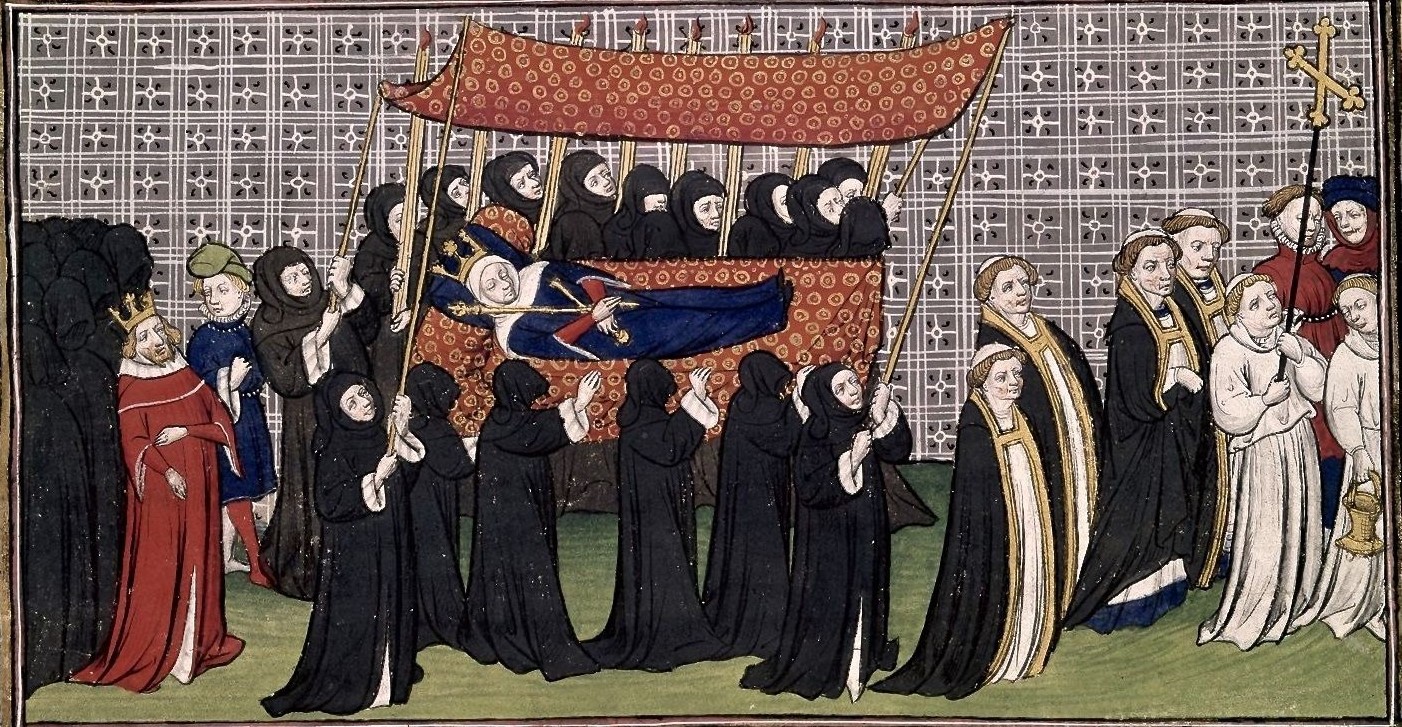
No sign of a hat like Henry’s at this royal funeral

Then, last night I saw a clip from an old black-and-white film of Cossacks riding wildly over a grassy landscape. I know that the distinctive hats of the Cossacks come in all shapes, sizes and colours, but they are generally along basically similar lines. The thing that caught my eye from this film clip was the shape of these particular hats. They were exactly the same as Henry of Bolingbroke’s mourning hat, even to the top of the crown being wider than the base. (He was in mourning at the time of the Creton illustrations because of the recent death of his father, John of Gaunt.)

Conspiring against Richard II?

Making a possible connection between Henry’s hat and Cossacks may seem to be stretching things, but in 1390-1, and again in 1392-3, Henry, then Earl of Derby, went on “crusade” or reyse to Prussia and the Holy Land. He went all over Europe, from the Baltic to the Adriatic/Mediterranean, and in that time came across all manner of people/races. Did he encounter any Cossacks? Was he much taken with their headwear?

Now, I’ve mentioned above that I think he looks ridiculous in those old illustrations, but I am not saying the Cossacks look ridiculous. Far from it. But Henry is otherwise dressed in the style of an English nobleman. The hat just doesn’t look right on him.
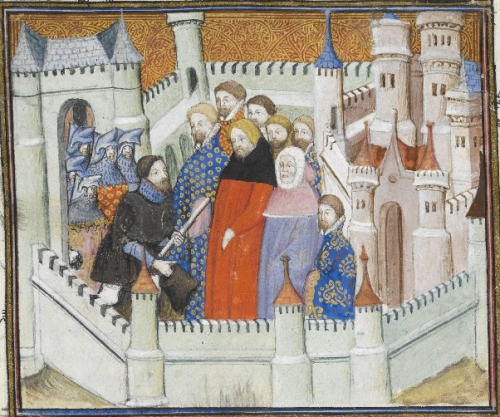
from Creton again

Anyway, I have to wonder if his parrot wasn’t the only novelty he brought back with him…did he bring a black Cossack hat as well? Or did he have one made for him on his return? If he did, and if he stood out so remarkably on account of it, I imagine there was a good deal of suppressed sniggering among his fellow aristocrats.

Subscribe to my newsletter

  1. Did it keep his head warmer? Was it practicality? (Classic western-style cowboys hats are practical and not just as a sunblock. I discovered that while standing in a pouring rain and having the rain fall off behind me and not onto my coat or pants.) Did he try one on and liked the way he looked in it? Did it make him look taller? Was it a political statement? It is quite different in style.

    Liked by 1 person

  2. This is a Caucasian hat. It’s called papakh. It was intended for shepherds of sheep, then it became popular. She became Cossack from the beginning of the 19th century (the military adopted her from the conquered peoples)

    Liked by 2 people

  3. Where did you get that hat? where did you get that tile?
    Isn’t it a funny one or
    Just the proper style?
    I would like to have one,
    Just the same as that.
    Where’er I go they shout “‘Ello!”
    Where did you get that hat?

    (Stanley Holloway).

    Liked by 1 person

    1. Oi! 😄

      Like

  4. The idea he wore it to make himself look taller makes sense. He was (relatively) short for a Plantagenet.

    Liked by 1 person

  5. […] retained this lodging under Henry IV, at least for a time, and she received confirmation of the generous grants of land and annuities […]

    Like

  6. […] there’s Henry IV, the first Lancastrian usurper. Well. he was crowned 13 October 1399 when his predecessor Richard […]

    Like

  7. […] the fall of Richard II and usurpation of Henry IV, Chaucer gained a new appointment that enabled him to live in reasonable comfort for the rest of […]

    Like

  8. […] the end, of course, Thomas Berkeley came out on top. The usurpation of Henry IV put him at an immediate advantage vis-a-vis his rivals and following the Epiphany Rising, both […]

    Like

  9. […] Henry Bolingbroke, of course, was not a tyrant. Not at all. It’s just that before he became king, he executed an earl and four knights, no doubt by mistake. He was neither king, high constable nor marshal, and anyway was a banished man. So he had no lawful authority whatever. But he was merely carrying on the honourable tradition of the Appellants. By the way, I have yet to see a learned article condemning these murders. Maybe one of those five chaps should have had the foresight to write pretty poetry like Antony Rivers. Someone would then have made martyrs of them. […]

    Like

  10. […] and Katherine were dead by the time his son Henry stole the crown from and murdered his first cousin Richard II, thus undoubtedly instigated the Wars […]

    Like

  11. […] case arose when Henry IV murdered his captive cousin, Richard II, and made a great show of bringing the body south to […]

    Like

  12. […] school, when Shakespeare’s Henry IV Part I had to be studied for ‘O’ levels. I didn’t like Henry IV then, and I don’t like him now. He was a usurper who murdered his cousin Richard II in order to […]

    Like

  13. […] Henry IV invited Christine to England. However, she had no difficulty in declining the request. As […]

    Like

  14. […] I hope that by the time you read this article you will already have visited yesterday’s Part I, which relates the English version of Marguerite de Courcy’s return to France. She left England under the cloud of having lived far too high a life for a governess and of stealing some English royal jewels. These are the charges levelled against her in most of the books I’ve read where she is referred to. The tale is often used to show Richard II in a poor light for sending his young queen’s beloved governess away and then going away himself, leaving the child alone. Apparently this is what the French thought of it. Nasty Richard! Boo! Hiss! Or, of course, it’s all propaganda, aimed at improving the image of his Lancastrian usurper, Henry IV. […]

    Like

  15. […] his loyalty to Richard because he supported the failed Epiphany Rising against the usurpation of Henry IV. In the portrait he seems to be considerably older than Richard, even though there were only about […]

    Like

  16. […] being the half brother of Richard II, supported that king throughout. When England was invaded by Henry Bolingbroke, Duke of Lancaster (who’d been exiled by Richard II), Richard was caught and arrested. The next […]

    Like

  17. […] information) Unfortunately for Roger, he passed away before Richard, and then that dastardly usurper Henry Bolingbroke murdered Richard to seize the throne for himself. That, in a nutshell, is Roger’s […]

    Like

  18. […] it is important to note that Henry Bolingbroke, Duke of Lancaster, had not been forfeited or attainted by Richard II as is sometimes implied. He […]

    Like

Leave a reply to sighthound6 Cancel reply