Would we have liked Chaucer to narrate audio books of his works….?


frontispiece to Troilus and Creseyde

There is an increasing appetite these days for audio versions of books. Whether just sitting at home, driving your car, or even out in the garden, listening to a famous actor reading to you, or even the author, is a great pleasure that sometimes beats reading the book for yourself.

Which makes me reconsider the medieval period, especially 14th-century England, when Richard II’s court enjoyed being read to by the likes of Geoffrey Chaucer. We all know the famous illustration above. The usual remarks about the scene are that (a) most of the court probably couldn’t read, or (b) it was just a passing fashion, a chance to be seen where it mattered. Besides, back then no one read silently, they did so aloud. Except in some parts of the Church, I think.

But was it really the done thing to sit around listening to someone reading out loud? Chaucer was probably a brilliant narrator, especially of his own work, and must have been very entertaining indeed. Just like listening to an audio book today, except that you actually saw him in the flesh as well, complete with his nods, winks, knowing smiles and crafty glances. What’s not to like about sitting around giving him your full attention?

I know I’d be among those sitting on the grass looking at and listening to the master!
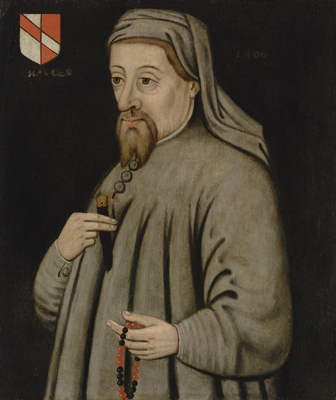
Geoffrey Chaucer


Subscribe to my newsletter

  1. […] the ‘Holy Cross of Bromeholme’ and is mentioned in ‘Piers Plowman’ and in Chaucer‘s ‘The Reeves […]

    Like

  2. […] of his that I endured at school offended me simply because I couldn’t stand him! I wanted Chaucer. OK, there’s no accounting for it, and some grey cells are definitely from a different […]

    Like

  3. […] love is behind it all, of course. So the posy rings that Chaucer’s Troilus and Criseyde exchanged, and the “broche, gold and azure,/ In which a ruby set was lik […]

    Like

  4. […] extract is from https://gardenandhappy.com/medlar/ “….Great writers such as Shakespeare and Chaucer used medlars to convey the loss of womanly virtue. In The Honest Whore, Thomas Dekker […]

    Like

  5. […] of historical, allegorical and astrological information, all of which was certainly known to Chaucer” (“Fresh Aspect” 37). His paper buttresses the present […]

    Like

  6. […] a form of French up until about the end of the 14th Century, English was already well on the rise (Chaucer read his English poetry to Richard II’s court) and by the early 15th century its triumph was virtually complete. By […]

    Like

  7. […] a triumph of stagecraft in which the 14th century excelled. Artificers at banquets, as described in Chaucer’s Franklin’s Tale, could bring bodies of water into the hall, make boats row up and down, grim […]

    Like

Leave a reply to Chaucer’s Pilgrims and calculating Easter Sunday 1394…. – murreyandblue Cancel reply