(by Annette Carson)
The Ampulla and Cor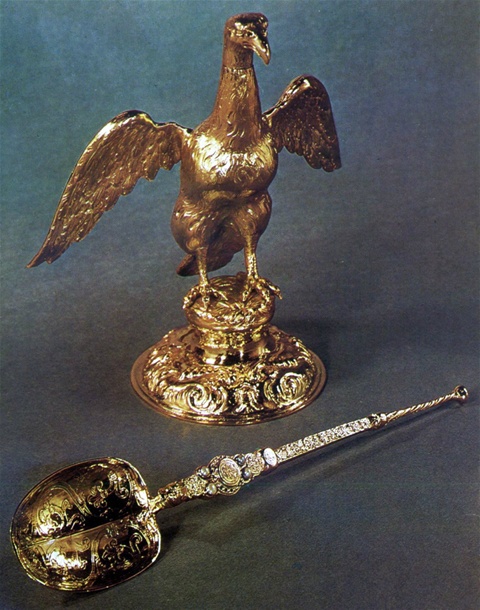 onation Spoon
Perhaps because they are not immediately recognizable as such, these are the oldest items in the coronation regalia and the only two that escaped the systematic destruction of royal regalia and crown jewels after the execution of Charles I. The holy oil (chrism) is poured from the beak of the golden eagle into the spoon and applied to the monarch’s head, breast and palms.
The Coronation Spoon is first recorded in 1349 as preserved among St Edward’s Regalia in Westminster Abbey. Already at this date it is described as a spoon of ‘antique forme’. Stylistically it seems to relate to the 12th century and was possibly supplied to Henry II or Richard I. It is therefore a remarkable survival – the only piece of royal goldsmiths’ work to survive from that century. The small pearls were added to its decoration by King Charles II.
It is unclear from the 1349 inventory whether the spoon at this date was part of the chapel plate. Its length, and the division of the bowl into two lobes, suggest that it always had a ceremonial purpose, and its presence among the regalia means that it has always been associated with coronations. One suggestion is that the divided bowl was designed in this fashion so that the archbishop might dip two fingertips into the holy oil. Hence it may well have been with this spoon that Richard and Anne were anointed in 1483.
The Ampulla is more difficult to date, its antiquity being less obvious at first sight since it has been subjected to frequent redecoration. Its feathering is characteristic 17th-century work, but when the head is removed the comparatively crude threading of the screw at the neck shows that the vessel is far older, and could have been the golden eagle used for the first time at the coronation of Henry IV in 1399. If so, it was this Ampulla which Richard III conveyed to Westminster Abbey the day after his own coronation: ‘an egle of gold garnysshed with perles and precious stones in which is closed the precious relique called the ampulle … to abide and remayne after his decesse within the forsaid monastery among the regalies now beyng in the said monastery for evermore’. By the king’s orders this holy object was to be available for delivery to him whenever he should ask for it.
Information taken from publications by H.M. Government and the Royal Collections Trust (and see Royal Collection website). N.B. Miniature reproductions of these items are commercially available.
- Comment
- Reblog
-
Subscribe
Subscribed
Already have a WordPress.com account? Log in now.
 The New Murrey and Blue blog
Leave a reply to Some minor problems with Thomas More’s account. – murreyandblue Cancel reply