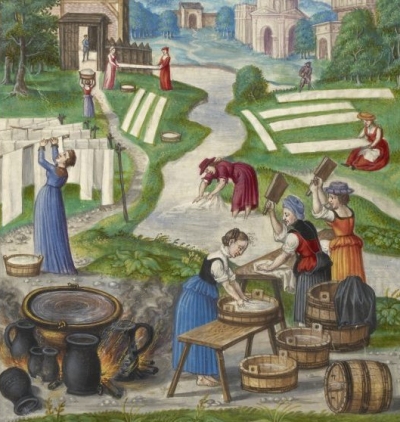
Clothes lines of some sort are visible on the left
Writing historical fiction involves a lot of research…well, it does if the resultant book is to be taken seriously. So when it came to describing medieval Moorfields, just north of London’s city wall, I came upon the inevitable mention of drying grounds for washing. Yes, I knew all about them, because they turn up in all sorts of ways. Washerwomen cleaned the clothes, sheets or whatever, and then spread them on the ground or over bushes. Dry weather was therefore somewhat essential…as it was over the centuries until the invention of dryers of various kinds.
I remember that when my Welsh grandmother was robbed of a suitably dry Monday (always washing day) she would arrange the well wrung washing on the rack that was then hauled up on a rope to hang over our heads in the always warm kitchen. But, if the Monday weather was good, out it all went on the clothes line, pegged up to catch the breeze on a Welsh hillside.
So there you have the relevant words: pegs and line. Such things seem so very obvious that it’s tempting to imagine they’ve always been around, but no. Inventive as the medieval mind was, it didn’t dream up such a novel way to do the business of dry what had been washed. Well, it did from around the 16th century onward (see image above), but still most washing was dried in the time-honoured way, on the ground or in bushes. The object, too, was to let the sun bleach materials that were off-white.

If you go to this piece about the clothes peg and this piece about laundry, you’ll read all about this.
So, much as I’d like to describe the clothes lines fluttering in 14th-century Moorfields, I can’t. Everything would have been on the ground or draped over suitable bushes. Or, I suppose, hanging over low tree branches? Whatever, no medieval CleverClogs seems to have come up with the idea of suspending a line between those branches and then hanging out the washing with a little peg of split wood! It would apparently be well over a century before such inspiration came. And even then the ground and bushes remained the overwhelming preference.


 The New Murrey and Blue blog
Leave a reply to yorkrose1483 Cancel reply