Shakespeare-London.jpg

Panorama of Old London.  The Old Bridge stood to the west of the new one.  

https://www.britain-magazine.com/features/inspiration/shakespeares-london/.

Of course Shakespearean London is post Ricardian but most of  the streets and buildings covered in this interesting article would have been there in Richard’s time.

For anyone visiting London,  this article  would be an excellent referral point especially for covering the lesser known parts.  Starting  at St Pauls station,  via Bankside,  a thoroughfare since the 13th  century,  ending back at St Pauls, the walk covers much including Borough Market, the church of St Magnus Martyr, where two stones from the original Medieval bridge are still in situ,  Eastcheap,  the London Stone,  close to  Cannon Street Station where once Warwick the Kingmaker’s London house, the Erber,  stood and St Pauls, rebuilt by Sir Christopher Wren after the disastrous Fire of London 1666.

I’ve posted some photos here of places covered on the walk although I’m not sure these are in the book, see below, from which this article is an extract.

Unknown.jpeg

The London Stone on temporary display at the Museum of London

Unknown-2.jpeg

The London Stone, Cannon Street.

bdba9f43-d0d4-4bf2-b15e-a9c8b61db150.jpg

Remains of Winchester Palace, Clink Street
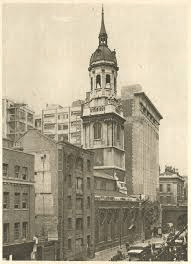
image.png\

Old photo of the medieval church of St Magnus Martyr, a surivivor of the Great Fire where it stood close to the northern entrance to the old bridge.

The article is an extract from a book ‘A Visitor’s Guide to Shakespeare’s  London by David Thomas.  Being a Londoner myself I will certainly find room for this book on my book shelf.

Shakespeare-London-1.jpg


Subscribe to my newsletter

  1. Hi Sparkypus, very timely article for me, thanks! I’ve been trying to find material on London c. 1450’s (NOT EASY!) There seems to be plenty AFTER 1500 and before 1400, alas, just as there is with so much else in Ricardian/ WoTR research, that period is buttressed by the Hundred Years’ War and Edward III or the Tudors!

    For those who like to get into the research ‘weeds’ I have found a couple sources that might be of use to others here –
    Marjorie B. Honeybourne, The City of London’s Historic Streets, from a 1971 article, can still be ordered online. Also her longer article in London Topographical Record (no. 22, from 1965), also something that can be ordered from the Society. More recently, A.R. Myers published Chaucer’s London, available from Amazon.

    If anyone knows a good resource for clothing of the period (WoTR) I would appreciate it! I have everything from Toni Mount (she is great, btw, very witty and informative, and a Ricardian to boot! She does have a fine ‘across the medieval period’ Everyday Life in Medieval London, but I am looking for quite specific info).

    Thanks again for the article and post!

    Like

  2. […] Literature I had to endure Memoirs of a Fox-hunting Man (Siegfried Sassoon)😟, Henry IV Part I (the Bard, of course)😦 and Keats 🙃. Well, Keats was OK, I suppose, but what I remember about him most […]

    Like

  3. […] fall into such disrepair in 1679, except for the tower, that it was declared unsafe and rebuilt by Sir Christopher Wren. Spire rebuilt by James Gibbs c.1719, with the surviving tower being, happily, incorporated. […]

    Like

  4. […] the horse dung treatment being examined by 21st century archaeologists.  With apologies to the Museum of London […]

    Like

Leave a reply to amma19542019 Cancel reply