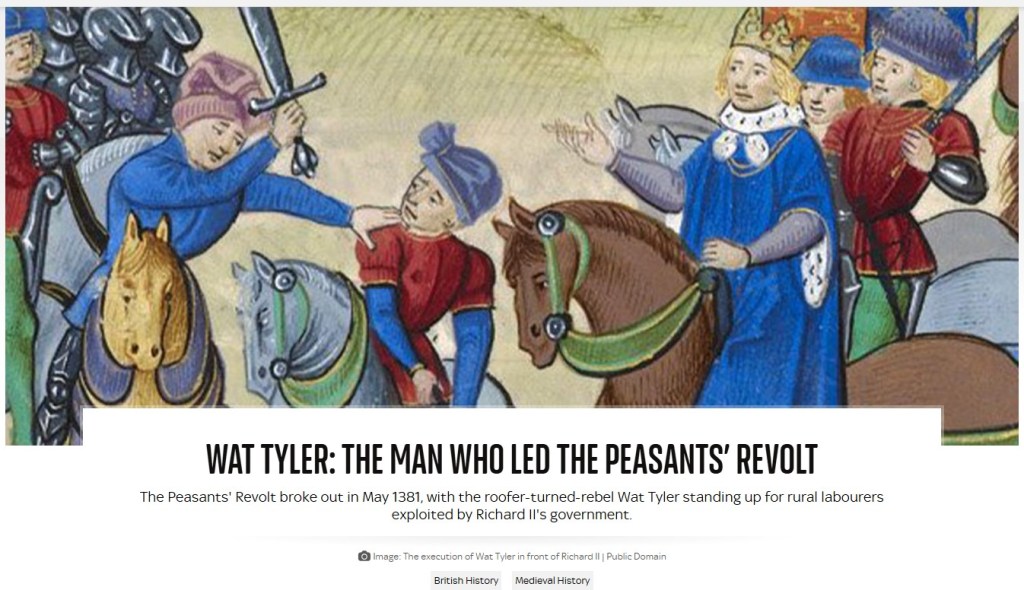
I’m writing this because of the article you’ll find at the following link: https://tinyurl.com/5vrc3c6z. Yet again there is a certain economy with the truth where Richard II is concerned. Because of this, we may not know much about Wat Tyler, one of the leaders of the so-called Peasants’ Revolt, but we sure as heck know that Richard II was a Louse of the Highest Order!
But was he? Did he make promises that he promptly chose to set aside?
In the same way, was Richard III the evil, bloodthirsty, child-murdering usurper most historians, almost all Tudor admirers, insist? Even in the face of a glaring lack of evidence, these purveyors of untruths know he was Satan through and through. The original Wicked Uncle. Now, thanks to the sterling efforts of Philippa Langley, John-Ashdown-Hill and their ilk, Richard III is beginning to be recognised as the excellent king he really was. He had every right to the throne, and had he been allowed to reign his full span instead of a mere two years, who knows what he might have achieved. England would certainly have been a happier place than it become under his oppressive Tudor successor.
To return to the above article, once again there’s a howling omission, to wit, that that Richard II was a boy of only 14 at the time of the Revolt. Thus readers who do not know anything about his reign will believe he was a man full-grown. He was actually a young teenager in the grip of his uncles and their government. He didn’t renege on anything, the adults around him did that for him.
In my opinion this hijacking of his royal, God-given word was of monumental consequence and affected Richard ever after. He was the king, he’d confronted the rebels bravely and promised to help the people’s situation, but those in charge took a red pencil to every word….leaving him to shoulder the blame ever after.
Since then, over the centuries, history has accused Richard II of “reneging”. Like his later namesake, Richard III, only the bad things seem to attach to his reputation. If there’s something unpleasant to rake up, whether true or not, it’s superglued in place to ensure his honour becomes dishonour.
I’m not pretending Richard II was perfect, because he wasn’t, but he did do what he thought was right. Yes, he was arrogant, yes, he made some mistakes, yes he had favourites, and by the end of his life he was a world away from his 14-year-old self. But from that day when Wat Tyler was murdered in front of him, Richard II was damaged goods. For years he was denied his rightful authority while his uncles and the magnates manipulated the power for themselves, even rising up in arms against him as what is known as the Lords Appellant! If he eventually took his revenge on them, can we really be surprised?
In the end he suffered the same fate as Richard III; death at the hands of a Lancastrian usurper who had no right at all to the crown. In Richard II’s case, his cousin, Henry of Bolingbroke (Henry IV). In Richard III’s, Henry Tudor (Henry VII).
Well, I have no time for Henry IV. The man was odious. My dislike of him actually began back in 1959/60, when Shakespeare’s Henry IV, Part I, was foisted on me for my GCE English Literature O level! 😦 Since then of course, I’ve learned so much more. As for Henry VII…well, enough said about the man who imposed the dark, cruel days of the House of Tudor upon England.
The consolation as far as I’m concerned is that after their regicidal usurpations both Henrys suffered increasingly poor health. And both spent a lot of time glancing uneasily over their shoulders for challengers. Guilt has that effect.
Well, I’ve said my piece. Stop bad-mouthing Richards II and III and search for the truth instead.

 The New Murrey and Blue blog
Leave a comment