Oh, I do get tired of all this Richard II bashing. Here’s the latest to spoil my morning tea: https://tinyurl.com/spr5me98.

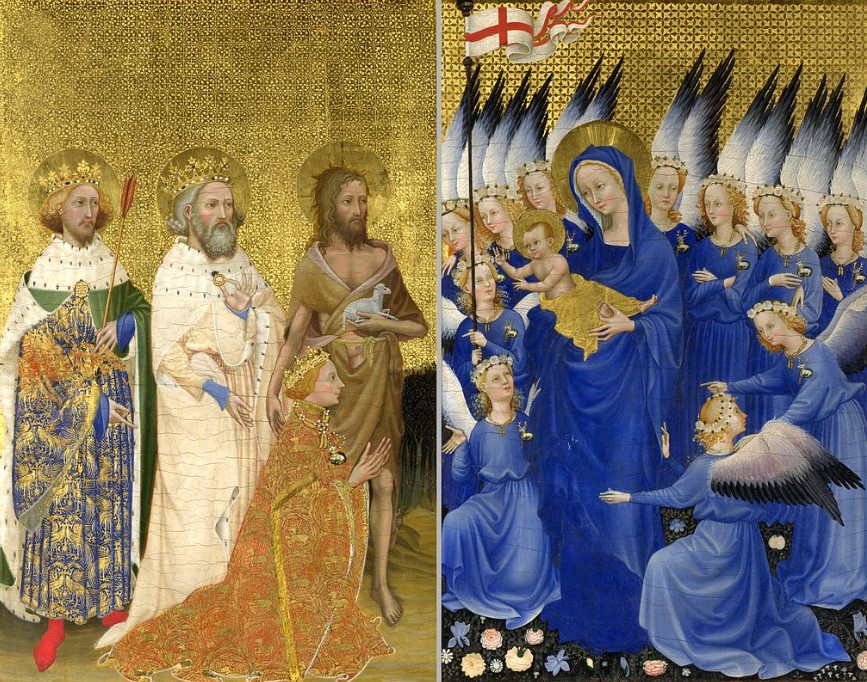
It’s as stupid as all the Richard III bashing. Yes, the Wilton Diptych (see above) is a picture of Richard II as a child, and yes, it seems to have been commissioned when he was most certainly an adult, but I don’t think it was painted like that because he saw himself as childlike or any other silly reason. I think the diptych is SUPPOSED to depict him as a 10-year-old child, at the time of his coronation.

If anyone can shoot this opinion down in flames, feel free. But Richard II wasn’t daft, nor was he most of the other things of which he’s always accused.

And don’t even START me on that murderous, usurping, Lancastrian toad Bolingbroke! 😠

However, I’ve received two other opinions that don’t shoot me down in flames, but offer excellent alternative reasoning. They’re definitely worth adding here. In alphabetical order, not preference! ☺️

My friend Janet Reedman suggests: “….Could the painting not also signify that he was ‘small’ in the face of the saints, Mary, and Christ? People with their weird and vaguely obnoxious theories are so tiresome….”

Another friend, Brian Wainwright, offers the following: “….Richard believed that he ruled as God’s representative on earth; he was the anointed of the Lord. The Wilton Dyptych shows him on his knees, being presented by his patron saints to the Christ Child, who is held by the BVM. An aspect of this was that in the Middle Ages, England was called the BVM’s dowry, such was the devotion to Her. So this may also be seen as Richard paying homage to the BVM. Far from showing his pride, this painting shows that he regarded himself as a vassal of Heaven. That also implies that Heaven would protect him….”

Thank you Janet and Brian. Food for thought!

by viscountessw


Subscribe to my newsletter

9 responses to “Please stop all the ridiculous Richard II bashing….!”

  1. the author is so keen to make his point that he’s sidelined ‘context’. a medieval kings idea of piety could encompass spiritual humility before god- but he had to display all the earthly trappings of power and authority – the ‘performance’ element was necessary. a king had to look and act ‘kingly’! why does this author think that medieval kings – or any of the nobility – aspired to behave like monks – the one king who did – henry v1 was a spectacularly unsuccessful ruler!. it is unbelievable that these writers cant just write their theological musings without trying to make tortuous links to a past that they dont understand – and why they feel the need to malign people whose world view was very different from ours – and whose lives they obviously cant begin to comprehend.

    Liked by 2 people

  2. As a rule I am hesitant to make connections between ‘portraits’ as they exist in Art and the individual(s) presumably or said to be the Subject of the portrait, any era, any region, any purpose or intent. Why? They are vast repositories of information, some – and only some of it pertinent TO the Subject, and deciding which moment the image represents is the mind bending work, in some cases, of a career. Some ‘portraits’ are never resolved much less identified for what they presumably ‘tell us’ – Giogione’s (surely misnamed) ‘landscape’ “The Tempest” is so fraught with perceived layers that any hope of identifying Subject, location, time or heaven forbid ‘meaning’ is as likely to satisfy as the ludicrous excesses taken with this ‘portrait’ of Richard II.

    An artist that I spent a number of years studying (Ingres) had a deft touch creating simple’ pencil portraits, a sideline income while he was living in Rome and Florence – and the accuracy that we see in a Holbein or Clouet is (I think) even more exacting in Ingres’ pencil portraits. And his eye could be – to our Ozempic inoculated era – a bit too precise and unforgiving, regardless of gender. The point here is to compare his many pencil sketches of the Subject with a known finished oil portrait (for example, the young and lovely Louise de Broglie, Viscountesse d’Haussonville, 1845) in which the sketches appear very much as Ingres did see his Subject. Which is to say, a slender, almost waif like and plain young woman of 24. Over the course of the sketches however she became ‘Ingresque’ – which we now say Louise has become what the artist wanted to see, wanted to create in the portrait, and soon the transition from the slender and (I think, drab) young aristo became so completely another woman, the plump, curvaceous, yet still delicate Louise, that Baudelaire called ‘her’ “voluptuous” and Ingres’ friend wrote to him saying that he must be in love with her to “have painted her in that way.”

    Absolutely, the painter(s), artisans, illuminators, craftspeople, all were part of a studio community, trained within what had been a gild and developed into the studio ‘system’ that Ingres knew. Their input, motivations, training, religious and personal convictions are as intimately tied to the final result as were the choice of oak panels for the Diptych, the tempera, gold leaf, fabulously pricey vermillion and lapis lazuli pigments – no one detail is sole authorship, but contributes to the whole, the Wilton belongs to a larger concept, something even larger than the mundane opacity of any one person, even a temporal ‘king.’ If the Richard of the Wilton has an identity it is not of this base world, but one I suspect we are not to know. Artists of any age, save the postmodern, kept many ‘conversations’ between their donor, patron, Viewer, and themselves (between them and now countless anonymous monks, illuminators, painters, etc, a hive, if you will, of their own industry and virtuosity). Academics may presume to speak on these things with authority, those from the studio know otherwise.

    Liked by 1 person

  3. My impression (and I am no historian) is that R2 was narcissistic, immature and not a good king. But I pardon him, at least somewhat, because of the Wilton Diptych and Westminster Hall, which I had the pleasure of viewing a couple of years ago.

    Liked by 1 person

    1. Well, impressions are often wrong….. ☺️

      Like

  4. just a p.s. viscountess – forgot to ask in my previous post – is the author correct about richard 2 introducing the ‘your majesty’ title? i always thought it was the insecure tudors who first used it. also – is it me – or is he implying that edward 2 abdicated in favour of his son? bit of a difference between being deposed and abdicating! a truely awful piece of work

    Liked by 1 person

    1. In her book the Mystery of the Princes Audrey Williamson says that before August 1485 kings were addressed as Your Grace or My Lord. However, the Tudor Weasel decided that he wanted to be addressed as His Majesty. Audrey believed that this was the start of the Divine Right of Kings.

      Like

  5. Hi. Right on both counts, Jay. ☺️ I too thought the Tudors fancied themselves as majesties. It seems to have been Henry VIII, 1519. As for Edward II abdicating in favour of his son….well, they keep telling us Richard II abdicated (Willingly! Gladly even!) in favour of his throne-grabbing cousin, Bolingbroke. Like yeah…. I gather the only willing thing Richard did when he gave up his crown was to place it on the floor and say he was giving it back to God, who’d given it to him. He certainly didn’t press it into Bolingbroke’s grubby hands and say “Here, Coz, I’m delighted to be rid of it!”

    Like

  6. Richard ii is being criticized about two paintings the First for having a portrait painted of him as a King sitting on his throne looking like a King, the same pose that was used on every Royal Great seal and often on coins throughout the years. At the end of the day the painting sits in Westminster abbey a place where Richard had contributed to the funding of, no different from modern day equivalents of photo’s of benefactors handing over a giant oversized cheque. I have never heard any one criticize any later monarchs having stately portraits painted of them sitting on a throne.

    As for the Wilton Diptych it was a personal alter piece so not exactly a statement for the world, Richard was married to Anne of Bohemia and this type of artwork and theme was very popular in that part of Europe, at that time and no doubt Anne’s influence on Richard was great. I find the theme very similar to The Adoration of the Magi that was painted on the walls of  St Stephen’s Chapel in the Palace of Westminster, scenes of gift-bearing to the Virgin and Child in the upper panels and St George presenting Edward III and five of his sons in full armour in the lower panels.

    The opinions of Janet Reedman and Brian Wainwright that you added to your post  viscountessw are both of merit and both opinions make total sense.

    Liked by 1 person

  7. Thank you, Nick.

    Like

Leave a reply to jay Cancel reply