
Since most people were unable to read, mediaeval drinking houses/pubs used colourful pictorial signs, leading on from the ‘ale-stake,’ a vertical or horizontal pole hung outside such establishments to show that fresh ale was available. This was a continuation of a Roman practice of using ivy or vine leaves to indicate a place that sold wine. In medieval times, evergreen bushes or branches were often used. As competition grew, more elaborate signs featuring pictures replaced simple foliage. These images were recognised by the illiterate population and gave the pubs their names. Common symbols included:
Heraldic Symbols: The UK’s most popular pub name is The Red Lion. A red lion was the personal crest of John of Gaunt, the third son of Edward III, and very popular. It was also the emblem of John Howard, Duke of Norfolk. There was later an ‘augmentation of honour’ added to the family coat of arms. The augmentation was granted to his son, Thomas Howard, 2nd Duke of Norfolk, by King Henry VIII in 1513 following the Battle of Flodden. The family arms were modified to include a special emblem of a demi-lion rampant (a half-lion standing upright) pierced through the mouth with an arrow. The design is a variation of the Scottish Royal Arms, making it a powerful and insulting symbol.

Image credit: Ipankonin, CC BY-SA 3.0 http://creativecommons.org/licenses/by-sa/3.0/, via Wikimedia
Religious Names: Before the Reformation, many pubs had religious names, such as ‘The Crossed Keys’ (for St. Peter) or ‘The Ship’ (for Noah’s Ark). After Henry VIII’s split from the Catholic Church, many landlords changed these to royalist names. Other religious names were The Lamb and The Angel.
Royalist Names: After Henry VIII’s split from the Catholic Church, many landlords changed these to royalist names to show allegiance to him. Names such as The King’s Head and The King’s Arms became popular during this time. The name The Royal Oak commemorates Charles II hiding in an oak tree from Cromwell’s forces. Many Royal Oak signs depict a tiny figure of Charles hiding in an oak tree’s canopy.
Common Objects and Trades: Signs would also show images of common objects or local trades. Examples include The Plough, The Golden Fleece, or a sign with a barrel.
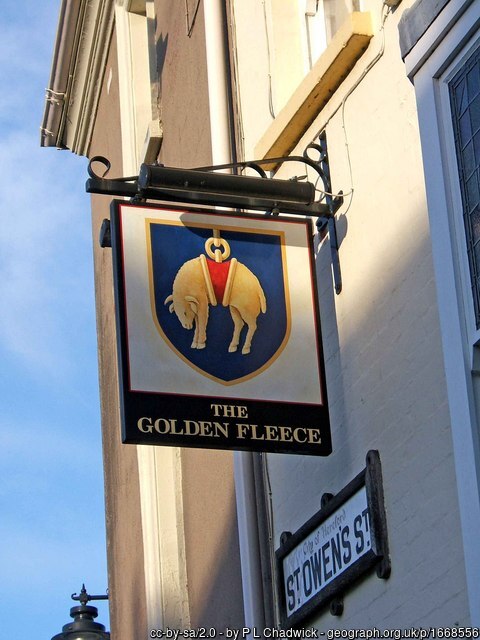
Animal Names: A sign with an animal could hint at other activities offered in or near the premises. For example, a pub called ‘The Bull’ or ‘The Bear’ might suggest that it hosted bull- or bear-baiting.
As we’re talking pub signs – here is a link to eight of the weirdest ones!
 The New Murrey and Blue blog
Leave a comment