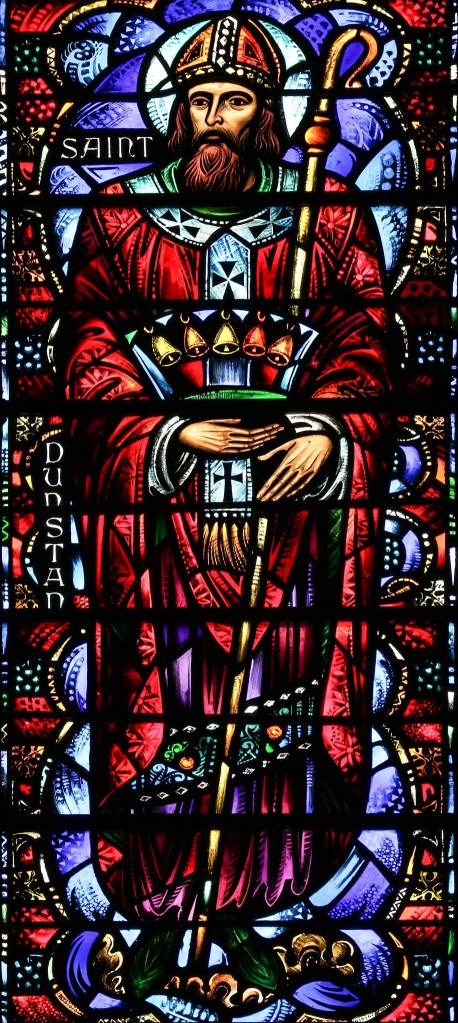
Dunstan was born around 910 in Somerset, and, as a boy, studied under Irish monks at Glastonbury. He showed early promise in terms of both scholarship and handicrafts, and at a young age became a priest. Over a long career – he died in Canterbury in 988 in his late 70s – Dunstan served as an important minister of state to several kings, excelled as a silversmith, artist, scribe musician, singer and teacher. His 11th-century biographer, Osbern, himself an artist and scribe, states that Dunstan was skilled in ‘making a picture and forming letters’. It is thought likely that he was the artist who drew the well-known image of Christ with a small kneeling monk (possibly a self-portrait) beside him in the Glastonbury Classbook, one of the first of a series of outline drawings which became a special feature of Anglo-Saxon art of this period.

He served as Abbot of Glastonbury, where he established the discipline of Benedictine monasticism, and rose within the catholic church as Bishop of Worcester, Bishop of London and, after a brief period in exile in Ghent (in 955, when he became the new king, Edwy’s, enemy because of his strong censure of Edwy’s scandalous lifestyle), as Archbishop of Canterbury (959-988).
Widely admired for his learning, generosity and justice, Dunstan was soon canonised and was the most popular saint in England for nearly two centuries, having gained fame for the many stories of his greatness, not least among which were those concerning his famed cunning in defeating the Devil.
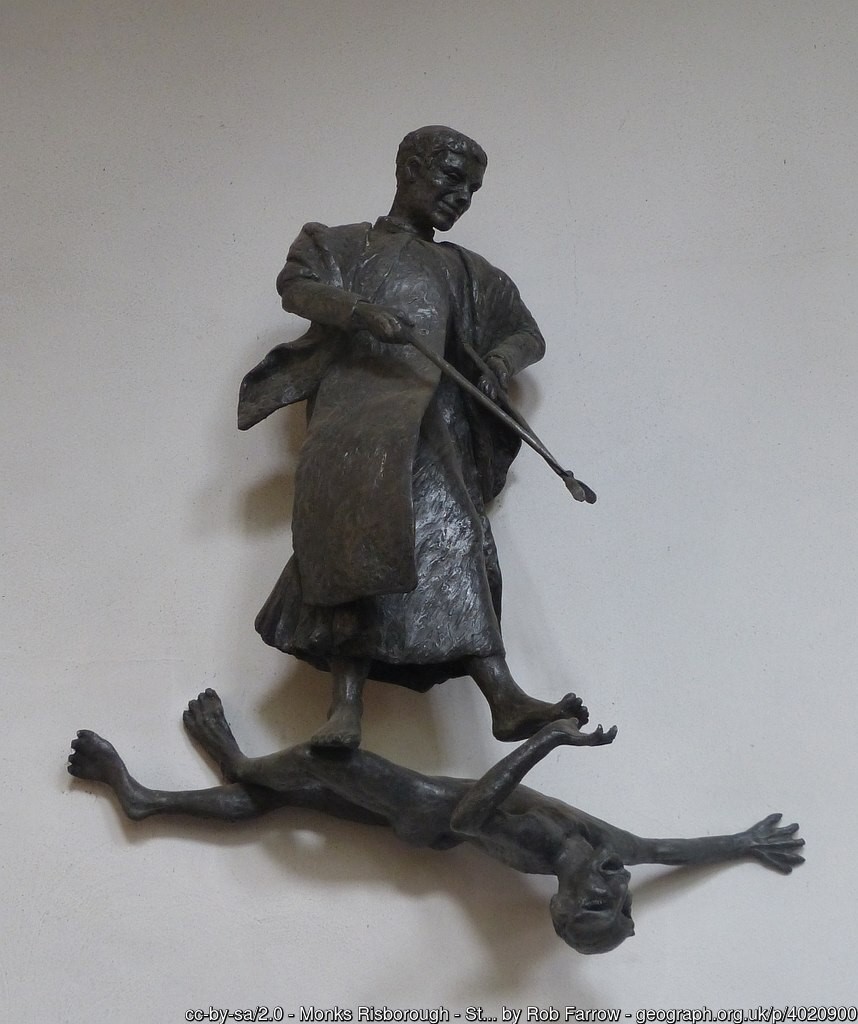
The sculpture depicted below is found on the southern wall of the nave of St Dunstan’s, Monks Risborough, towards its eastern end. It portrays St Dunstan and the Devil. As a skilled metalworker, this came in handy when he happened to encounter Satan one day. Giving chase and cornering him, Dunstan grasped the Devil’s nose with his blacksmith’s tongs.
He was buried in Canterbury cathedral but, after the fire of 1074, his remains were moved to the north side of the high altar.
St Dunstan’s church was founded in the 10th century in the small settlement of St Dunstan’s without Westgate, on the main route to London and Whitstable. It was rededicated in 1030 to St Dunstan, who was canonised that year and was well known to the many pilgrims who would have made it their last stop before entering Canterbury itself.
It is notably associated with Sir Thomas More and Archbishop Thomas Becket during turning points in the relationship between church and state. Both were called Thomas, were Chancellors of England, friends with a King Henry, martyred for their beliefs and canonised, although Sir Thomas More’s canonisation by the Roman Catholic Church wasn’t until 1935.
Four years after the murder and martyrdom of Archbishop Thomas Becket in 1070, King Henry II entered the church to change into a woollen shirt before walking barefoot to the Cathedral, in penance for his part in Becket’s murder. After his execution, Sir Thomas More’s daughter, Margaret, who had married William Roper of Canterbury, was said to have recovered his parboiled head from a spike at the Tower of London. It was eventually buried with her in the Roper vault at St. Dunstan’s church in 1577. When the vault was enlarged, the skull was transferred to a niche behind a grille where it remains to this day, apparently last seen during an investigation in 1978.
Lesser known is the legend that Harold Godwinson secretly buried a stillborn baby in the consecrated grounds of St Dunstan’s church, not wanting it to be buried in unhallowed ground.
Dunstan is recognised as patron saint of blacksmiths, goldsmiths, silversmiths and musicians. The Roman Catholic Church marks his feast day on 19 May, as does the Church of England.
 The New Murrey and Blue blog
Leave a comment