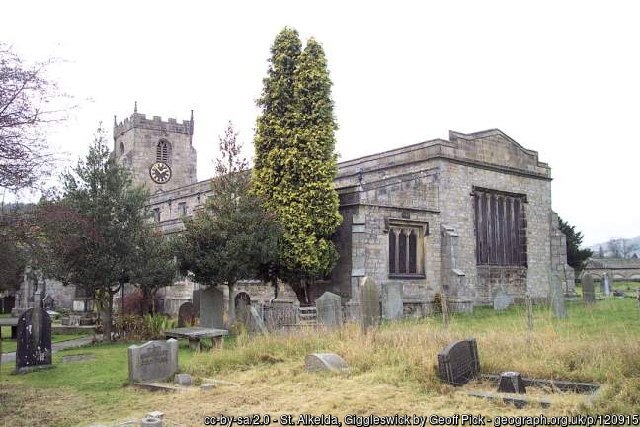
Many Ricardians know that there are just two churches in the world dedicated to St Alkelda, one is in Middleham and the other in Giggleswick, but very few are aware of a mysterious stained glass in the latter. The whole matter started with a parish fair. Parishioners from both churches were looking for items to sell at a coming fair in a parish room. The room was actually a house the church had bought in 1932 and had been linked to the vicarage until the early Sixties.
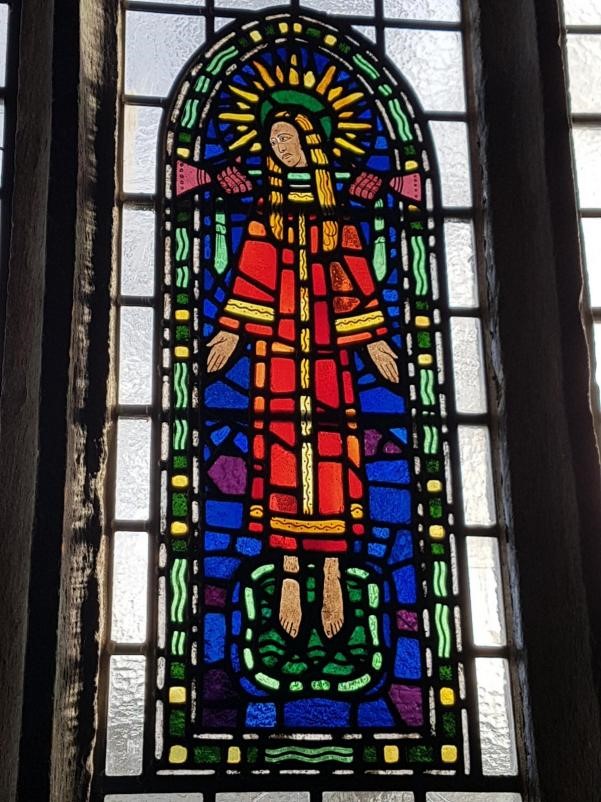
The two parishioners Barbara Thornton and Kate Lockwood, came across a pile of very old newspapers and were going through them to see if they contained something important, but it was at the bottom of that pile that they made an incredible discovery. There was a beautiful stained glass, 2.5ft high, that showed a woman being strangled with her feet in water, the exact description of St Alkelda’s martyrdom. It was the Rev Hilary Young, then priest in charge, who identified the figure as St Alkelda.

Everyone was absolutely gobsmacked. They started to investigate about the finding and the relatives of the former vicar were contacted, but they could not remember anything before 1955. Many questions were unanswered. Who had made the stained glass and when? Why it had not been used? Was it too Catholic to be shown in an Anglican church? This was the explanation given by the local historian Thomas Braynshaw[1].
What was the reason why St Alkelda is depicted with her feet in the water anyway? This is connected to her name. In Old English-Norse the word haelikeld means “holy well” and, in fact, both in Middleham and Giggleswick there are wells, so it is highly probable that the real name of the saint was a different one. There could be an explanation, though it is not supported by evidence. St Alkelda is worshipped just in two churches close to each other in Giggleswick and Middleham, and both these churches are dedicated to St Mary and St Alkelda so why put together an unknown saint and the Virgin Mary? Simply because they are not two different people, but just one, that is Saint Mary of the Holy Well, so St Alkelda’s name was Mary. The agiography says that Alkelda baptized newly converted people with the water of the well and apparently that water could heal eye diseases too.
For centuries there were doubts that the saint was not a person, but an object, the well, but in 1818 during the refurbishment of Middleham church, a coffin was found. It contained the skeleton of a woman and was located where the tradition indicated the saint had been buried. Today a plaque reminds us of the finding.
What happened to the stained glass? After the fortunate discovery, it was carefully cleaned and the cleaning revealed a very interesting detail. There were some red and blue pieces that were thicker than the others and they could have been reused. They are probably medieval and they likely belonged to another glass depicting the saint, or something totally different. In his book “A History of the Ancient Parish of Giggleswick”, Brayshaw reported that in the church there was a stained glass with some blue pieces recorded in 1620. We can infer that the glass was a medieval one and it was destroyed probably in 1644 on the orders of Cromwell. Some pieces probably survived and the unknown artist gave them a new life, inserting them in the new stained glass.
In order to have an authoritative opinion, in 2017 the glass was examined by the glaziers of York Minster, but not even they were able to give an answer. Their idea was that the artist simply imitated a medieval technique when he recreated the pieces, but this theory does not make any sense as just those pieces are thicker and possibly medieval.
In June 2019 the Lightworks Stained Glass, Clitheroe, fitted the glass during a celebration led by the Archbishop of Craven, finally allocating the glass in Giggleswick church, and it is now possible to admire this rare, mysterious piece of art where it has always belonged.
Today, Giggleswick is very popular for pilgrimage walks between the two churches and there are organised walks of three or more days. Click here for more information.
[1] Thomas Brayshaw, Churchwardens of Giggleswick, Forgotten Books, 2018.
 The New Murrey and Blue blog
Leave a comment