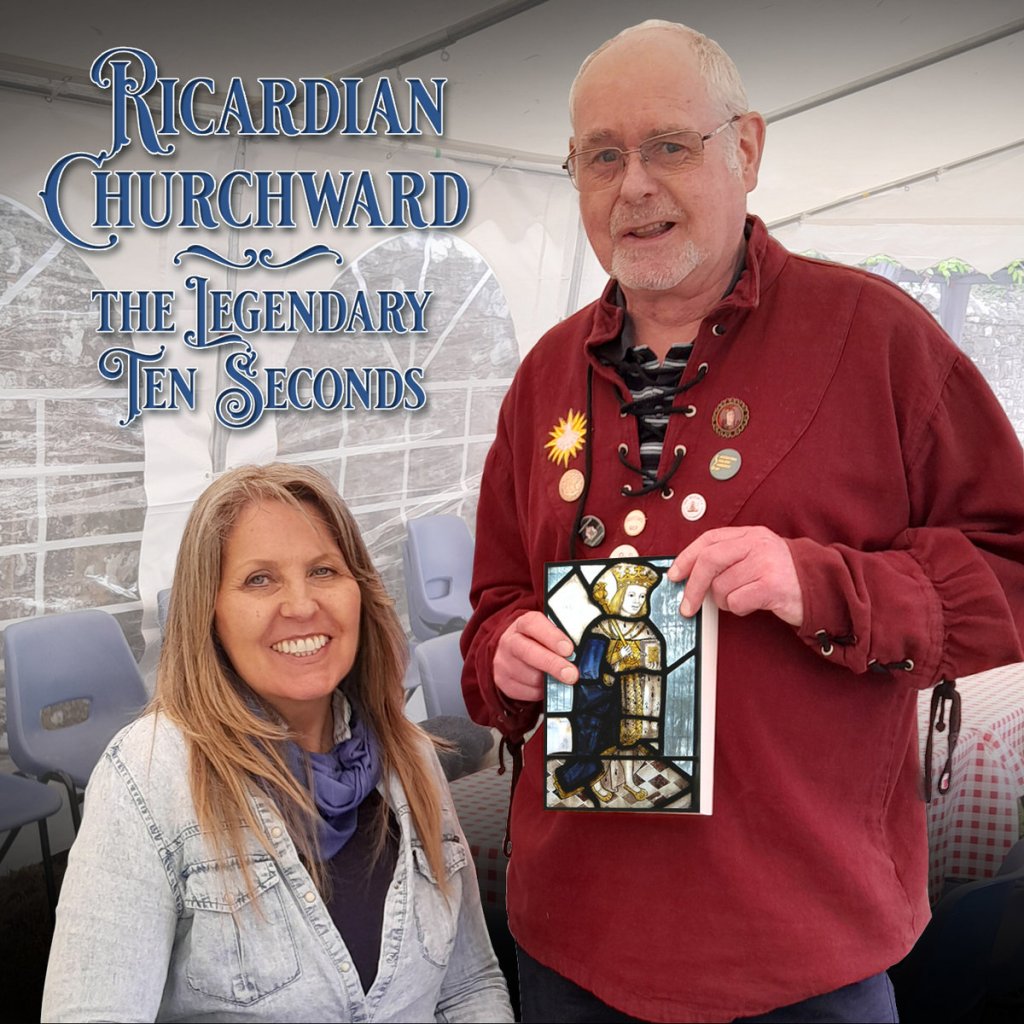
I’ve had the honour of reviewing and contributing to some of the Legendary Ten Seconds’ past output, and am delighted to have the chance to share my thoughts on this new album, which is entitled Ricardian Churchward.
As Ian “Ricardian” Churchward’s lyrics relate in the opening track of his latest compilation, he writes and sings about Richard III, his “favourite king”. Ian and his group, the Legendary Ten Seconds have produced a great backlist of folk-rock albums. Well, his favourite king has to be the favourite king of everyone reading this review now!
“Ricardian Churchward”, the first song in the album, is an amusing mickey-take of both Ian himself and all those who have damned Richard III throughout history. A long list of Tudor lies has somehow taken root in the world’s psyche. I thoroughly enjoyed this track and, knowing Ian, can imagine his smile as he sang it. He certainly has the Ricardian bit between his teeth in this album, and takes no prisoners when he has Tudorite propaganda in the crosshairs!
The next track, “Bones in the River” also takes a pop at Tudor myths and those who believe them. Especially those who insist that Richard murdered his nephews, the Princes in the Tower. It’s a chirpy track that mocks all the ridiculous rumours.
Next comes “Cheyne of Gold”, which concerns the (ahem) “undeniable proof” claimed by Tim Thornton to be his very own research discovery! Ahem, indeed. The discovery in question is of a lady’s last will, in which she apparently bequeaths a chain of gold that was supposedly once owned by Edward V, elder of the Princes in the Tower. Well, it’s not a new discovery, everyone already knew about it, and it doesn’t “prove” anything, no matter how much Tim Thornton and his Tudor cronies (particularly Tracy Borman) bang on about it. Ian’s music and lyrics puts these Tudorites in their place.
The fourth track is “His Crowning Glory”, which as you can probably imagine concerns Richard’s coronation. This strikes a different note because it reminds us that Richard was a rightful king who was the first to take his coronation oath in English so that his people could all understand. Justice was high in his mind, as the few laws he was able to pass have proved ever since. All Ricardians know he would have been a great king, had he been given the chance to reign long enough. But he was betrayed and murdered by “supporters” who stabbed him in the back. This song strikes the right note and conjures the scene as the crown is placed on Richard’s head.
“In Sanctuary”, the next track, concerns the birth of Edward V, firstborn of the two son of Edward IV and his queen, Elizabeth Woodville. England was in the midst of the turmoil of the Wars of the Roses, at a time when the great Earl of Warwick, known to posterity as the “Kingmaker”, was at the peak of his machinations. Having fallen out with the Yorkist King Edward, Warwick had turned upon him and gone over to and restored the Lancastrian King Henry VI, forcing Edward IV to flee into exile. Edward’s pregnant queen Elizabeth Woodville was in sanctuary at Westminster Abbey when she gave birth to the boy who was meant to one day be Edward V. Edward IV did return to his realm, of course, and, finally emerged victorious at Tewkesbury in 1471, after a few bloody battles and the deaths of both Warwick and Henry VI.
“In Sanctuary” is a brisk track, filled with the tension of war. It is also longer than other tracks. The music is strong and the mediaeval atmosphere is unfailing.
The sixth track, “The Year of Three Kings” is an instrumental version of one of the Legendary Ten Seconds’ best-loved songs of the same title. It’s an infectious song that has everyone participating in the boisterous chorus, and I wondered how Ian would treat it when there were no words with which to join in. I really enjoyed the result, which (to me, I hasten to point out, maybe not to everyone) seemed almost like a close-by echo of the original. It had a sort of wistful and yet hopeful tone which appealed to me.
Track seven, “Pretenders to the Throne” took us back to the Tudor-prodding of earlier songs on the album. Never a bad thing! The lyrics point out that if anyone lacked a right to the crown, it was Henry Tudor. Quite right too. Boo! Hiss!
“Sir Richard Charlton” is the title of the eighth track, and concerns the anxiety on Sir Richard’s estates as his people await news of him after the battle of Bosworth. He’s in Tudor’s hands and is accused of treason….as was everyone who fought for Richard that day. Tudor had the gall to date his own reign from the day before the battle. Such jiggery-pokery was already the light-fingered fellow’s favourite pastime. If he’d played football the goalposts would never have been still for more than a minute, if that. The track is easy-going, with a strong but steady beat that reminded me of the drums that accompanied the condemned to the scaffold. But that impression is just me.
“The Tragedies of England”, track nine, starts by naming several past disasters for our land, such as losing Harold at Hastings, Richard III at Bosworth and Edward V at Stoke. But Ian is keeping up the barrage against the Tudors because the song launches into their advent, which was surely one of the biggest tragedies of all. Oh, misery! What a vile lot they were, bringing with them darkness, mistrust, spies, oppression…you name it. Vilest of them was Henry VIII. If his father was dark, Henry VIII was darker, and more bloodthirsty. So well sung, Ian.
Track ten is another instrumental, this one entitled “Lancastrian Lament”, and as you’d expect from the title, it’s sad. But not too sad, after all, they were the opposition. Their laments meant Yorkist hurrahs! The Wars of the Roses split families and were the cause of great bitterness between former friends. Of course, this was to happen again in the English Civil War and many other conflicts. Under/overtones or not, I liked this track.
The eleventh and final track, “Philippa’s Song version two”, is an homage to Philippa Langley, to whom all Ricardians—and Richard III himself—owe so much. It’s a delightfully lilting song, and (as with all Legendary Ten Seconds tracks) maintains that wonderful folk-rock sound.
To hear the Legendary Ten Seconds is to be taken back in time, while somehow managing to keep our feet firmly here in the present. We can be in our normal everyday surroundings, but are able to see and experience the music of the mediaeval period that grips us so intensely. And thanks to the clever lyrics, we can almost reach out and touch those great figures who feature in this most tumultuous time in our history.
This is another brilliant album, and I’m proud to have been asked to review it. Some of my interpretations may not be how others hear the tracks, but I can only recommend them all. I have no particular favourite, because they’re all excellent. The Legendary Ten Seconds continue to shine!
You can hear the tracks here: https://thelegendarytenseconds.bandcamp.com/…/ricardian…
by Sandra Heath Wilson, aka viscountessw.


Leave a Reply