This is the fourth in our series of interviews with notable people associated with Richard III. Dominic preferred to write his replies and they are very long and detailed, so we have decided to publish in two parts. Don’t let the length of it put you off – it’s really worth reading!
Dominic Smee: My name is Dominic Smee. I have been described as ‘King Richard III’s body double’ because I have a virtually identical curvature of the spine (scoliosis) to King Richard III. Due to this similarity, I took part in a Channel 4 television documentary in 2013 in order to investigate how an armourer might have approached creating a harness for somebody with this condition. In order to test the armour which was made for the programme, I learnt how to ride and fight in plate.
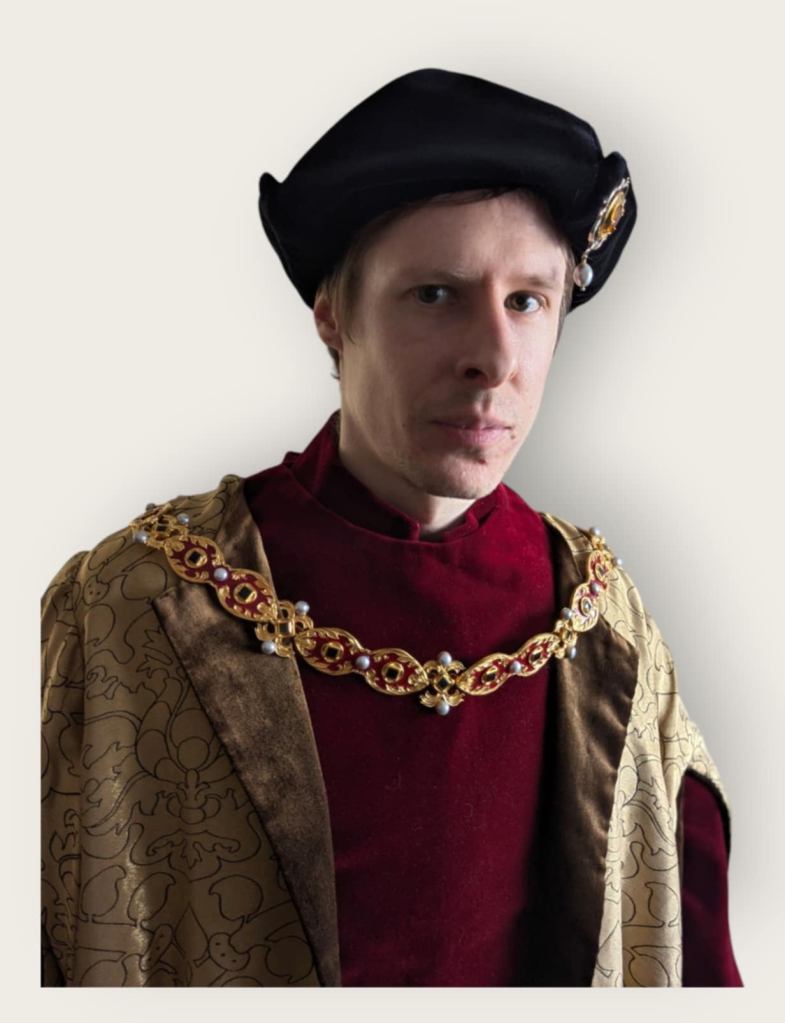
Joanne Larner: Please tell us a little bit about your background and how you first became interested in Richard III
DS: I’d like to say thank you for sending me the questions in advance so that I can prepare my answers. I appreciate that.
Some years ago, whilst studying for a HND at Staffordshire University, I was tasked with making a drama / documentary on the colour red. I used this opportunity to approach a friend and work colleague of my mom’s who ran a re-enactment group, which at the time, was based at Bosworth Battlefield. I pitched my idea to the lecturers at university, and won with the scenario of a re-enactor ‘seeing red’ and going too far. As a result of this project, my mom and I both became members of the then resident re-enactment group, ‘Les Routiers de Rouen’. We began attending what used to be an annual battle re-enactment at Bosworth Battlefield, usually on the closest weekend to the 22nd August. Being a group of ardent Yorkist supporters, King Richard III quickly became more than just a historical figure in my peripheral vision. Les Routiers would eventually have the honour of showing visitors around the Grey Friars dig site before anybody knew just whose remains had been discovered. Some of the members were also fortunate enough to undertake a vigil guarding King Richard’s mortal remains during his overnight stay at the battlefield in reinterment week.
Like many others, I learnt about Shakespeare’s Richard III in English lessons. I also touched on the Battle of Bosworth whilst studying History at secondary school, but I never really made a personal connection with the man himself until I recognised my physical similarity many years later when the discovery of his mortal remains was shared with the world.
Even though I was not personally interested in Richard until my mid-twenties, he was still a big part of my life growing up. My mom spent 7 years researching and writing a work of fiction about the mother of his illegitimate child. We spent many a holiday traipsing around historical sites connected with his life. I remember stating at one point how I was fed up with Richard III, and wanted nothing more to do with him – oh the irony! To this day, my mom still cannot place why she was drawn so powerfully to Richard and for so long. I guess in some round-about way, my mom gave so much of her life to Richard, and now Richard has somehow returned her investment by giving back such an incredible experience.
JL: How did you find out you had a scoliosis and how has it affected your life?
DS: I didn’t realise that I had scoliosis – the full name for our shared condition is ‘adolescent onset idiopathic thoracic scoliosis – until I bent forwards one day in front of my mom without a t-shirt on. It is called adolescent onset because Richard and I both developed it when we were teenagers. It is idiopathic because we do not know what the cause is, although there are many reasons why someone would develop scoliosis. The curvature is in the thoracic (middle) part of my spine, and a scoliosis means the sideways curving of the spine, as opposed to kyphosis (forwards). Whilst I was leaning forwards, my mom noticed that the bones of my spine were not completely straight, so she decided to make an appointment to see my GP, and they referred me to a consultant. I was then sent for various X-rays and the progression of my scoliosis was monitored. With all things considered, I decided not to have corrective surgery on my back. Some people have questioned the wisdom of that decision, but I maintain my right to that choice; I have not regretted declining the opportunity to have an operation. Indeed, if I had not made this decision I could not have taken part in the documentary.
I have to make an important disclaimer here before I answer the second part of your question. Every case of scoliosis will be different, and the way that a person reacts to this condition will also vary. It is unwise to say that because I can or can’t do something, that that was absolutely the case for Richard or anybody else with the condition. We know what Richard achieved because we have primary sources to corroborate this. I also know what I was able to do with minimal training. Anything beyond that requires a level of extrapolation; that we predict the most probable scenario based upon the facts we know to be true.
It is important to remember that Richard was somewhat protected by his birthright. He had access to the best medical help and support for his time. He knew his lot in life, he was prepared for it, and any personal weakness could be compensated for. Richard’s scoliosis did not change the course of his life. The people around him would have accommodated his own particular needs so he could not fail.
The late John Ashdown-Hill pointed out in his book that I may not have been an appropriate choice for a body double because of my other health conditions. He was correct in the sense that the only aspect of me which ought to have been compared with Richard’s remains is my scoliosis. However, my own health conditions did not prevent me from ‘proving to the world that Richard could perform in combat’, so with regards to the investigation, my other health conditions are inconsequential.
To attempt to address your question then of how scoliosis has affected my own life. Whilst the narrative of the documentary explored how far the condition affected my capabilities in simulated combat, it did not address in detail the physical or psychological implications of having a significant curvature of the spine.
During adolescence when my body should have been developing an image of muscular masculinity with the level of fitness required for competitive sports etc, I was increasingly bound by an ever-curving spine. My range of movement performing various karate techniques, as well as in racket sports such as badminton and tennis would begin to suffer. Not enough that I could not punch, kick or swing a racket, but in the proper transference of power through good technique. I also suffered terribly from blisters and my balance did not improve with practice. Again, how far that is down to my scoliosis alone would need to be investigated by experts in the field. Ultimately, the frustration of encountering functional limitations – imperfections which I could not overcome, led me to stop enjoying, and eventually walk away from, the various sporting activities in my life. The shame I felt from failing to ‘measure up’ led me to seek out impossible goals in my life in order to validate how I felt inside by proving externally how incapable I saw myself as. It wasn’t until I succeeded in the documentary as the real me, that this cycle was broken.
Whilst Richard will undoubtedly have been upset by the growing physical impact of his condition, he could not have used it as an excuse to walk away from his duties. As a member of the nobility, the required standard was his standard.
I’ve never fully opened up about the impact of scoliosis on my life before now, as to do so may portray a level of self-pity, which ultimately could have threatened the overly positive reception which I felt I had received following the documentary. I didn’t want my personal inadequacies to taint Richard’s reputation. However, since the narrative of the documentary did not really allow for this part of my life to be made public, then there are undoubtedly many people out there with scoliosis who feel like their struggle was not fairly represented in the media. I want to use this as an opportunity to shine a bit of a light onto that.
I mentioned before how my mom first noticed my scoliosis because I was bending forwards without my top on. After the curvature of my spine was identified, it was then monitored by Orthopaedics, and the progress revealed to me through x-rays which grew increasingly more difficult to digest over time. These appointments became less about check-ups and more about guarding myself against decisions which were quite frankly beyond my ability to process at the time. As somebody who may be on the autistic spectrum, I struggled to answer what I saw as invasive psychological profiling questionnaires designed either for research, or to ascertain my suitability for surgery. I felt like the walls were closing in around me. I wanted to run away from the responsibility of choosing whether or not to have corrective surgery, and I wanted to run away from my obligations in life.
One of the most significant – and probably far-reaching impacts of having scoliosis is the impact which it – as any other disfigurement, can have on a person’s self-esteem. Body image is important to us all – especially growing up. As teenagers, we compare ourselves to our peers in order to ascertain our place in the world around us. The clothes we wear are a big part of how we express our individual identity. For me, what I wore became more about how well my rib hump and gracile build was disguised, than about looking good. Working with Ninya Mikhaela to create a tailored doublet which looked aesthetically pleasing, complimented my appearance, yet disguised my scoliosis, was empowering. For the first time in my life, I felt good in public wearing something which followed the shape of my body.
I feel that this kind of bespoke clothing service would be invaluable in helping to affirm people with disfigurements who feel ashamed of the way they look through no fault of their own.
What I personally needed as a struggling adolescent coming to terms with a physical disfigurement, was not surgery, but counselling. I needed somebody to talk to who wasn’t emotionally involved. For me and my family, it was very much a case of have the operation with its associated risks and limitations, or you’re on your own. I ultimately chose the latter. Some people require life-saving medical intervention. For anybody reading this who might be in that situation, it is important that you seek advice from a trained medical professional. Every case of scoliosis is different; you cannot generalise.
Again, to reiterate, it would not be right to project my own personal experiences onto Richard, or indeed anybody else with scoliosis. We are all different, and the way in which we deal with obstacles in life varies greatly. But this is my story.
JL: How did you come to be Richard III’s ‘body double’?
DS: It all started back when the ‘King in the Car Park’ documentary series aired in 2012-13. When I saw footage of Richard’s scoliosis, I became aware of just how similar my curvature looked to Richard’s. Shortly after this realisation, a video of Dr Tobias Capwell giving a talk to the Richard III Society was posted on Les Routier’s Facebook Page. At the time, he was the Curator of Arms and Armour at The Wallace Collection in London. In this video Dr Capwell was attempting to ascertain how a medieval armourer might approach creating a harness for a knight with scoliosis such as that recently discovered in Richard’s remains. He assumed that it would be highly unlikely for somebody alive today with such a significant curvature of the spine to not have undergone corrective surgery. I contacted Toby and presented him with photographic proof of me wearing somebody else’s munitions (one size fits all) armour – drastically oversized! I told Toby that I would be happy to help him with his research, as I’d always dreamed of wearing my own armour. He told me that there was a chance that I could travel to Sweden and learn to ride and fight in armour as well! He also revealed that he was in contact with a television director, and that there might possibly be a documentary somewhere in this – would I like to be involved? I remember thinking this was an absolute dream come true – far beyond my own resources to achieve – where was the dotted line to sign!?! On the train journey home, Gary Johnstone, the Director, phoned me up and introduced himself. The following day, he came to Tamworth for a screen test, and the rest is as they say, history!
The actual label of ‘Richard III’s body double’ was not coined until much later when I began giving talks on my experience during the Channel Four documentary.
JL: How did it feel to know your scoliosis was almost identical to that of Richard III?
DS: It was a surprise and a bit of a shock, actually. To think that I had a link to a medieval king of England in quite a significant way was amazing.
JL: When you were asked to participate in the Channel 4 documentary, ‘Richard III: The New Evidence’, how did you feel about putting yourself on public display?
DS: This is a very poignant question, and I am going to declare something which I have never made public until this moment.
To first give you a bit of context, I was incredibly self-conscious prior to my involvement in the documentary. I would never wear a t-shirt in public and I hated clothes shopping. I hadn’t been swimming since my scoliosis was first shown to me in an x-ray. My own brother never saw me topless in the house. The boldness which I possessed in choosing to reveal my scoliosis to the world was very much out of character for me.
In 2011, I had just dropped out of my final year of a university degree. I was probably at the lowest I have ever been in my life. I locked myself in my bedroom and whittled away the hours playing computer games. I was deeply ashamed of my physical appearance. Depression and low self-esteem are commonplace amongst many people suffering from such disabilities.
I am a Christian. Shortly after reaching this low point in my life, I decided to attend a Christian event called Spring Harvest. I remember desperately crying out to God and asking for a miracle in my life. I cannot remember the details, but while I was attending a ‘Big Top’ event, I had a vivid image appear in my mind. In this image, I was in a corridor looking out at myself standing in a room full of people, with my top off. At the time, this was the last thing I wanted to do. I questioned, challenged and reproached God every step of the way from that moment.
When I stood in that run-down little corridor at the back of the sports hall on the first day of filming, and looked at the grimy mirror in front of me as I got changed into a shirt and hose (medieval type trousers), that long-forgotten image immediately resurfaced in my mind. I instinctively knew what I was going to be asked to do. I knew that I was going to do it, and I did. God had given me foreknowledge so that I could work through my fear and anxiety, so that when the moment came, I knew I was not alone. He had given me the faith to endure that time in my life.
Right up until the end of filming, I was afraid that people would judge me based upon my own flawed perception of myself. I imagined people would fixate on my weight as well as my failure to become the muscular ideology of Richard, who I thought people wanted to see. In reality, what I experienced was the exact opposite. I was overwhelmed by gratitude and positive comments about how brave I was; many of these coming from people who themselves were struggling with disabilities.
My only regret is that I never publicly gave God the glory that He deserves for what happened.
JL: Were you pleased to show the world that Richard could do all the physical things expected of a medieval king, wearing armour and so on? (Whatever your feelings, you were splendid in the role!)
DS: Thank you for that compliment, Joanne! To be absolutely honest with you, my attitude to what I did changed as filming progressed. I initially took part in the programme to help Dr Tobias Capwell with his armour research. It wasn’t until part way through filming, that I began to recognise the broader implications of my involvement in the documentary.
When I began to realise that the reputation of a king who had already been much maligned could potentially be impacted by the results of this ‘experiment’, I really did start to feel the pressure. It stopped becoming a ‘journey of discovery’ – to coin the Director, Gary’s phrase, a fun test for my limits in an arena I desperately wanted to explore, and very quickly became a potential Shakespeare V2 if I did not ‘measure up’.

All things said and done though; I was proud of what I did achieve (big shout out to the crew and instructors) – it was a long and gruelling experience, but one that I would take part in all over again if I had the chance! It was a brilliant opportunity to rubber stamp the adage of not judging a book by its cover, but ultimately, we did not need to see me galloping at a quintain in full plate to prove that Richard was a skilled warrior despite having a significant scoliosis – we have the primary sources to testify to that fact, but it certainly was glorious and thrilling to boot! The mistake many continue to make is turning to a work of fictional entertainment written for a Tudor audience in place of factual evidence.
I will always remember the heartwarming messages and conversations from the many, many people who were moved by what I did.
JL: Can you describe the training and preparation you had to do to fulfil the challenge of the documentary?
DS: Some time ago I worked out that I had about 40hrs of horseback training and 32hrs of foot combat training spread out over 4-6months. I had, on average, 2 days a week of riding and 1 day with the ‘sword’. Five days a week were spent doing a daily exercise regime which I was told represents that of a professional footballer. In addition to learning how to hit the quintain in armour, I had to learn a short-choreographed fight sequence. I was given access to a dietician and managed to gain a stone in weight, which for me was a big deal!
JL: Was there anything that happened that was missed out, misrepresented or glossed over in the documentary?
DS: I was told that there were over 100 hours of footage on the cutting room floor – that should give you an idea of how much was left out!
There was one particular scene which I feel misrepresents the reality of Richard’s ‘breathlessness’. If you pause the footage of me on the treadmill, you will realise from the screen that I had already been running for 19 minutes. To give a bit of context, I had been standing up all morning on the train from Tamworth to Euston, sent to Canary Wharf and hadn’t eaten anything since breakfast. This was also one of the exercises in a series of tests to gauge my overall fitness. Whilst I believe that there is an impact on my respiratory capacity, I feel that it could be better explained using the footage taken of me playing badminton with my brother. In my mind, the spinal column acts as a shock absorber, so when I lunge forwards (or even if somebody attacks me with a downward blow which I need to block), then the impact should be dissipated through the skeletal system. I can experience muscular tiredness and pain at the apex of my curve because that is where all of the force is concentrated. To use another analogy – the suspension is not working properly. That is also where Richard’s arthritis is present. The reason why this has an effect upon my breathing is because I hold my breath to tense my muscles and brace myself against such an impact. Over a prolonged period of exertion, this would lead to less oxygen in the body and thus, breathlessness.
This assessment is merely my own interpretation of how my body works; I am not medically trained or qualified to offer this as scientific fact.
There is also another scene where I am attempting to wear Arne Koet’s cuirass. Arne is one of the sparring knights in the programme, and has a slim build, but is quite a bit taller than I am. He was the closest comparison to me that we could find at short notice in order to answer the question of whether Richard could have worn an off-the-peg harness as opposed to getting some made bespoke around his scoliosis. The result of this experiment was that Toby could not close the cuirass around my ‘rib hump’. There was so much empty space in the rest of the breastplate that Toby could move his hand around inside. If we had padded out the empty space with a doublet, I’d have lost mobility which is important to my survival in a combat situation, taken on a significant amount of extra weight for my spine to carry, and risked overheating. Ultimately, this part of the story was cut, but would have been an interesting bit to include from an investigative point of view.
During the course of my combat training, I realised that a longer weapon placed more strain on my back because you have to use more than your arms to utilise such an instrument effectively. It is similar to the conclusion I reached whilst practising karate and from playing tennis and badminton as a teenager. I felt like I could not use my whole body in a swing or attack because I could not properly utilise the full force of a technique in unison with that motion. The imbalance caused by the asymmetry always seemed to leech away some of that power. We silently switched to a battle axe for the choreographed fight sequences, without ever really fully exploring whether this was a mechanical or strength issue which could have been faced or overcome technically by Richard himself.
Once again, this assessment is merely my own interpretation of how my body works; I am not medically trained or qualified in sports science to offer this as scientific fact.
In retrospect, I think the most important aspect of who Richard was, was glossed over in the documentary; his faith. In today’s culture, faith can be seen as a crutch – a sign of weakness, or even as an admission of guilt – he was so evil he needed forgiveness. A person’s beliefs cannot be quantified by scientific fact. Therefore, ordinarily, such a thing cannot be counted as reliable evidence.
However, despite this, it is still important that we do not allow contemporary bias to colour our view of the past.
Richard’s beliefs will undoubtedly have defined who he was, how he navigated the world around him, and the decisions he made. If Richard had a personal faith, then he would have strived to be a better man because he was a follower of Jesus Christ, or at the very least, would have questioned his personal motives. However, many people at the time believed in God out of a sense of fear for their eternal soul, and attended Mass because it was the accepted thing to do. How far can we say that he had a personal faith because he supposedly had an English copy of the bible, and personally annotated his book of prayer? How far can we use the content of ‘Richard’s prayer’ to suggest that he had a personal relationship with God? I am not medieval or Catholic, nor am I a historian, to qualify an adequate analysis of Richard’s faith. However, even if I were a well-informed academic, I still could not speak for the personal beliefs of a man who is not in the room to express them for himself. Even if I were a Catholic or lived in medieval times, I still could not speak for the personal beliefs of another person besides myself. All we can do is look at the primary sources which document his thoughts and analyse his actions in order to attempt to extrapolate the kind of faith which he may have had.
What I can say for certain is that my own personal relationship with God has absolutely influenced the way I have interpreted my scoliosis and other such struggles throughout my life, so there may be a common thread which can be pulled somewhat, but it is very important not to tie that thread around Richard as he is a person in his own right.
In conclusion, and with regards to Richard III personally, I do still feel that the link between one’s personal faith and their actions and motivations, is in fact worthy of exploration.
This interview will be continued tomorrow.


 The New Murrey and Blue blog
Leave a reply to butterfliesandbirdsong Cancel reply