Birds of prey were “extremely prolific” on Old London Bridge….

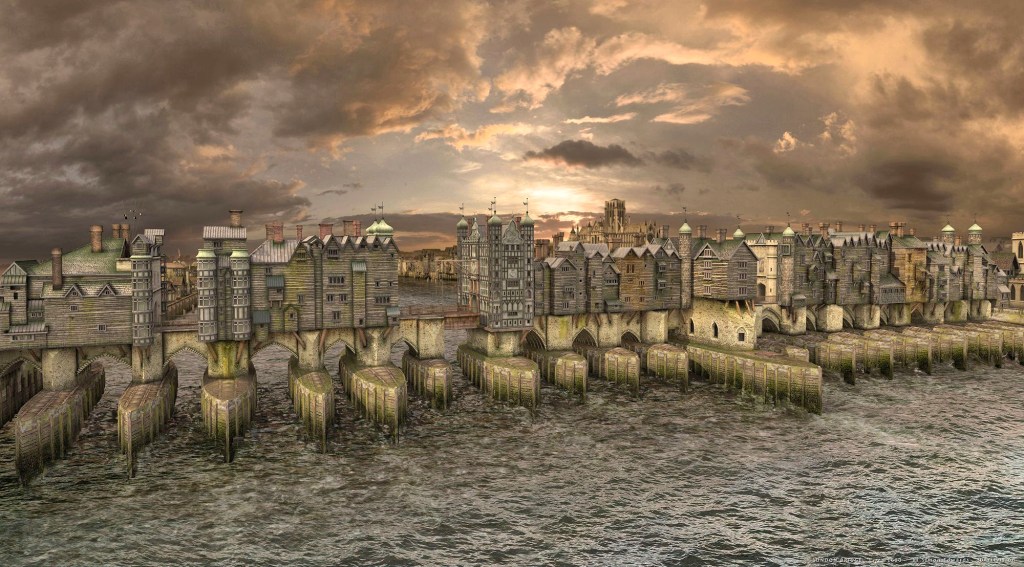
An absolutely wonderful image of Old London Bridge, by Simon Edwards, of whom you can read more at https://s-edwards.com/london-bridge/.

“….Thanks to a reintroduction project, Red Kites have made a remarkable comeback from the brink of extinction in the UK. They’re now found across much of Wales, and central and eastern England, as well as parts of northern England, Scotland and Northern Ireland. You might see them flying over woodland, open countryside and even towns….” (from https://www.rspb.org.uk/birds-and-wildlife/red-kite)

Even towns? Well, how does the middle of medieval London grab you? Yesterday I came upon an interesting reference to red kites being “common in medieval London” and in the 15th century were “extremely prolific on London Bridge”.

I found the reference in The Black Prince’s Palace at Kennington, Surrey, by Graham J. Dawson, British Archaeological Reports 26, 1976, page 168, which in turn referenced the source as R.S.R. Fitter’s London’s Birds (1949), page 100.

It seems the kite had almost disappeared from the capital by the end of the 18th century and for a long time it was only found in Wales. Now it’s beginning to flourish elsewhere again, as witness the first paragraph above.

Red kite (milvus milvus) from https://www.woodlandtrust.org.uk/trees-woods-and-wildlife/animals/birds/red-kite/

It’s hard to imagine now that while traversing Cheapside, on glancing up one might see a red kite eyeing you for size! No, they’re scavengers, feeding primarily on carrion, so obviously they wouldn’t attempt to abduct a walking human – but don’t go to sleep out in the open! 😮☺️ (Only joking!)

But just imagine seeing these wonderful birds of prey in the heart of a city. As for being extremely prolific on London Bridge, it’s hard for us to picture now. Even in the 15th century London was very big, very crowded and very noisy….and in winter, very smoky too. But there’d be a LOT for them to scavenge.

Nowadays we have to go looking for them in certain rural areas of the country, but back then they presented themselves freely. It’s very possible—indeed probable—that Richard III often saw them. Perhaps he even had to shift a bit sharpish to avoid being dive-bombed!

(My late husband was a prime target for birds. They’d single him out and then….well, it became a joke in the family.)

by viscountessw


Subscribe to my newsletter

7 responses to “Birds of prey were “extremely prolific” on Old London Bridge….”

  1. M.E. Lawrence Avatar
    M.E. Lawrence

    There’s lots for an ambitious raptor to do in the big city. My husband, a professional ornithologist in his youth, used to sit in his high-rise office (Northern California) and record the habits of a particular peregrine falcon, known in our household as “She,” for the local falcon-welfare volunteers.

    Liked by 1 person

  2. Beth Williams Avatar
    Beth Williams

    I can well imagine these birds ‘foraging’ on the Bridge, all manner of foodstuffs were sold in London itself from baskets and stalls and those weaving in and around shoppers, and once the pigs were relegated to back yards (allegedly) and not allowed to just roam about the streets and alleys (sometime after Edward III, you might know exactly Viscountessw, it could well have been under statutes of Richard II) then these kites had only the dogs for competition! Here in the states with shorelines it is the seagulls who are a ‘problem’ and are known as ‘rats with wings’ – not beloved creatures at all for daytrippers! Seagulls here will rip the food straight out of your hands (and a finger or two) – beach towns here have been known to hire professional hawkers who walk about the shoppers’ areas, usually the boardwalks, with a falcon on their wrist, and NOT a seagull in sight. I wonder if similar efforts were made by shopkeepers who had wares to protect, or those wafer makers one reads about?!

    Liked by 1 person

    1. We have flying rats here too, Beth. Nothing is sacred to them. They come inland and rip trash bags to shreds before spreading the contents everywhere, and ice-cream or fish and chips are favourite targets. Cars are covered in their droppings, and when they have young they dive-bomb anyone they think poses even a vague threat. Awful birds. But we love to hear them at the seaside.

      Like

  3. Beth Williams Avatar
    Beth Williams

    thought of something else too, since these kites were known to search out and eat carrion, the Bridge was a natural location for them as the heads of criminals and traitors were piked at the Great Stone Gate on the south bank, beginning with William Wallace (that would be under Edward I). They were perched atop iron spikes putting them where the scavenging birds could easily reach them, although prominent ‘heads’ were often tarred first so they would last longer.

    Liked by 1 person

    1. A nice thought to go with my morning tea, Beth! 😄

      Like

      1. Beth Williams Avatar
        Beth Williams

        And I’m fun at parties too (in my own way … )

        this made me think -seriously – we all know about Edward I and his nasty habit but did Richard do this as well? I couldn’t find any examples for Richard, but a couple for big bro, Edward, he had their cousin, Thomas Neville (‘Bastard’ Fauconberg) executed up at Middleham (don’t ask for details, I have yet to uncover just when and why, he had been pardoned by Edward for that whole assault on London business in May (’71) and next thing you know, bam, he has Richard coming down from the north to fetch Neville, in Southampton (?) drag him up north and execute him there, just to have the head shipped back down to London! The other examples from Edward (yup, there were more) were all piked at Micklegate bar in York, so they don’t count. Welp, there’s goes another morning tea!

        Like

  4. Well, we don’t have red kites in North America, but we once again have red-tailed hawks and bald eagles right in the big middle of Dallas. Texas. Yee-hah!

    Liked by 1 person

Leave a reply to viscountessw Cancel reply