
St Ninian was ‘a most holy man’ according to the Venerable Bede. He was born around 360AD, near Hadrian’s Wall. He is first heard of in the 8th century as being an early missionary among the Pictish peoples of what is now Scotland from his monastery in Whithorn, Galloway. For this reason he is known as the Apostle to the Southern Picts.
He is also known as Ringan in Scotland, and as Trynnian in Northern England.
Nothing is recorded about his teachings, and there is no unchallenged authority for information about his life. Even Ninian’s identity is uncertain, and historians have identified the name ‘Ninian’ with several different historical figures.
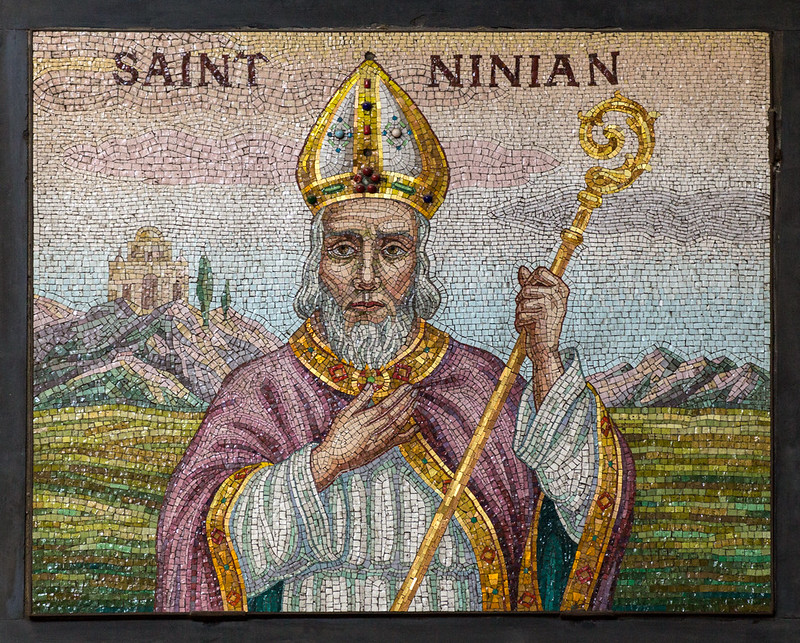
https://creativecommons.org/licenses/by-nc-nd/2.0/
The earliest mention of Ninian of Whithorn, Galloway, is by Bede in c. 731. The 8th-century poem Miracula Nyniae Episcopi records some of the miracles attributed to him. A Life of Saint Ninian (Vita Sancti Niniani) was written around 1160 by Ailred of Rievaulx, and in 1639 James Ussher discusses Ninian in his Brittanicarum Ecclesiarum Antiquitates. None of these sources of information about Ninian are unchallenged, however.
Tradition says that Ninian was a Briton who had studied in Rome and established an episcopal see at the Candida Casa in Whithorn, both of which mean ‘White House’. He named the see for Saint Martin of Tours, he converted the southern Picts to Christianity, and is buried at Whithorn. Variations of this add that he had actually met St Martin, that he was the son of a Christian king, and that he was buried in a stone sarcophagus near the altar of his church. Further versions assert that he went to Ireland, and died there in 432.
Old stories attribute healing powers to Ninian and his staff, praying God’s protection for local shepherds and their sheep.

There are many dedications to St Ninian in the UK. Above are the locations of them (England, Scotland, Isle of Man).

Tradition holds that St Ninian’s Cave was the hermitage of its eponymous saint. This can’t be verified, but it may well have functioned as a retreat from the monastery at Whithorn. Ten crosses are cut into the cave wall itself, and eighteen early Christian carved stones have been found in the cave. They can now be found at Whithorn Priory and Museum.
Richard III was devoted to Ninian: he dedicated four major religious foundations to him and a prayer of St Ninian was added especially to his personal Book of Hours.
There is a new window which includes a depiction of St Ninian in St Mary’s parish church, Barnard Castle. You can find out more about it here: Windows for the King
 The New Murrey and Blue blog
Leave a comment