
Blog examining the recent research about the ‘Princes in the Tower’
The above link, on the Medieval History blog, examines the actual evidence revealed in the recent documentaries, regarding the fate of the ‘Princes in the Tower’. I quote a few parts here and have put in bold words I think are significant.
The author says:
‘In my latest blog I explore Langley and Thornton’s work and consider what conclusions, if any, we might reasonably draw from it all.’
I think the important word here is ‘reasonably’, which sounds as if both sides will be given a fair appraisal.
However, there are a few statements that I take issue with. They start off in a ‘reasonable’ way (although I don’t think there’s any evidence that Edward IV died from ‘a haemorrhagic stroke’ – there is a strong theory he could have been poisoned), but then, while explaining the background they say:
‘Then there was Richard, appointed the boys’ protector...’
This is incorrect. Edward himself, on his deathbed, appointed Richard ‘Protector of the Realm’. Many believe that Richard was supposed to protect his young nephews and instead ‘seized the throne’ from them making him seem even worse than the usual story, but that’s not the case. Protector of the Realm meant he had to put down rebellions within the Realm (like the Woodvilles and Hastings) and invasions from without (like Tudor). Nothing to do with looking after the ‘princes’.
They continue: ‘He seized control of the boys, almost certainly with an eye to side-lining the Woodville faction. Then, a few weeks later, he declared the boys illegitimate and claimed the throne for himself.’
The use of the word ‘seized’ suggests violence when the reality couldn’t have been further from the truth. It was the Woodvilles who had more than 2000 men at Stony Stratford. Richard and Buckingham together only had 600, yet Richard took control of the situation, arrested those who had seemingly attempted to ambush him, sent the 2000 home and escorted the young Edward to London, where his initial actions show he fully intended to have Edward crowned. Richard eventually persuaded Elizabeth Woodville to let Edward’s younger brother join him at the Tower.
It was only after Stillington’s (not Richard’s) revelations about the bigamous nature of Edward and Elizabeth’s marriage that Richard was asked to take the crown (he didn’t ‘claim it for himself’).
The next point I take issue with is: ‘Richard III’s new regime came under increasing pressure from conspiracies, both real and imagined.’
I don’t know of any ‘imagined’ conspiracies he had to deal with. It makes him sound paranoid!
After the princes stop being seen in the Tower, we get this: ‘…the princes’ absence from public life became the subject of increasingly dark rumours. Perhaps their uncle had murdered them? Or, perhaps, it had been the Duke of Buckingham? The rumour mill began to gather pace, both in England and on the continent.‘
Admittedly, there were some rumours that they were dead, but there were just as many that they survived and had been moved elsewhere, yet only the ‘dark’ ones are mentioned. They makes it sound as if the rumours were everywhere! In fact, we know that they were mostly cropping up in places where Richard enemies had been located – this was both in England and France (technically ‘the continent’ but this suggests it was the whole continent!)
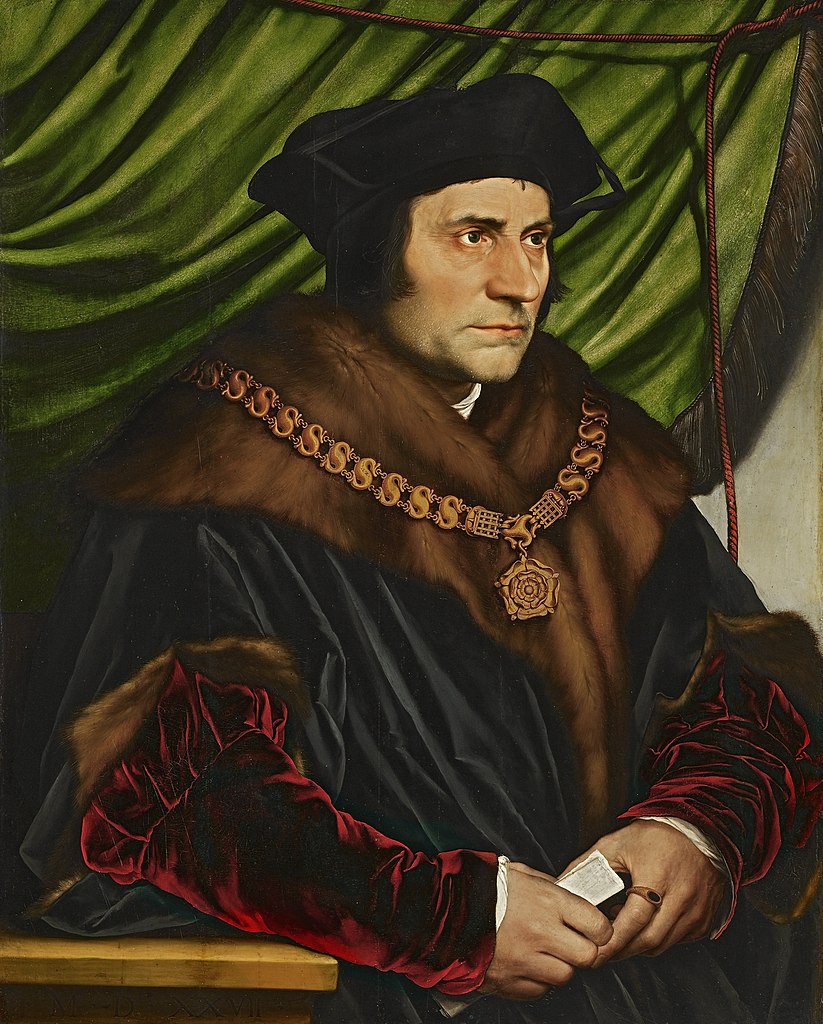
The blog then skips to Tudor times and their accounts (ignore the actual contemporary ones, then!). They say that Tudor historians wrote their accounts and state: ‘One of the most prominent of these was Sir Thomas More, a senior Tudor courtier and polymath’. Thomas More, a historian? That’s the first I’ve heard of that!
They say the murder theory was mentioned by other Tudor writers but: ‘However, More’s version included more specific details than those appearing in any previous account. More even claimed that the boys’ remains had been concealed in a makeshift burial site in the Tower.’
These ‘specific details’ are not flagged up as speculation (More uses phrases such as ‘so men say’, etc, basically admitting he is just reporting hearsay. He also says he doesn’t know whether there is any truth in these rumours, but they don’t mention that.
They also fail to mention here the facts that 1) he wasn’t an eye witness, 2) his source was Bishop John Morton, one of Richard’s deadliest enemies, in whose household More was when young.
They do say that he was writing under the Tudors and this could have been biased. They also admit later that: ‘More was a statesman, not an historian.’ but the seed has already been sown that he was more knowledgeable, professional, almost, than he really was.
Another problem with More is admitted: ‘…several errors that creep into More’s narrative. For example, he states that Edward IV was 53 at the time of his death when he was actually 40.’
Even here, they are not entirely accuarate. Actually, More doesn’t say he was 53, he says he was ‘fifty and three years, seven months and six days’. This is not a simple mistake. If he wasn’t certain of Edward’s age, he wouldn’t have been so detailed, so suggesting he just made a simple error is disingenuous. I and many others believe it was deliberate to show the whole narrative was invented. It actually correlates much more closely with Henry Vii’s age at death.
A more comprehensive examination of the problems with Thomas More can be found here: The Problem with More
When examining Thornton’s discovery of the will, mentioning a chain belonging to young Edward, and the theory that More got his information from the son of one of the ‘murderers’, the blog does say:
‘…why would Forest’s son rat his own father out to More? Why risk destroying the reputation of your own family?’ This is a very good question, but they could have gone further.
They don’t mention that Tyrell may well have been associated with the princes in a purely innocent way and the chain may have been given to him as a reward for service, even by Edward himself. Nor do they say that there is no description of the chain. In the documentary, it is assumed to be his ‘chain of office’ which make it sound very suspicious, but that’s unlikely as in that case it would more likely have been called a ‘collar’. It may have been a small silver or gold chain of no particular significance.
A regards the Philippa Langley documentary they flag up a few problems there, too. One is: ‘Where had they (the boys) been in the intervening years?’
Well, one of the documents found states exactly where Richard/Perkin Warbeck had been, so they are immediately discounting this.
The second problem is: ‘…the confused identity of the first pretender. Three different near contemporary sources provide three different identities for this individual’.
This is true, however it isn’t mentioned that there is a credible theory that his identity was deliberately confused by Henry. The book ‘The Survival of the Princes in the Tower’ by Matt Lewis goes into these theories.
The blog uses phrases similar to More’s reporting of the rumours, such as: ‘The story that emerged...’ and ‘The official Tudor verdict...’ making the Tudor version seem ‘reasonable’.
Henry is portrayed as merciful to ‘Lambert Simnel’:
Accepting that the boy had been used, Henry VII decided to pardon him and set him to work as a servant in his kitchens.
Well, if he had been ‘used’ as a substitute for the real pretender, this would have been his reward: a job and later promotion to a falconer.
As for ‘Perkin Warbeck’ they state: ‘If he’d been Richard, where had he been all these years? And, if he was a well-educated English prince, why was it that his spoken English was reported as being poor?’
As I said, one of the pieces of evidence is a detailed account of where he had been! And what is the source for his English being ‘poor’? I’ve only seen the opposite of this reported.
This detailed account is dismissed as: ‘…could be nothing more than a contemporary fraud designed to bolster the credibility of the pretender’s claim.’
However, in Philippa’s accompanying book, she shows that the details given of names, dates and places have all been checked and authenticated, it isn’t just that the document dates from the right time period. A fraud wouldn’t have all that detailed information.
The conclusion regarding the pretenders states:
‘…both Lambert Simnel and Perkin Warbeck remain far more likely to have been imposters than the real princes.’
Are they? Considering that there is no concrete evidence that the boys were killed (and Philippa looked for this as well as evidence for their survival) and quite a bit, (including documents that were not for public consumption, so far more reliable) that suggests they did survive, I dispute this conclusion. It seems this is not such a neutral examination of the evidence.


 The New Murrey and Blue blog
Leave a reply to Janet ODonnell Cancel reply