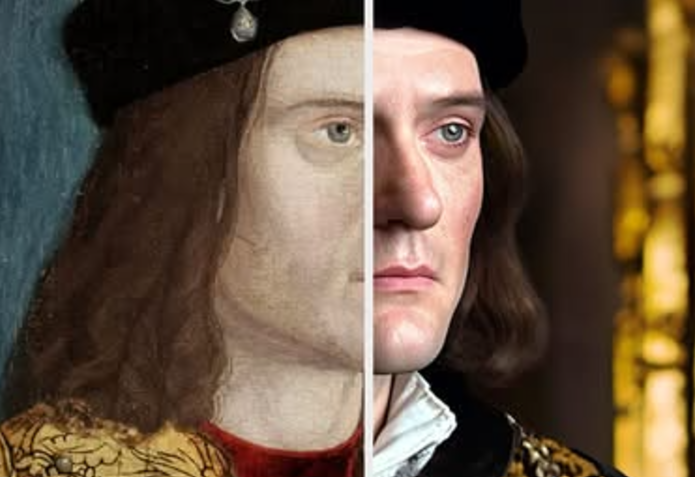
I recently came upon this link to a new video— https://youtu.be/CBXaZkCnP44—of Richard III and his nephews. The likenesses were based on the earliest known portrait of Richard (see left above, made 30-40 years after his death), and in the case of the boys, likenesses of their parents. The still images are manipulated to make them smile and even laugh.
I have to say that I thought the recreation of Richard was mostly spot-on, and captures the man he was in 1485, a widower who’d also lost his son. There’s pain in his expression. He’s spent many nights crying secretly for those he’s lost. And now he’s facing a second invasion of his realm.
Do I have a gripe about the video image? Well, only a small one. For me his chin was not quite right. We know from his skull that his chin was reasonably prominent. But this, of course, wasn’t evident in his surviving portraits, most of which are from the 16th century, so the artists did not have their subject sitting before them. But the portraits do generally agree that he was dark-haired and very slender (just look at his taut throat).
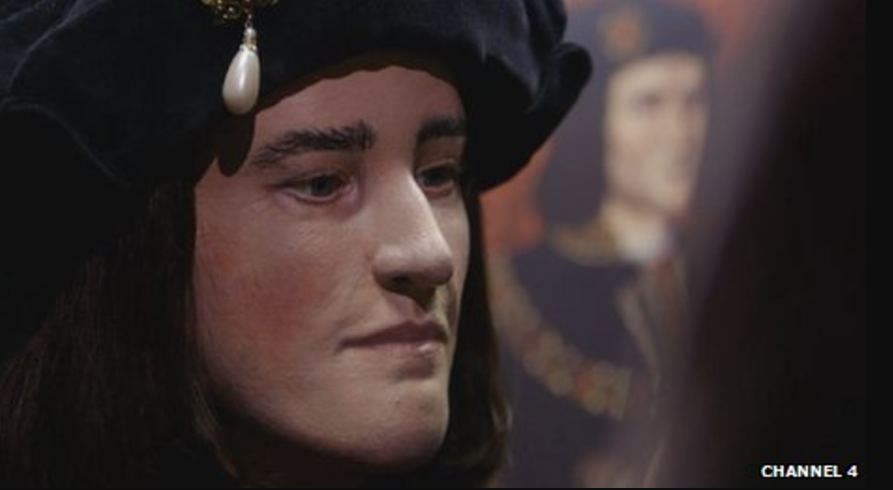
When his remains were found in 2012 a facial reconstruction was made. It was complete with rather wild, rampant black eyebrows which I hope have now been tamed, more in keeping with his portraits. Richard’s eyebrows were well-behaved (eyebrows were plucked back then as now), and did not look like two hairy black caterpillars preparing to do battle above his eyes!
The boys’ likenesses are arrived at more tentatively, of course, because there is an utter dearth of contemporary portraits. They were only nine and twelve respectively, and we all know how children change as they grow. So in the video they are drawn from known portraits of their parents, Edward IV (https://richardiii.net/richard-iii-his-world/his-family/edward-iv/) and Elizabeth Woodville (https://richardiii.org.uk/topic/49550/elizabeth-woodville-anxious-mother-or-calculating-shrew).
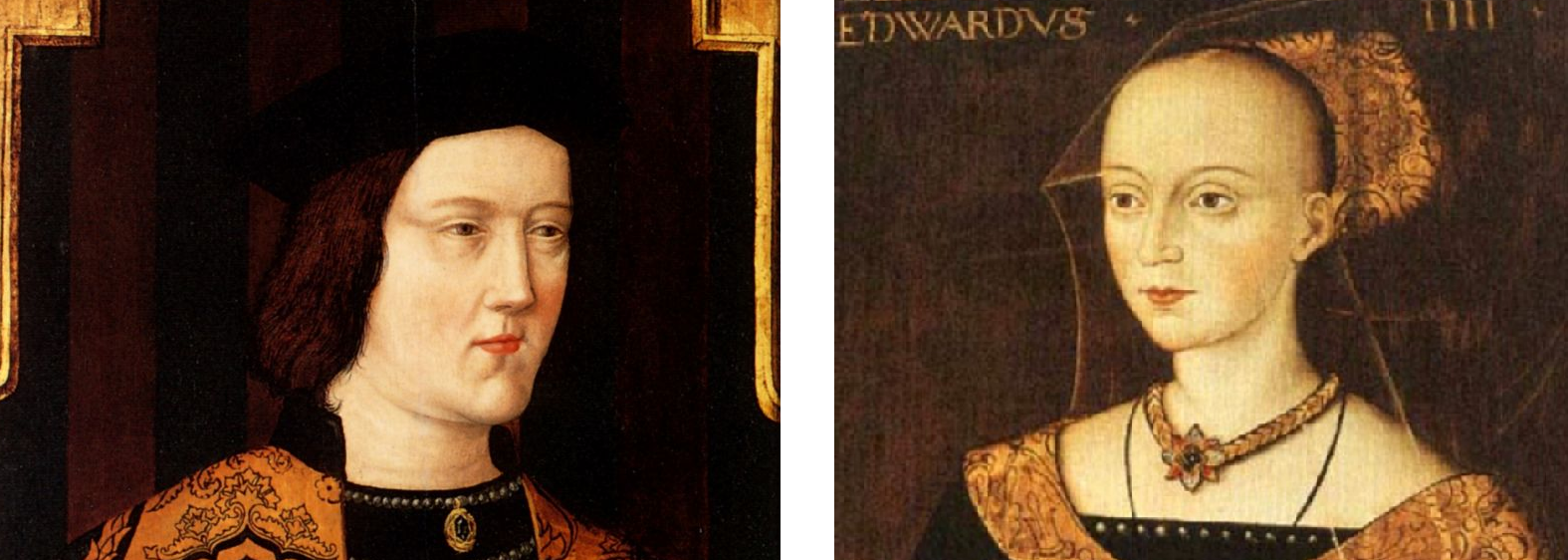
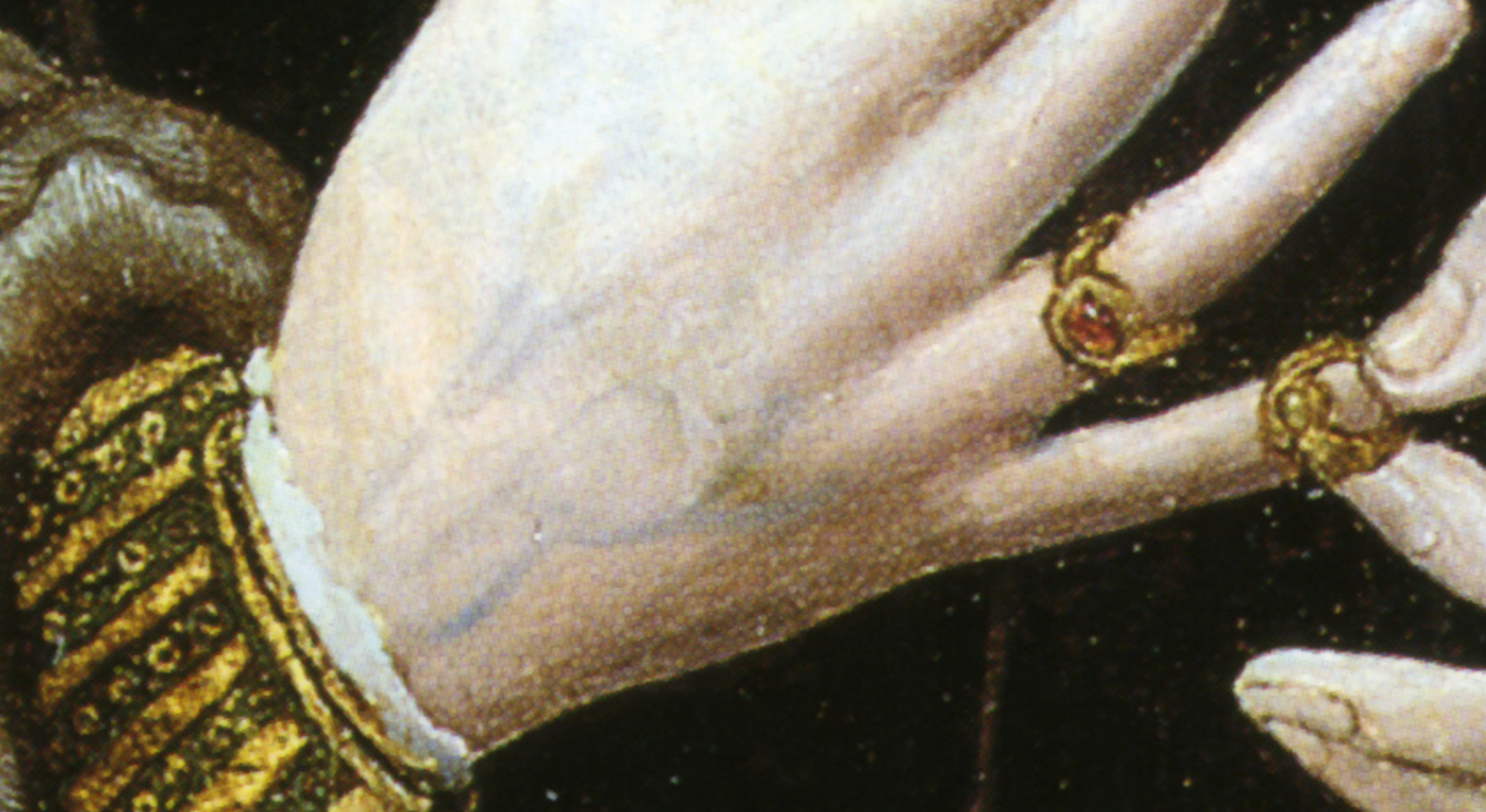
But just how “safe” is that? The boys’ parents were both thought to have been fair-haired, but we also think of Richard III as being the only dark-haired son of Richard, 3rd Duke of York. (See https://murreyandblue.org/2024/12/02/richard-3rd-duke-of-yorks-just-claim-to-the-throne/ and https://richardiii.net/richard-iii-his-world/his-family/richard-duke-of-york-father/.) Yet modern science has proved that Richard was probably a blonde, blue-eyed child (96% chance of blue eyes, 77% of blond hair), and that his hair darkened to brown as he grew up. From his adult portraits he definitely seems to have had brown wavy hair, blue/grey eyes, and skin that was fair to pale. The blue veins on his hands are certainly visible in his National Portrait Gallery portrait. But the NPG portrait isn’t contemporary, so are the veins guesswork? And were his nephews, like Richard himself, only blond in childhood? Would they too have been much darker as they grew up?
Richard’s eldest brother, Edward IV, was also good-looking, and at almost 6’ 4” was very tall for the time (he’d still be regarded as very tall today). For various reasons his tomb at St George’s Chapel, Windsor, was opened in 1789 and locks of his hair were found. It was said to have been long and “mid-brown”. (https://www.sal.org.uk/collections/explore-our-collections/collections-highlights/lock-of-hair-of-edward-iv/ and https://www.windsor.gov.uk/ideas-and-inspiration/blog-latest-news/read/2020/04/the-death-of-king-edward-iv-b42.) However, I put “mid-brown” in quotes because when I look at pictures of this lock of hair, it seems to have a dark copper sheen. So was he closer to being a redhead?
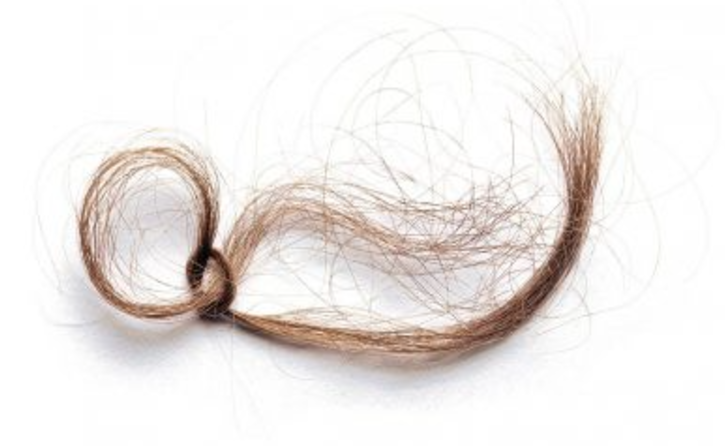
And did he and Richard share facial features? Heaven knows. Some images make them very similar indeed, other not so. Genes pop up everywhere at random, and not always in close relatives. Still do, of course. My daughter has my blonde colouring, but her build and character is all her father’s side. My eyes are green, her father’s were grey, but hers are blue. Her son has blond hair and wide-set blue/grey eyes that make him quite distinctive. We thought he was the only family member with these particular looks, but one day a photograph of his distant, previously unknown to us paternal cousin (in the Royal Navy) turned up and they might have been brothers.
So it’s very tricky indeed to be certain of colouring and facial structure, unless we have reliable sources. In the case of Richard III, we have his remains, and so can be certain of his physical features if not exact colouring. He was a slender, good-looking young man of thirty-two when he died. He certainly was not the twisted, murderous, middle-aged creature that has come down to us courtesy of More & Co.
It would appear that when we think of figures from the past, heaven alone knows which of their relatives, if any, they actually took after. If Henry Tydder and Margaret Beaufort are anything to go by, we ought to be able to spot a Beaufort a mile off! Looking at youthful portraits of Henry VII, Prince Arthur and Henry VIII is like looking at the same person! Definite Beauforts. Yet as Henry VIII grew older, he was nothing like his short and puny grandmother Margaret or tallish, equally puny father. Instead he was tall and muscular, and became increasingly overweight The same description fits his maternal grandfather, none other than Edward IV. By the evidence (Edward’s hair and Henry’s many portraits), they both had red/dark copper hair. So trying to be certain of anything is like entering a draughty labyrinth at night with a guttering candle.
Red hues turn up constantly. But then if you go back through a few generations, they all share the same gene pool. A few portraits of Henry VII suggest reddish hair, and his wife, Elizabeth of York, was the daughter of Edward IV. Small wonder that Henry VIII was a redhead. It was hard to escape from it in medieval royal and noble circles where there were so many marriages between kin. And how often are redheads described as “fair”?
The new video has aroused a lot of interest, with all sorts of reactions. Most seem to agree that Richard is definitely right, but not so the boys, who are regarded as “too romantic” and “too modern”.
There is a contemporary portrait of their paternal grandfather Richard, 3rd Duke of York, in the Shrewsbury Book of 1445 (https://blogs.bl.uk/digitisedmanuscripts/2012/07/the-talbot-shrewsbury-book-goes-online.html.) In it he is clearly shown to have had yellow-fair hair. But are the darker lines in it a hint of copper? It should be accurate because the duke was still very much alive when it was painted. As an aside, his calves look padded, like those of 18th/19th century footmen? Shapely calves were desirable, and the duke’s don’t look natural to me! 😊
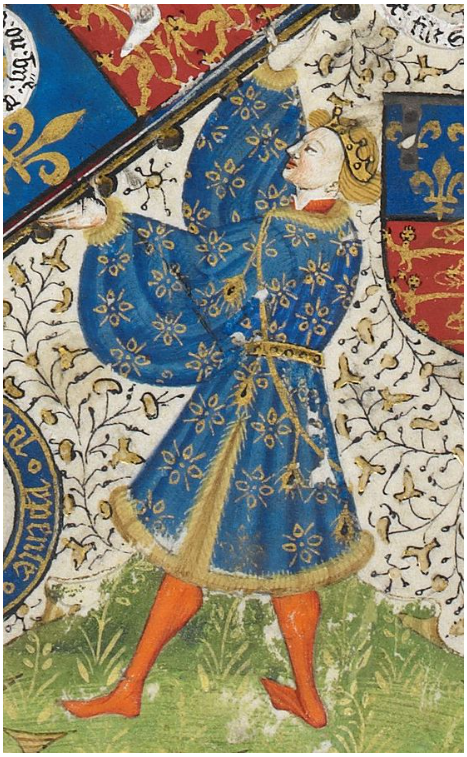
Of the duke’s four sons, Richard III, the youngest, is the one said to have resembled him the most. You wouldn’t think so from the above likeness. But perhaps the duke wasn’t a big, burly man like his eldest son, Edward. Perhaps he too was smaller and leaner, and that is why Richard is likened to him? I have written previously about the looks of Richard, 3rd Duke of York, and whether or not his youngest son, Richard III, resembled him. See here https://murreyandblue.org/2021/03/27/was-the-3rd-duke-of-york-like-his-youngest-son-in-appearance/.
But as I’ve said before, it’s more difficult to give looks to the two boys in the Tower. Except….there is a very interesting article by Sparkypus at her Medieval Potpourri blog that points out two startling family likenesses. I quote her: “….What jumped out at me was the remarkable resemblance of the duke to his young grandson, Edward V – whose portrait can be seen in a window at Coldridge Church, Devon….”
The constantly developing story of the window at Coldridge Church is very exciting, because if it is proven to be of Edward V, as is 95% certain, it means he lived well beyond 1483 and died a natural death as an adult. This means that his uncle, Richard III, did not murder the boys in 1483. (https://sparkypus.com/2020/12/26/a-portrait-of-edward-v-and-perhaps-even-a-resting-place-st-matthews-church-coldridge/) Oh dear, devotees of the House of Tudor will be jumping up and down in a rage because they’re forever prating that Richard was a vile, conniving, usurping child-murderer!
Please note that the commentary on the video describes the window image as being made “….after Edward’s death in the 1500s….”
The Medieval Potpourri article compares the church window’s image with that of his paternal grandfather, the 3rd Duke of York, who is shown in another contemporary portrait, see below, both from Medieval Popourri. You can read Sparkypus’s article here https://tinyurl.com/ennjnbe8.
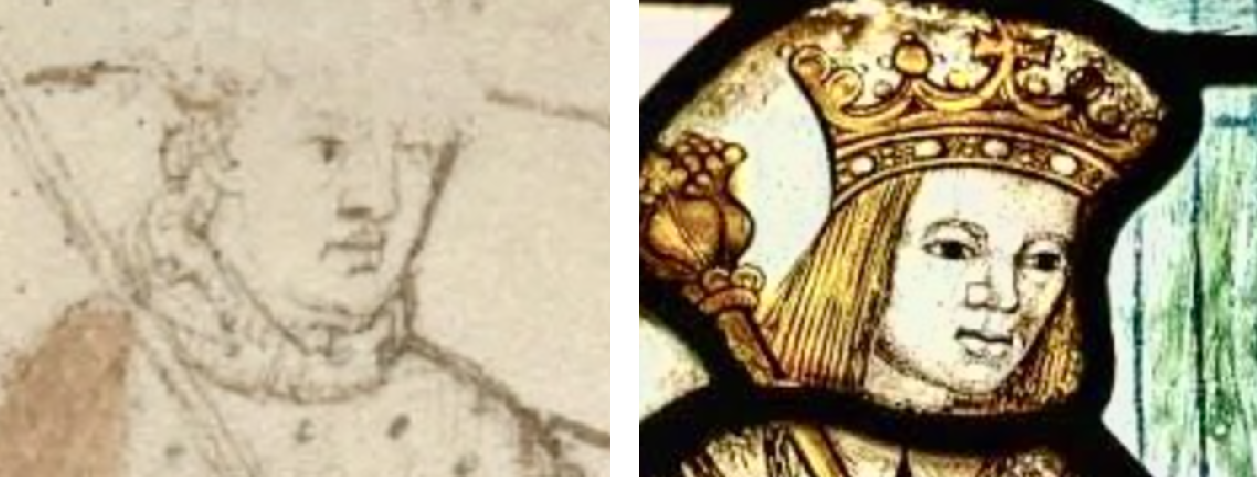
(R) Edward V, from St Matthew’s Church, Coldridge, Devon.
Perhaps a little belated scene-setting is necessary at this point. There were four York brothers all told. Edward of March, the eldest, then Edmund of Rutland, George of Clarence, and finally Richard of Gloucester. The looks of all have been considered by this blog. Here are a few more links:-
- https://murreyandblue.org/2018/07/11/strong-jaws-for-george-and-richard/
- https://murreyandblue.org/2017/05/06/more-about-the-heights-of-richard-and-george/
- https://murreyandblue.org/2017/05/22/and-now-for-the-height-and-appearance-of-edmund-earl-of-rutland/
The second-oldest brother, Edmund, Earl of Rutland, (https://www.englishmonarchs.co.uk/plantagenet_72.html died at seventeen in 1460 at the Battle of Wakefield alongside his father (https://www.britishbattles.com/wars-of-the-roses/battle-of-wakefield-1460/). So he disappears from the scene, but nevertheless his possible physical appearance is of interest to Ricardians.
With the duke and Edmund dead, Edward of March was to win the throne for his father, supported by George and Richard. George appears to have been the classic middle brother, and (rightly or wrongly) perhaps suffered from all the resentments that can go with the role. For important reasons that are covered elsewhere and do not concern the theme of this post, George’s loyalty to Edward swung to and fro. He set himself against his brother and king, and in 1478 was sentenced to death for treason. But on the more mundane note of this post, what did he look like?
Was he another giant like Edward? Or smaller and darker like Richard? Well, there is a suggestion by the late John Ashdown-Hill that George—not Richard—was actually the shortest brother! I cannot say I’m taken with this, because if Edward was so very tall and his two surviving brothers were much smaller, there would surely have been comments recorded. Richard was between 5’ 4” and 5’ 8” (variation due to his scoliosis) and seems to have been regarded as the shortest of the family. There’s never a specific mention of George’s looks or height.
Of course, it might be that Edward’s size was what set him apart from his father and all his brothers….so maybe there was some traction in the unlikely rumour that he was the result of a fling between his mother, Cecily, Duchess of York, and a mere archer named Blaybourne! (https://tudorsdynasty.com/edward-iv-legitimacy/) The Duchess and the Archer? I can’t imagine it of the woman rightly known as Proud Cis!
So, all in all, pinpointing the definitive appearance of the members of the House of York is set to remain one of life’s great mysteries….unless, of course, it’s ever possible to examine (with today’s forensics etc.) the remains of the duke, Edmund, George and his children, and, of course, Edward IV and his children. So much more could be ascertained from subjecting their remains to the same rigid tests as Richard III. But it won’t happen.
That Urn in Westminster Abbey, should it ever be opened and its contents investigated, won’t tell us who the remains are, only who they are not! And that some of the bones are animal. The bones of George and his wife Isobel are supposedly in a glass case in a subterranean cell behind the high altar of Tewkesbury Abbey. But, like the urn, they too have been mixed up with other remains.
Just imagine if we had the true remains of them all, especially their skulls. Then likenesses could be made, as with Richard. How exciting that would be.
So, to return to the new video which prompted this post, I applaud the representation of Richard. I also give due credit to the one of the boys, which the commentary admits is a rather hazy matter. The portraits of Edward IV and Elizabeth Woodville were used, but maybe a better choice would have been portraits of the boys’ paternal grandfather, the 3rd Duke of York. But all due credit to the video and its entirely fair commentary.
There’s that word again. Fair.

 The New Murrey and Blue blog
Leave a comment