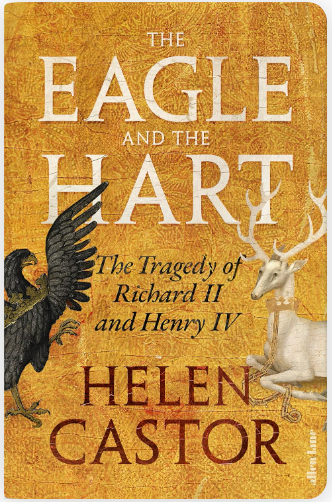
Oh dear, I do wish Helen Castor’s book The Eagle and the Hart (to be published today, 3 October 2024) was being touted as fiction, because excellent as it clearly is, its whole concept takes a stance that grates on me.
The title ought to be The Hart and the Eagle, because Richard was the king and Bolingbroke the cousin who usurped and murdered him. The Eagle and the Hart of the title are Henry IV and Richard II respectively, and it appears to praise Henry of Bolingbroke but condemn Richard of Bordeaux out of hand.
I found the book here—https://www.goodreads.com/en/book/show/77264775-the-eagle-and-the-hart—and if I take the following extract from one of the comments, you’ll perhaps see what has ruffled my feathers: “….A vibrant account of the conflict between England’s most decadent tyrant and its noblest usurper….” That’s as bad as a book that portrays Richard III as really being like Shakespeare’s monstrous nephew-murdering creation and Henry VII as a pure and noble Galahad to the honourable rescue.
Richard II was not England’s most decadent tyrant and Henry of Bolingbroke most certainly was not England’s noblest usurper, and if Helen Castor’s book says they were, then I’m afraid I will not be reading it. There’s noble and there’s noble. Yes, Bolingbroke was a nobleman, but no, he wasn’t a noble man.
This is an occasion when reading blurbs and comments kills a book for me instead of instilling an eagerness to read every page. I do not claim that Richard II was an excellent king, but I think he is always misjudged. He didn’t have the right character/personality to keep a grip on the England of the 100 Years War, but he tried. He wanted peace with France, but his aristocracy wanted war, war and more war. Yes, he liked the good things in life, but are you telling me that Bolingbroke didn’t? Come on now.
Yes too, the cousins had really fallen out, and yes, Richard banished Bolingbroke and confiscated his lands….but the confiscation was temporary and never intended to be permanent. Yet Richard is always accused of seizing the Lancastrian inheritance forever. Thus Bolingbroke is praised for returning to England in 1399 to “claim his patrimony”. How can anyone really believe that was Bolingbroke’s purpose? He came back to take the throne while Richard was away in Ireland. He wrong-footed Richard, captured him, stole his crown and then murdered him. I will always believe that the whole purpose of Bolingbroke, and his father John of Gaunt before him, was to lay hands on the succession. Bolingbroke saw his opportunity and took it. So he was an ambitious chancer who happened to be a nobleman.
I’m interested in both Richard II and Richard III, so I’ll be managing without this book….just as I manage perfectly well without the Bard’s “historical” plays.
I concede that I may be misunderstanding the gist of Helen Castor’s book, but these words are included in the blurb: “….Richard was the white hart, a thin-skinned narcissist, and Henry the eagle, a chivalric hero, a leader who inspired loyalty where Richard inspired only fear. Henry had all the qualities Richard lacked, all the qualities a sovereign needed, bar one: birth right….”
That’s plain enough for me to feel sure I haven’t misunderstood anything. At the moment I can only find pre-publication listings, including the same blurb everywhere. But here’s one other article: Richard II was damned by a fatal flaw – and no, it wasn’t his sexuality (msn.com)
Later: Here is a review of the above book. I stand by my opinion and will not be reading anything that does nothing but damn Richard II from the moment he draws breath. What chance did he stand when as a boy and teenager he was managed and controlled by ambitious uncles who didn’t want him to grow up because his childhood gave them all the power? He was damaged goods and his own character didn’t help him. But he did try to do what he thought was the right thing. https://www.msn.com/en-gb/entertainment/celebrity/how-richard-ii-s-rampant-egomania-turned-fatal/ar-AA1rH0vZ?ocid=U508DHP.


 The New Murrey and Blue blog
Leave a reply to mry4441 Cancel reply