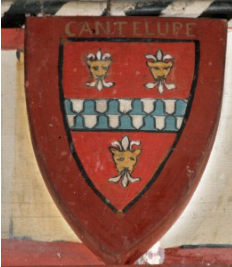
I confess that when I wrote the article The disgraceful second marriage of the unpleasant 3rd Earl of Arundel…. – murreyandblue, {21/9} I thought such marital chicanery was a one-off (Henry VIII excepted!) I certainly didn’t expect to happen upon another instance. This second example of heir-shuffling isn’t as easy to explain as Arundel’s, however, although it seems to revolve around another husband being prepared to elbow his firstborn son aside in order to improve the lot of a much preferred son by a second marriage.
This new puzzle came about when I wrote another article, The mystery castle I didn’t know I was passing in 1957-1960…. – murreyandblue, {13/5} in the course of which I wanted to learn which Baron Cantilupe was which. No easy task, as I soon discovered. I confess here and now that when I see/hear the name Cantilupe, I can’t help thinking of melons. OK, so the spelling isn’t the same, but there are a lot of variations on that one name. However, according to the Wikipedia article on cantaloupe melons: “The name cantaloupe was derived in the 18th century via French cantaloup from The Cantus Region of Italian Cantalupo, which was formerly a papal county seat near Rome, after the fruit was introduced there from Armenia.[3] It was first mentioned in English literature in 1739….” So nothing whatsoever to do with the medieval Cantilupes who came from Normandy with the Conqueror.
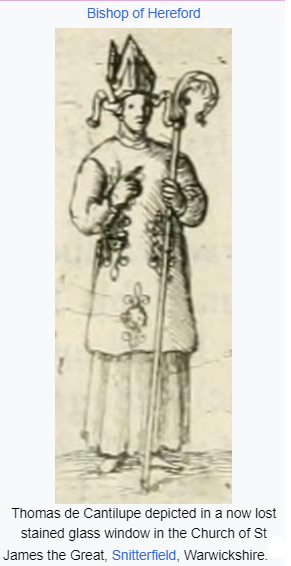
The other important fact about the Cantilupes, of course, is that they boast a saint, St Thomas de Cantilupe, Bishop of Hereford, who seems to have two feast days, 25 August and today,2 October. I haven’t investigated to find out why he has two.
It seems that the 3rd Baron Nicholas de Cantilupe, 3rd Baron Cantilupe (c.1301-1355), a younger son himself, was married first to a lady known only as Tiphaine. I haven’t found any other information about her, except that she gave birth to the 3rd Baron’s firstborn legitimate son. But later on, whether Tiphaine died or was jettisoned by some other means, the baron remarried, this time to a lady named Joan, who was the widow of Sir William de Kyme. Her maiden name isn’t known to me, although no doubt it can be found out there in Internetland. What matters is that she too gave the baron a son.
Here it becomes tricky, because both of the 3rd baron’s sons were named William. I’ll call them William A (Tiphaine’s son) and William B (Joan’s son).
When the 3rd Baron turned up his toes, he “disinherited” Tiphaine’s son. This seems to have involved enfeoffing some lands and property to others, especially to Joan’s son. And he kept a good amount to himself and then to Joan for her lifetime. William B proved to be a chip off the old block, giving things away so that he too made sure William A gained as little as possible. So when his father died, Tiphaine’s unfortunate son had nothing to inherit, except the title itself. Which he did indeed eventually, because by the terms of his father’s will, after all the beneficiaries of the second marriage, and when the second wife Joan died, William A would indeed inherit.
Thus, William A having been “postponed in his inheritance” [in favour of his own] sons and their issue, was not summoned to Parliament. On the death of his younger half-brother [William B], he [William A] succeeded as his father’s rightful heir, and, having done homage and fealty, he had livery of Middle Claydon, Ellesborough, Greasley, and Ilkeston, 6 July 1375….”
However on his death (I don’t quite understand how) “….any Barony, that may be supposed to have been created by the writ of 1299, became extinct….” So William A’s sons were only ever knights. You’ll find it all in The Complete Peerage, Volume III, under the listing for Cauntelou, pp-111-116. So I guess William A was indeed “disinherited”. Had the 3rd Baron gone to the length of seeing to the ending of the Barony rather than let it continue through William A’s line?
So what brought about all this bad blood? Was it simply another example of another man like the awful Earl of Arundel, wanting to ditch his first wife in order to have a second wife whom he lusted after? Or was it that the 3rd Baron and Tiphaine couldn’t stand the sight of each other and her son, William A, took his mother’s side. Or, of course, the simple answer to Tiphaine’s disappearance is that she died. Nowhere can I find anything about her apart from her first name.
In the Earl of Arundel’s case the discarded first wife, Isabel le Despenser, was backed by her disinherited son, Sir Edmund Arundel. The earl managed to get rid of the very much alive and inconvenient Isabel le Despenser by claiming he’d been a minor and had disagreed with the marriage from the outset. What a whopper! But the Pope chose to believe him and the annulment was forthcoming, disposing of Isabel and disinheriting Edmund in a trice.
But there doesn’t seem to have been an annulment in the Cantilupe case. So what was there? Something had to have brought about the huge move of disinheriting—in whatever form this took—because denying William A the title wasn’t really possible, only making sure he gained nothing else. The fact that William A did eventually gain the baronage and some lands surely means he was definitely legitimate. His father didn’t dispute this point.
Was the 3rd Baron’s loathing for his firstborn so great that he did all he could to make certain William A’s future was as difficult and penniless as possible? Of course, I seem to be taking William A’s side in all this, but he may have been an obnoxious, depraved so-and-so who when his end came was destined to go down among the flames rather than up into the clouds!
Oh no doubt there are numerous other such cases, but these two just happen to be the ones I’ve come across in the course of my internet-rambling. Does anyone out there know the truth behind this Cantilupe mystery?
There is another story attached to the Cantilupe family, a rather gruesome and notorious murder about which I will be writing soon.
Footnote: Now here’s a very different twist to the story of the 3rd Baron and his sons. If you go to this site you’ll find: “…On Nicholas’s [3rd Baron] death in 1355, a bitter legal battle ensued. His valuable estates of Greasley and Ilkeston had been taken over by his brother Richard. However, Nicholas’s wife Joan de Kymas [Kyme] disputed the inheritance at the Nottingham Assize court and proved that an alleged deed of gift by her was a forgery. The transgressors were heavily fined and William, their son, was eventually disinherited. When Joan died in 1364 the title and castle went to their grandsons Nicholas and William….” So make of that what you will! William A was actually the son of the 3rd Baron’s brother Richard? If it’s true, then it makes a veritable pig’s ear of everything else I’ve found. But also if it’s true, why doesn’t the 3rd Baron’s will refer to William A as his nephew? Presumably when the 3rd Baron died in 1355 he didn’t know aything about any forged signatures and such devious things. So it’s up to you what you believe. Suffice it that something went on and the barony came to an end.
Oh, and as a final footnote (I promise) the same blogspot contains the following anecdote: “….When I was a boy, over seventy years ago, I was in Ilkeston St Marys church. Canon Reginald Foskett, the vicar told me about the tomb of de Cantelupe. They were not sure if he was William or Nicholas an ancestor of Nicholas of Greasley Castle….The tomb originally stood in front of the altar. The Victorians moved it to its present position. They opened the tomb and removed the skeleton. Rev Foskett said that one of the workmen held the lower jaw up to his own face – it fitted over his own!….” Good heavens. Was the workman very small? Or the jawbone that of a very large man?


 The New Murrey and Blue blog
Leave a reply to The grisly murder that ended the Cantilupes…. – murreyandblue Cancel reply