
I’m about to write concerning an Ancient Origins article from 2021 which I have only just come across and which has made me see red. You’ll find it here https://www.ancient-origins.net/history-important-events/richard-iii-0016100.
I’m afraid my response is rather long, because once I started there was a lot to set straight. But before proceeding, I have only one word to describe the Ancient Origins article….CRAP!
Here goes. Once upon a time in fifteenth-century England there were three royal brothers of the House of York. Edward, the eldest1, was King Edward IV, next came George, Duke of Clarence2, and finally there was Richard, Duke of Gloucester3.
But George turned upon Edward, who condemned him to a traitor’s death. Appalled, Richard pleaded for George’s life, to no avail. Edward was adamant and would hear nothing in George’s defence. Attainted and his children barred from the succession, George was executed. So then there were only two royal brothers.
During the Wars of the Roses, Edward had won the throne (for the second time) after defeating Henry VI of the House of Lancaster. Henry VI died soon afterward in suspicious circumstances. The rivalry of the two warring houses then quietened during Edward’s reign, but hadn’t gone away.
Edward IV wasn’t yet out of his teens when he was first crowned. The Lancastrians fought back and ousted him for a few months, but he was soon back on the throne. Young, handsome, virile and charming, he was a charismatic leader and fearsome warrior. He proved to be a strong king capable of ruthless action—as witness his treatment of George and the dubious death of Henry VI—but he had one big flaw….he played around with women. Perhaps he’d discovered that promising marriage to some of them was a sure path to their bed. Trollops obliged anyway, but he had a thing about properly brought up ladies with morals—maidens, wives or widows, it didn’t matter, just as long as he could lure them from the straight and narrow.
But he couldn’t seduce a certain Elizabeth Woodville4 that easily. The promise of marriage wasn’t enough, he had to actually go through with it, or seem to, at least. She was rather unsuitable—a Lancastrian widow and not highborn—but in 1464 Edward “married” her. Secretly of course. Maybe this time he was truly in love because he certainly acknowledged her and set about producing a family with her. There were political circumstances that meant it suited him to produce her as his queen. In the years to come, however, the truth about this union was to cause a cataclysm in the land and would lead directly to the death of Edward’s only remaining brother, Richard.
Unfortunately, Elizabeth Woodville had a large number of ambitious and unscrupulous relatives who for one reason or another Edward chose to advance. One of the ways he did this was by imposing Woodville brides and grooms upon leading aristocratic families. It did the House of York no favours and only fomented trouble. But Edward did himself no favours either, for his dissolute life ruined his health, he grew fat and idle and died suddenly on 9 April 1483 at the age of only forty.
On his deathbed, Edward showed complete faith in his remaining brother, Richard by naming him to be the Protector of England. Richard was ten years younger than Edward IV and had always been loyal and supportive, staying away from court politics by means of his role in the northern counties. There he’d earned an excellent reputation and was praised and trusted for his justice.
The new boy-king—12-year-old Edward V—had his household at Ludlow, and was always surrounded and influenced by a gang of Woodvilles who would certainly not have painted a flattering picture of the boy’s paternal uncle, the Duke of Gloucester. Edward IV’s sudden death prompted a Woodville plot to get the boy to London, crown him and take control of both him and the country before Richard, who was conveniently far away in the north, knew anything about it. Treason it was, but not if they managed to pull it off. Had Edward V been party to this plot? We don’t know, but I fancy he must have had an inkling that something was going on. He was twelve, not a babe in arms.
But although the Woodvilles withheld news of the king’s demise from the new Protector, someone did notify him and he set off quickly for the south with a retinue of gentlemen dressed in mourning. Not an army, please note. He was going in his new capacity as Protector, to take care of the realm and and guide the new young king.
As the Woodvilles and their prize made their way hastily toward London, they were hugely dismayed to come face to face with the new Protector at Northampton.5 They tried to fool him, meaning to do away with him there and then, before he could get his feet under the table, but Richard was too wily and intelligent for them. By now he knew they’d wilfully omitted to tell him anything about the death of Edward IV, so their real objective was plain enough to him. In his capacity as Protector he disposed of the traitor. Then he accompanied Edward V to London, intending to arrange the coronation and take up his own Woodville-free responsibilities as Protector.
But what did Edward V think? Did he turn to Richard because Edward IV had trusted and nominated him to be Protector? Or did he resent the defeat and execution of his Woodville escort? We will never know what the boy thought.
However, Richard soon learned that all was not as it seemed on the surface. It came to light from a very reliable source that the late king’s marriage to his Woodville queen had been bigamous because Edward, ever the playboy, had already been secretly married to another woman, Lady Eleanor Talbot, daughter of the Earl of Shrewsbury.6 Clandestine marriages such as this, made in a private setting, were perfectly legal, especially if the ceremony was performed by a proper priest, as seems to have been the case with Elizabeth. but Edward IV had hoped this first venture would remain a secret. So when he took his vows, whether the priest was genuine or not, with Elizabeth Woodville he committed bigamy and knew it!
Then, four years later in 1468, when his first wife died, he didn’t make any attempt to marry Elizabeth Woodville legally. Although perhaps this was impossible anyway.7 Thus Edward V, born 1470, was always baseborn, and never had a right to the crown!
If George, Duke of Clarence, hadn’t died a traitor and his children hadn’t been excluded from the succession, his son, the Earl of Warwick,8 then eight, would have been next in line to the throne. But now it was Richard of Gloucester who was the senior legitimate male heir to the throne of England.
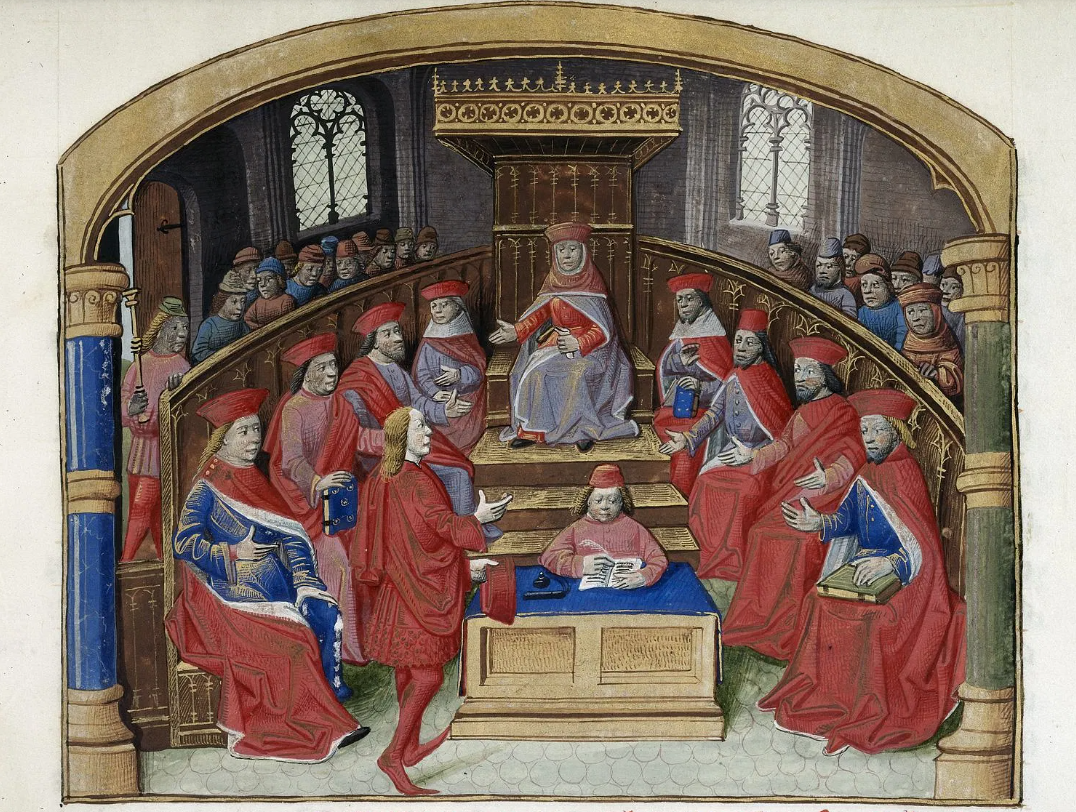
Richard was formally invited to become king by the Three Estates of the Realm9 and after some deliberation, he complied. Please note that fate had led him to this. He hadn’t tricked and plotted his way to it, and certainly didn’t rush in with an army of retainers and bludgeon his way to the top job. He’d didn’t snatch it or usurp it in any way at all. Everything was legal, proper and above board.
According to Mr Jones, the author of the article: “….He [Richard] may not have planned to claim the crown himself at first, however, due to the Woodvilles’ unrelenting, ruthless ambition. Richard III becoming king might’ve been his only path to preserving his life. For once Edward V was crowned, Richard’s powers of protector ship [sic] would cease, and he would have been defenseless against retribution from the new boy king. He would have likely ended up in the Tower and been executed for treason….”
Well, that at least is more even-handed, Mr Jones, but I don’t think there was any “likely” about it. The Woodvilles were brutal and Richard would have been done away with! They’d already tried once at Northampton. And Richard didn’t even dream of claiming anything until he learned of his brother’s bigamy. Even then he was asked, very nicely, if he’d please be good enough to accept the crown.
So on 6 July 1483, at the age of thirty, Richard became King Richard III. But the circumstances leading up to this moment had stirred up old resentments from those Yorkists who didn’t believe Edward IV had committed bigamy. Well, there are always people who won’t accept even the glaringly obvious. Also incensed was the House of Lancaster, but Lancastrians were hard-wired to oppose Yorkists. And vice versa, of course.
In Brittany, the situation was being capitalised upon by one Henry Tudor, a fugitive who claimed, rather wishfully, to be the last remaining heir of the House of Lancaster.10 He began to drum up support from all discontents in England by saying he’d return the House of Lancaster to its rightful place on the throne. And he vowed to restore Edward IV’s line by marrying that king’s eldest daughter, known as Elizabeth of York.11 The marriage promise was a neat move that did indeed attract grizzling Yorkists.
But while Tudor himself was as yet an impending threat, his devious and dangerous mother was a clear and present one. Margaret Beaufort12—the wife of Lord Stanley, a slippery but wealthy northerner13—was in England, working tirelessly behind the scenes to promote her son’s cause. Outwardly she was obedient to Yorkist rule, but every breath she took was treasonous. She loathed the House of York, but had bowed and scraped to Edward IV and now went so far as to play a prominent role in Richard’s coronation. Margaret Beaufort considered her son to be the true king, and nothing less than his wearing the crown would do. She was obsessed. Utterly. And she was supported secretly by her equally two-faced husband, Thomas, Lord Stanley.
Given all the above, will someone please tell me why Richard of Gloucester was wrong to have ascended the throne in 1483? Explain to me why he should instead have proceeded with the coronation of the illegitimate, decidedly Woodville Edward V. The boy’s rapacious maternal relatives were no longer the kinsmen of a boy-king and his queenly mother, only of an illegitimate child (and his siblings) by a king’s mistress. Edward IV had knowingly claimed that Elizabeth Woodville and his children by her were his legitimate family. He had fully intended his baseborn son to become Edward V when he knew all along that at the end the trueborn heir was his own brother, Richard of Gloucester.
Richard had been deceived and used shabbily, yet he’d always been faithful, loyal and supportive. Now he must have wondered anew what it was that so goaded Edward into executing George, Duke of Clarence. Had George discovered the truth about Edward’s marriage? If he had, it would have meant that George (like the situation in which Richard now found himself) had been Edward’s heir, and his son, the little Earl of Warwick, was a future king. Certainly Edward was brutal enough to dispose of his own brother to shield such a dangerous secret.
So no, of course Richard shouldn’t have proceeded with the coronation of Edward V. He himself was now rightfully the King of England, with a legitimate son of his own to succeed him.
Richard took good care of his nephews and nieces by Edward. The girls remained with their mother and eventually became part of Richard’s court. When he died he was negotiating separate royal Portuguese marriages for Elizabeth of York and himself, he being a childless widower by then.
The two boys were housed in the royal apartments at the Tower of London. They were not, I repeat NOT, chained up in a damp and dreary dungeon. Illegitimate or not, they were of royal blood and Richard was their uncle. He didn’t treat them as anything less than his nephews, although if they really were mini-Woodvilles, brought up to view him suspiciously, how frequently he must have gritted his well-meaning avuncular teeth is anyone’s guess.
But then something happened. The boys disappeared—or seemed to—and the rumours began that Richard had murdered them. Well, you know what’s said of rumours, they’re carried by haters, spread by fools and accepted by idiots. In the case of Richard III, before being carried by the haters they were first dreamed up carefully by his enemies, i.e. those who supported Henry Tudor. Begrime a man’s name often enough and the lies will stick. Like mud.
Richard was still childless and unmarried when, after reigning for two years, he died during the infamous Battle of Bosworth14 on 22 August 1485. At a critical moment in the conflict he was betrayed and turned upon by the Stanleys, especially the worthless Sir William Stanley,15 younger brother of Lord Stanley. Richard, a fair man and a good king, paid the ultimate price—the loss of his life—because of his own brother’s selfish deceit. And also because the Stanleys played Iscariot.
What we got in Richard’s place was Henry Tudor, who not only looked like his shifty, calculating mother, but thought like her too. With the House of Tudor was to come fear, suspicion, lies and spies, corruption, Big Brother, brutality, and even the execution of women! Those who’d supported Henry Tudor at Bosworth got what they deserved….but England didn’t deserve him. England deserved Richard III.
Incredibly, to the present day Richard’s name and honour continue to be blackened. There’s still no evidence of any murders at all, but the fools carry on spreading the untruths, and the idiots continue to believe.
So in Mr Jones’s article, while he appears to deal fairly with the “facts” about Richard III and the fate of the boys, it’s clear (to me, at least) that he has always believed Richard was guilty, and that he’d simply gone through the motions in his article.
Mr Jones’s quest for the “truth” means the humdrum repetition of old myths. He even credits the urn bones of 1674 with being those of the boys in the Tower! Or rather, he doesn’t query their incorrect identification. In fact the human bones in the urn are probably Roman, and the animal bones…well, who knows, but they’re 17th century for sure.
We’re supposed to believe that in 1483, Richard murdered the boys and had their remains buried secretly at the Tower. In a few brief hours overnight, they were deposited deep under a stone staircase, without a single soul knowing anything about it? Really? All that hacking, hammering, heaving and hauling bodies around was achieved in utter secrecy? No one heard anything? And when daylight came, not a soul noticed the disturbed area and thought, “Wait a tick, where’d that heap of rubble come from? It wasn’t there when I went off duty last night.”
I thought there were always guards at the Tower (they sure as hell proliferated when the Tudors were in control!) So come on, Mr Jones! The bones had been down there for a lot longer than 1483, and when found in 1674 were messed around with, mislaid and then had animal bones added to make up the numbers! The remains of the missing princes? My Aunt Fanny!
Mr Jones devotes paragraphs of the article to why, when Richard was apparently in such murderous mode, he didn’t also bump off George’s son, the Earl of Warwick. Mr Jones’s eventual conclusion is that Richard killed the boys in the Tower because they were members of the power-mad Woodville family which had tried to murder him at Northampton. Warwick, on the other hand, was apparently spared because he didn’t have an equally scavenging family to stir up trouble. Oh well, that’s it then. A complicated centuries-old mystery solved in two sentences.
There was a fourth nephew, by the way, the adult John de la Pole, Earl of Lincoln.16 son of one of Richard’s sisters, the Duchess of Suffolk.17 Richard liked and trusted Lincoln and at the end is believed to have named him as his successor. Mr Jones says “….Warwick was the heir to Richard’s crown until 1485 when he [Richard] changed his mind and named his other nephew, John De la Pole, Earl of Lincoln, as heir….”
So Warwick wasn’t spared because of his lack of a trouble-making family, but because Richard knew that a change in the law would clear the way for the decidedly legitimate Warwick to be in the succession again. The House of York would thus remain in power. But, let’s face it, while Richard’s own son still lived he wasn’t likely to change things in Warwick’s favour, but once Richard’s boy died in 1484, it became a different matter. Even then, however, perhaps Richard came to realise or didn’t think Warwick was able enough to be king, and so chose Lincoln instead. His reasons are our conjecture.
Mr Jones gives no credit whatsoever to the fact that Richard mightn’t have killed ANY nephew. He simply dismisses it out of hand. “….There are many who believe that Richard III did not have reason to kill the princes once they were declared illegitimate and that Richard was, in fact, completely innocent of this foul deed. This is logical, but not borne out when examining the behavior of the aristocracy of England at the time who certainly believed the boys were dead, despite no bodies being found, at least until 1674….” Eh? The aristocracy of England? Oh, we’re talking about the pettish Duke of Buckingham18, who didn’t think Richard had rewarded him enough. Buckingham, who abandoned Richard and raised an army to support Tudor instead. Buckingham, whom Richard captured and executed. Buckingham, of whom good riddance!
As well as Buckingham, there was (er, wasn’t) the tardy Duke of Northumberland19, who failed to turn up at Bosworth. Northumberland was peeved by the prominence of the Nevilles, his rivals in the north. Among the Nevilles numbered Richard’s queen, Anne Neville.20 Northumberland then threw in his lot with Tudor. He was eventually murdered by the citizens of York who were rebelling against Tudor’s taxation. Poetic justice, I think.
So this pair of sulky fellows hitched their wagon to Henry Tudor’s dodgy team. Hardly the entire aristocracy.
Lord Stanley, Tudor’s stepfather, was to become Earl of Derby after Bosworth. He and his brother William only pretended to be Richard’s supporters. How noble and chivalrous. But let’s not forget that Sir William Stanley did eventually have second thoughts and wanted the House of York back on the throne. But Tudor found out and promptly had William’s Janus head separated from his body. Unfortunately, the slippery Earl of Derby died naturally in his oil sump of a bed.
Let’s return to April 1483 and Edward IV’s deathbed. Had he at last seen the light about the Woodvilles? Was that why he left the realm in Richard’s capable hands? He had complete faith that Richard would see Edward V safely crowned? We’ll never know, but we do know that once Richard had gained control of Edward V in Northampton, he executed the conniving, murderous Woodvilles who’d accompanied the boy from Ludlow. If he hadn’t, they’d have killed him. It was as simple as that. And he was Protector, so it was within his powers to carry out such executions.
Word of events at Northampton had soon spread, and other Woodvilles immediately took to their sprightly heels for Brittany….where lo! Henry Tudor was gathering his army. With the latter’s promise to marry Elizabeth of York (who we mustn’t forget was half-Woodville) her fleeing kinsmen decided to throw in their lot with him. They thought it would result in the preservation of their importance. They didn’t know Tudor! Or his mother.
But also as a result of Richard gaining control of Edward V “….Elizabeth Woodville and her remaining children entered sanctuary at Westminster Abbey. Richard soon collected the younger of the princes, Richard of Shrewsbury, Duke of York, under the pretext that he would play a role in his brother’s coronation. However, after being declared illegitimate, the princes vanished.….”
So it had to be a pretext. It couldn’t possibly be that Richard really did intend to go ahead with the coronation of Edward V? Or that the ceremony would indeed have proceeded had not the truth about the boys’ illegitimacy come to light. Nor is it mentioned by Mr Jones that Elizabeth Woodville stole a lot of crown treasure and broke the sanctuary wall to haul it inside with her! Crushed by Richard and with her conniving family scattered, it was a disagreeable shock for her to have been cut down to size after being top dog for so long. She wasn’t going to go quietly. Or be penniless. And I doubt if her intention was to donate it to the Henry Tudor Poor Fund.
Mr Jones then relates that her next move was to ally herself with that same Henry Tudor. Why? Because she knew Richard had killed her boys. “….This seems unusual if the former queen had even the faintest hope that her boys were alive, because putting Henry on the throne would surely put the boys’ lives in jeopardy were they living….” How prophetic, because in my opinion it was indeed Henry who tried to put an end to the boys in the Tower raid of 1483, of which more below.
But then Mr Jones goes on “….The only conclusion can be that she [Elizabeth Woodville] knew, as many others knew, the princes were dead….”
So she knew? How, pray? Did Richard wave his bloody hands in front of her and tell her he was guilty? Of course he didn’t, but she was a sitting duck to be tricked by one of Tudor’s creatures. My money’s on Margaret Beaufort. The carrot was Tudor’s vow to marry her daughter. Were that to happen Elizabeth Woodville would again be known as Edward IV’s true queen and widow….and the mother of Tudor’s queen. Not quite as good as being queen herself, but tempting enough.
But the Yorkist match wasn’t what Tudor really wanted. His lofty notion was that once he was on the throne he’d make a grand foreign union and establish his line as one of the great ruling families of Europe, but—aggravatingly for the poor chap’s cherished fantasies—he first had to gain support in England and then get rid of Richard. He had to marry Elizabeth, or, at a push, her next sister Cecily of York.
For Henry the big problem with marrying Elizabeth of York was that she’d been legally declared illegitimate and this would have to be overturned. But in doing that, Tudor would make her missing brothers legitimate as well. Legitimate and with a better claim to the throne than his! Damn it! That wouldn’t do. They had to go and, ideally, Richard III had to be incriminated as their killer! And when Tudor was king and the marriage performed, the resultant children would be a fine blend of York and Lancaster. Tudor glory stretched ahead. Oh, how he’d bask in his kingdom of eternal sunshine. Perhaps that wasn’t so bad a prospect after all. But first….those tiresome brats. Where had their annoyingly efficient uncle hidden them? Damn him!
The boys were alleged to have been murdered, nothing more. When they’d “disappeared” from the Tower, it wasn’t because they were buried deep under a stone staircase but because Richard had actually sent them to his sister Margaret, Duchess of Burgundy21, in Bruges. Richard knew they’d be safe with her.
That this was his strategy has been long suspected by those who believed in Richard—it was certainly known when Mr Jones wrote his article in 2021. There had always been theories to this effect, hints and a few records that seemed to point to the boys’ presence in Burgundy, But now, of course, it’s been clarified by the great work of Philippa Langley and The Missing Princes Project.22
It had also been thought that the elder boy had possibly died of some illness. Of natural causes that would have taken him even if he’d stayed in England and been crowned Edward V. Recently, however, another possibility has been discovered concerning him.23 Whichever narrative is true, it remains a fact that Richard III took great care of his nephews and always saw to their security. Any threat to them came from their not-so-loving, soon-to-be brother-in-law, Henry Tudor!
The trigger for the boys being sent away in the first place seems to have been the 1483 raid on the Tower that I mentioned above. It was a “….daring plot to rescue them [that] failed…” says Mr Jones. Oh, these failed plots! As for the intention being to rescue them….I think it more likely the idea was to make sure they really were dead. And who would benefit from this? Well, if I point out that one of the ringleaders of this raid was Sir John Welles,24 who was none other than the half-brother of super-sneaky Margaret Beaufort and would be rewarded by Tudor with Cecily of York as his wife….need I say more? Keep it in the family, eh?
If the plot to take the boys from the Tower and do away with them had worked, Henry could have shown their poor little bodies to the world as proof that evil Richard had done them in. So let’s be frank, Mr Jones, the exiled Henry is a stand-out name for the role of beneficiary from their termination. And if anyone was ever the master of propaganda, ‘twas he. All of which leaves a large flashing neon arrow pointing at him, his awful mother, his fellow exiles (including Welles, who’d fled to join him), the entire House of Lancaster and the rotten Yorkist eggs closer to home. It certainly doesn’t point at Richard III!
Once duped into supporting Tudor, all these fools would soon realise that what they were actually promoting wasn’t the restoration of the House of Lancaster and a union with York, but the nascent House of Tudor. And we all know how that was to develop.
Oh, and while I think of it, Mr Jones goes to some length to explain why the Earl of Warwick survived through Richard’s reign, but then whizzes past the fact that in 1499 Warwick was executed by Tudor, then Henry VII. Why? Publicly the reason was a trumped up charge of treason, but more likely it was simply that Tudor was disliked and Warwick was a legitimate Yorkist prince who’d come of age and had to be eliminated before he started gathering popular support. Well, howdy-doody-da! Tudor certainly set about wiping up any Yorkist/Plantagenet blood still daring to flow in living veins, and the drops he missed (e.g. Warwick’s sister, the Countess of Salisbury25) were mopped up for him by his grotesque son, Henry VIII. Now there’s a monster for you! Welcome to the House of Tudor.
Why is it so hard for people to accept that Richard of Gloucester had always been a good and loyal supporter of his eldest brother, Edward IV? He executed only those who threatened his life or the safety of the realm. So why is it credible that he suddenly metamorphosed into the nightmarish fiend invented by More and Shakespeare? We’re to believe that Richard went to bed one night a decent and just man with scoliosis, and somehow woke up the next morning a murderous sex-mad psychopath with an enormous hump on his back, a withered arm, an allergy to strawberries, a temper verging on the lunatic and uncontrollable delusions of hellish grandeur?
These rabid anti-Richard idiots clearly see nothing wrong with that ridiculous scenario. No, no, it’s all true, they cry, and they just know that he’d had his covetous eye on the throne since childhood!
And thanks to the blatantly OTT Tudor Propaganda Machine, the Great Lie about Richard has maintained its grip through the centuries since Bosworth. Articles like the one penned by Mr Jones only make sure it continues….all while claiming even-handedness, of course.
There were no murders. The whole thing was a lie perpetrated by the Tudors. So I say again, Mr Jones – CRAP!
1 Edward IV: https://richardiii.net/richard-iii-his-world/his-family/edward-iv
2 George, Duke of Clarence: https://richardiii.net/george-duke-of-clarence-his-brother
3 Richard, Duke of Gloucester/Richard III: https://richardiii.net/richard-iii-his-world/reputation/a-man-of-the-people-richard-iii-the-pursuit-of-justice/
4 Elizabeth Woodville: https://www.historyhit.com/facts-about-elizabeth-woodville/
5 What happened at Northampton: https://murreyandblue.org/2024/09/03/intriguing-events-at-northampton-and-stony-stratford-april-1483-the-croyland-chronicler-mancini-and-vergil-who-to-trust/
6 Lady Eleanor Talbot—see the blurb of this book: https://www.amazon.co.uk/Eleanor-Secret-Queen-Richard-Throne/dp/0752456695.
7 Marrying a woman with whom a man already had illegitimate children: https://sparkypus.com/2024/06/12/investigating-henry-viis-repeal-of-titulus-regius-a-guest-post-by-annette-carson/.
8 Edward, Earl of Warwick: https://sparkypus.com/2021/08/28/edward-earl-of-warwick-his-life-and-death/
9 Richard was offered the throne: Three estates and https://thehistoryofengland.co.uk/resource/titulus-regius-and-gloucesters-claim-to-the-throne/
10 Was Henry Tudor actually a 100% Beaufort? https://ricardianloons.wordpress.com/2018/03/15/richard-iii-and-the-tudor-genealogy/)
11 Elizabeth of York: https://richardiii.net/faqs/elizabeth-of-york/
12 Lady Margaret Beaufort: https://en.wikipedia.org/wiki/Lady_Margaret_Beaufort
13 Thomas, Lord Stanley: https://en.wikipedia.org/wiki/Thomas_Stanley,_2nd_Earl_of_Derby
14 The Battle of Bosworth: https://richardiii.net/richard-iii-his-world/the-war-of-the-roses/the-battles/the-battle-of-bosworth
15 Sir William Stanley: https://en.wikipedia.org/wiki/William_Stanley_(died_1495)
16 John de la Pole, Earl of Lincoln: https://en.wikipedia.org/wiki/John_de_la_Pole%2C_Earl_of_Lincoln and https://en.wikipedia.org/wiki/Battle_of_Stoke_Field.
17 Elizabeth, Duchess of Suffolk: https://richardiii.net/richard-iii-his-world/his-family/elizabeth-duchess-of-suffolk/
18 Henry Stafford, Duke of Buckingham: https://www.bucks-retinue.org.uk/index.php/history/stafford-family/2nd-duke-of-buckingham
19 Henry Percy, Duke of Northumberland: https://luminarium.org/encyclopedia/henrypercy4.htm
20 Anne Neville, Richard III’s Queen: https://richardiii.net/richard-iii-his-world/his-family/anne-neville-wife/
21 Margaret of York, Duchess of Burgundy: https://richardiii.net/richard-iii-his-world/his-family/margaret-duchess-of-burgundy/
22 The Missing Princes Project: https://murreyandblue.org/2024/01/16/more-praise-for-philippa-langleys-discoveries-concerning-the-princes-in-the-tower/ and here https://murreyandblue.org/2024/03/27/the-gelderland-document-proof-of-life-of-richard-duke-of-york-alias-perkin-warbeck/.
23 Coldridge: https://murreyandblue.org/2022/04/09/edward-v-the-coldridge-mystery-and-the-telegraph-article/ (and for a fictional version https://murreyandblue.org/2023/11/02/the-boy-who-had-been-king-edward-v/.)
24 Sir John Welles: https://en.wikipedia.org/wiki/John_Welles,_1st_Viscount_Welles
25 Margaret Pole, Countess of Salisbury: https://en.wikipedia.org/wiki/Margaret_Pole%2C_Countess_of_Salisbury


 The New Murrey and Blue blog
Leave a reply to Three misrepresented medieval monarchs….? – The New Murrey and Blue blog Cancel reply