
In January 1376, 63-year-old Richard Fitzalan, 3rd/10th (depending on how you calculate it) Earl of Arundel, passed away at Arundel Castle and was interred at Lewes Priory, where his 54-year-old second wife had lain to rest since 1372. The earl was nicknamed “Copped Hat” because of the type of gabled headwear he favoured, and he was one of the wealthiest magnates in England. Why do I write about him? Well, because he had been at the centre of a notorious—and ignominious—marital scandal that to this day leaves a stain on his name. And on the name of his second wife, Eleanor de Bohun, Countess of Arundel

What this pair did was contemptible, but only served to prove that if you were overloaded with wealth and promised to lavish large amounts of it on the Church, the Pope—in this case Pope Clement VI)—would give the nod to your wishes. It didn’t matter that the Earl of Arundel (see here Richard Fitzalan, 3rd Earl of Arundel and here https://en.wikipedia.org/wiki/Richard_Fitzalan,_3rd_Earl_of_Arundel) lied quite outrageously in his noble teeth, he was still “believed”. The only good that came of it was a black mark on his chivalry that meant he was never admitted to the Order of the Garter. But otherwise he got away scot-free with something that I for one find abhorrent.
The saga begins in 1321, when at about the age of seven Richard Fitzalan married Isabel le Despenser (about eight) at the royal manor of Havering-atte-Bower. In due course, after they reached an age to consummate their marriage, they had a son. But then, in the early 1340s, the earl announced his rejection of Isabel, saying he’d been underage and unwilling at the time of their marriage. Eh?
Well, maybe Richard was underage in 1321—they both were—but a good few years had passed since then. He claimed to have been beaten until he performed in Isabel’s bed. A likely story. He was sixteen when their son Edmund (see here “Sir Edmund de Arundel” (FitzAlan) (c.1327 – c.1381) was born in 1329, and would have been of an age to consummate the marriage since he was fourteen. He was also old enough to shout out his disagreement with the marriage. But he didn’t. So he was beaten every night until Isabel conceived? I don’t think so. He wasn’t a frightened child trapped in some gloomy Despenser lair, she was with him and the Fitzalans! Poor creature.
So he’d had plenty of time and opportunity to repudiate the marriage, but chose instead to climb into his wife’s warm bed. Nor at any time did he get up on his hind legs and bray about the injustice he’d suffered. That didn’t happen until around 1341/2, a l-o-n-g time after Isabel had borne him a son in 1329. If his marriage was so obnoxious to him, why didn’t he say so sooner? He’d been Earl of Arundel since 1331 and wasn’t muzzled! The answer—clearly—is that he was OK with the marriage until the Despensers fell from grace.
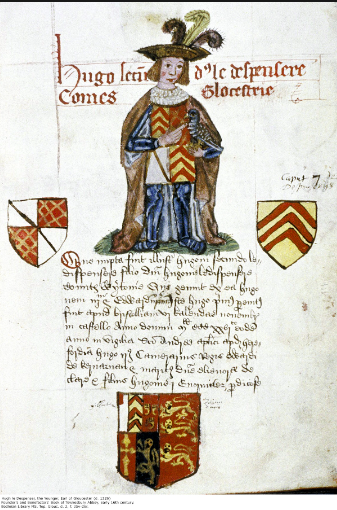
Things had changed drastically since 1321, when Isabel’s family, the Despensers, had been riding very high in royal circles, two of them—father and son—having been favourites of Edward II. Isabel was the daughter of Hugh Despenser the Younger. Back then the earl’s father Edmund Fitzalan, 2nd Earl of Arundel – Search (bing.com) had seen the match as an excellent and advantageous move. Then, after the marriage and the 2nd Earl’s demise, the Despensers and Edward II fell from power, and suddenly a Despenser wife was more an encumbrance than a prize.
Richard became twitchy about being married to someone whose very name was a stigma. Did he really want his line continuing with Despenser blood? How much nicer if it were something more impressive. Something really cool and royal, perchance. And then his ambitious eye fell upon Eleanor de Bohun, whose royal connections were a carrot second to none. She was the fifth daughter of Henry, 3rd Earl of Lancaster, grandson of Henry III through that king’s son Edmund Crouchback (1st Earl),
So, when Richard Fitzalan looked at the fragrant Eleanor he saw the royal-blue blood coursing through her dainty veins. Well, maybe she was very attractive too, perhaps more attractive than his wife. The pair seem to have taken to each other like the proverbial ducks to water. They became lovers, so one has to suppose that Richard was smitten….although I still can’t help suspecting the greatest lure was probably her royal connection. If it weren’t for that, would he still have gone to the lengths he soon did to be rid of his wife and son in order to marry the new royal darling?
But said darling was also, rather awkwardly, Isabel de Despenser’s cousin, which was something about which—when the time came, of course—the Church would be tricky. Consanguinity and all that. Best leave the Holy Father in ignorance, eh? Yes, excellent idea.
More irritatingly, she too was married. Her husband was John de Beaumont, 2nd Baron Beaumont, and she’d borne him a son when she was one of Queen Philippa of Hainault’s ladies. Then, in 1342, John de Beaumont died conveniently in a tournament and left Eleanor tantalisingly free to remarry. Free, and already proven to be fertile because she had a healthy son! Oh, she was prime material for Richard Fitzalan’s ambitions. But, of course, let it not be forgotten that Richard was prime material for her ambitions too. He was very rich. Disgustingly, outrageously rich, in fact.
Unfortunately for him, of course, although she was now free, he was still lumbered with Isabel Despenser. Hence all the negotiations with the Pope, from whom Eleanor’s identity and close relationship to Isabel was withheld. Richard must have coughed up one heck of a lot of money for the Holy Father to proceed on so little information as a vague name. Someone called Beaumont? Oh yes, that’s fine. The Pope probably learned the truth later, when they were married and nothing could be done about it. But his palm had been very well greased.

Now, at this point I have to raise the matter of Eleanor’s character and morality, because it’s surefire certain that Richard Fitzalan didn’t do it all by himself. She’d had an affair with this married man and was his mistress while initially still married herself (which is bad enough) but then she stood by and watched the cruel destruction of Isabel Despenser and Edmund’s consequent bastardisation. Eleanor then willingly, possibly eagerly, married the man who was capable of such acts, so she was no better than him. She was a widow and didn’t have to remarry. She chose to live in sin with Richard Fitzalan and then take marriage vows with him. It doesn’t matter that Clement VI issued all the necessary documents in 1344 (on today’s date, 4 December), morally at least that second marriage was wrong. Bigamous even. Can you imagine the tongue-clacking at the English court? Yes, so can I.
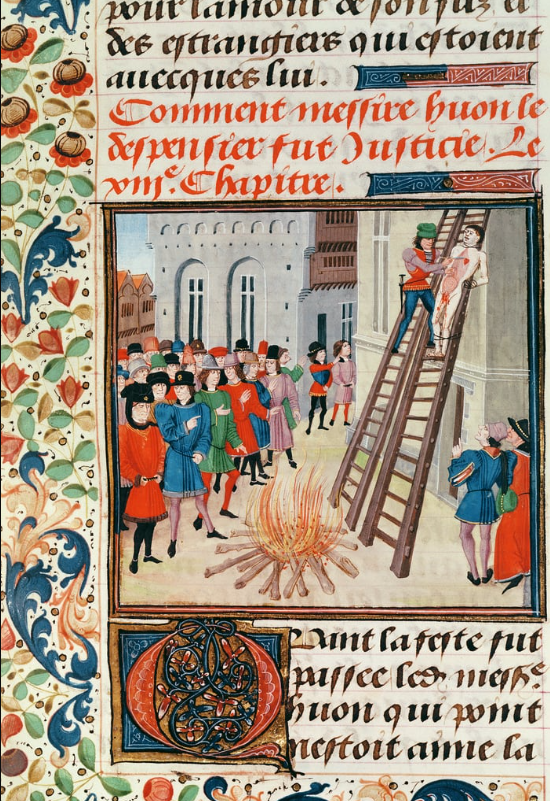
Now, was any of this the fault of the unfortunate Isabel? No. She too had been underage at the time she married Richard Fitzalan; she too had accepted the marriage and when of a suitable age she’d borne a strong, healthy son. She too had witnessed the downfall of the Despensers and the terrible death suffered by her father. From then on she was tainted by the odium attached to the name Despenser. On top of all that now she had to endure her cruel husband’s cold shoulder and then his complete rejection.
Of course, we have no way of knowing how she really felt about Richard Fitzalan. Did she love him at any point? Or simply tolerate him because she had to? Even if they loathed the sight of each other, which if so I could understand more his fierce desire to be rid of her, but not to do so at the expense of casting off his son and heir too. Unless, of course that son and heir, Sir Edmund de Arundel, loathed him as well and always took his mother’s side. But countless fathers and sons have a poor relationship, so what’s new?
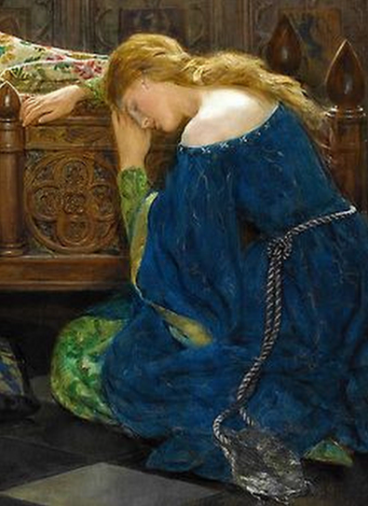
By the time Richard repudiated Isabel there must have been years of his growing contempt for her Despenser blood. He doesn’t seem to be to be the sort of man who’d bother to hide it. She was in his control and he treated her as he pleased. Was he a control freak? It would certainly go with the territory. Her emotion on losing him was probably twofold: certainly her own virtual destitution, but mostly for her disinherited son. For Edmund she would spend many hours of unhappiness, as in the (admittedly romanticised) Pre-Raphaelite painting below. But hey, I’m on her side and want to drum up support!
In my opinion Richard Fitzalan, 3rd/10th Earl of Arundel, was an unpleasant, scheming, conscienceless man who’d do whatever he thought necessary to get what he wanted. What a charmer. Trampling over others didn’t matter, even when it was his own wife and son. What he wanted now was a dazzling royal wife to bump up the prestige of the Fitzalans (and to make his bed more interesting in the process) not a pesky Despenser whose background had become anathema to him.
In The Fitzalans, p 42, Burtscher says “….on 12 March 1345 in the presence of Edward III and Queen Philippa, Arundel and Eleanor, the daughter of Earl Henry of Lancaster, contracted marriage clandestinely, that is to say, without a public reading of the banns, in the Royal Chapel at Dutton in Surrey….A further dispensation to marry Eleanor was granted in July 1345….” The ceremony may have been in early February. Hmm, it’s all very dubious. But whichever date, and by whatever means, Richard Fitzalan and Eleanor of Lancaster were now “married”. They were to have three sons and three surviving daughters. How nice for them.
I have to remind you here again that Eleanor had been party to it all. You can see much more about the scandal here.
In the meantime, what had happened to the earl’s discarded family? Isabel retired to some manors in Essex that her former husband had graciously deigned to give her, and she died in 1374 or 1375, which was well after he’d married Eleanor. But what happened to the now illegitimate son who until 4 December 1344 had every legal and blood expectation of one day becoming the Earl of Arundel? Sir Edmund Fitzalan…um, sorry, the bastard Sir Edmund Arundel….was determined to have what he knew was rightfully his. Good for him. He and Isabel had been shafted, as the delightful modern phrase goes.
As a child he’d been married (at the behest of the same dear Daddy who now claimed such marriages were abhorrent!) to Sybil, the daughter of William Montacute, 1st Earl of Salisbury. They now had daughters, so he wasn’t fighting for just himself, but for his own children’s future. He was knighted in 1352, followed a military career, and continued to protest vigorously against his illegitimacy, but was always squashed like an insect by Fitzalan money and influence.
Then, in 1376, Daddy “Copped Hat” died and was lain to rest in Lewes, beside his second countess. The Fitzalan inheritance went immediately to Edmund’s eldest half-brother, Richard Fitzalan, 4th/11th Earl of Arundel Richard, Earl of Arundel, for whom I have to confess a sneaking liking. He was, as I’ve said before, a WYSIWYG man, gruff and forthright. It’s just a shame that he shouldn’t have been Earl of Arundel at all. Well, in my opinion, at least.
Anyway, when my WYSIWYG man inherited the earldom, Edmund leapt into furious action to dispute his half-brother’s right to anything at all. From then on he was a very sharp and persistent thorn in the Fitzalan side. But his efforts kept foundering because he didn’t have the money or power to succeed. He also tried to regain six manors that had been unquestionably the property of his mother Isabel. (Were they the manors in Essex the late earl had given to her so very sweetly?) But all six remained in the grasping hands of the Fitzalans. How come? The late earl had abjured the Despenser marriage and paid the Pope to expunge its very existence, but now it suited Fitzalan claws to sink into and hang on to Isabel’s property.
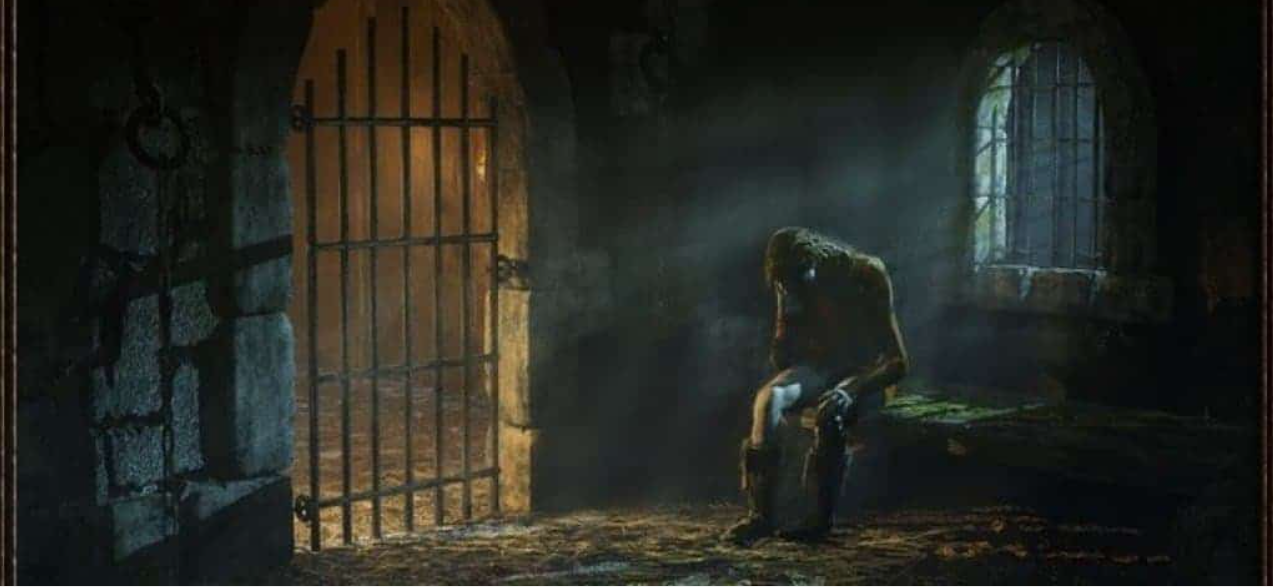
Poor Edmund created such a lot of mayhem and clamour that in 1377 he was imprisoned in the Tower. He was eventually released on the intervention of the prominent Montacute relatives of his wife Sybil. He died at the end of 1381 or beginning of 1382, at the age of around fifty-three, leaving three daughters who tried for a while to pursue his rightful claim to the Fitzalan inheritance. Edmund had striven his utmost to achieve justice, in the process causing no end of irritation for the Fitzalans, but he was finally denied all claim to his birthright. He was even omitted from his father’s will. In fact, the atrocious “Copped Hat” went to considerable lengths to keep Edmund out of everything.
To read a very detailed account of Edmund’s case against his father, read pages 42-48 of Michael Burtscher’s The Fitzalans.
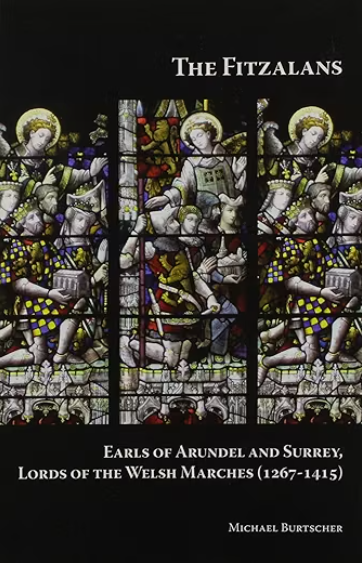
My sympathies lie entirely with Isabel and Edmund, whom I only wish had succeeded in the struggle. In my opinion “Copped Hat” and Eleanor of Lancaster weren’t spouses at all, because his true wife, Isabel le Despenser didn’t die until the year before him, long after he and Eleanor were hitched in 1345. I don’t care if the Pope issued this, that and the other, his Holy fingers must have been crossed behind his back and he should have known that there was something iffy about the mystery woman the earl was clamouring to have. But money talks.
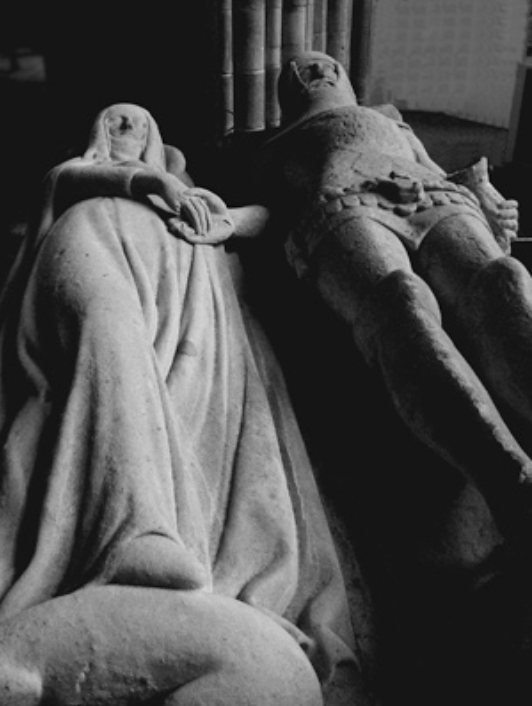
One thing is crystal clear to me. The 3rd/10th Earl of Arundel and his second “wife” should never have received the Church’s blessing.


 The New Murrey and Blue blog
Leave a comment