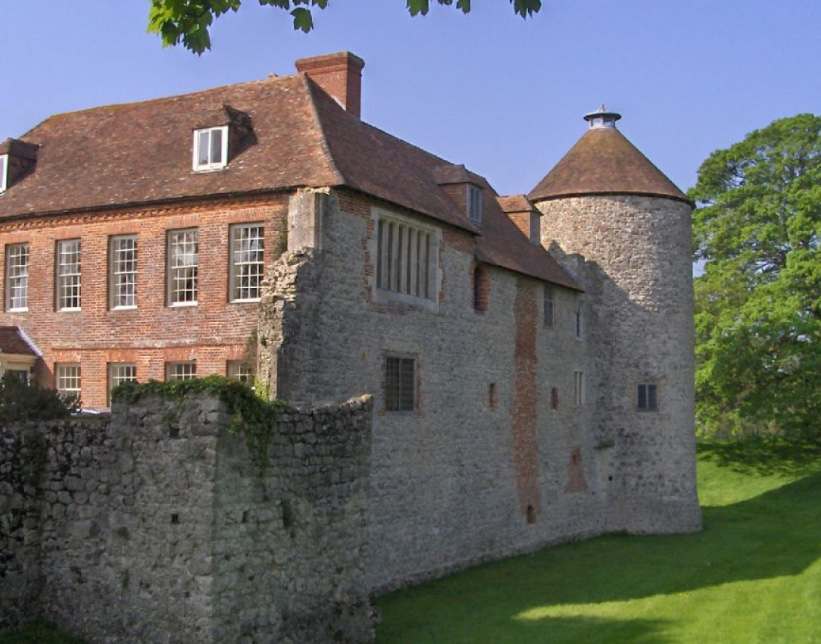
Now the venue for weddings, Westenhanger Castle in Kent was once visited—and owned—by Henry VIII and Elizabeth I. The latter was an honour, the former was not. In my opinion anyway.
The Great Storm of 1987 did untold damage across the country. Don’t we all remember it? It certainly made no exception of Westenhanger, especially the Tudor barn. Fortunately in 2002 new owners, the Forge family, decided to restore what they could of everything and were helped by a grant from English Heritage, which had put Westenhanger on its “at risk” register.
Apparently Henry VIII liked Westenhanger so much that he “persuaded” the then owner to exchange it for some land in Dorset. Then, according to this very informative 2010 link Westenhamger Castle and Great Barn – a restoration project | Great British Life: “….Henry spent a large sum of money ‘making it fit for a royal residence’, putting in new garderobes, and improving the kitchens by building three great hearths for roasting meat. Remains of the hearths have recently been uncovered and replica kitchens are being built using the original foundations….The king also built accommodation specifically for his entourage….”
Because of all this, Westenhanger (which apparently started life as the Anglo-Saxon pad of a son of Hengist) ended up as “a 125-room [Tudor] palace”!
Back in the middle of the 14th century (18 August 1343) Sir John Kirriel [Kyrells, Kirriel, Kyriell, Criol, various other spellings] obtained a licence to crenellate the then manor house and thus fortify it at a time when the Hundred Years War had commenced and defences on the coast of Kent were particularly important. That was 681 years ago today, and poor Sir John can have had no inkling of what would happen there after his demise.
By the middle of the 17th century Westenhanger was the second largest house in Kent, and in 1691 it was damaged by an earthquake.
In the Wars of the Roses the Kirriels supported House of York, and at this site Westhanger House and Castle , near Hythe Kent | Artware Fine Art you will read the fate of the last surviving male member of the family: “….The castle stayed in the [Kirriel] family until the Wars of the Roses when Sir Thomas de Criol was beheaded the day after the Second Battle of St Albans by order of Queen Margaret of Anjou. Sir Thomas de Criol had no sons, and Westenhanger came to his son-in-law, Sir John Fogge. The manor house at the time contained 126 rooms….” [125 or 126….well, what’s one room between friends?]
Sir Thomas was one of the two honourable but unfortunate Yorkist knights left to guard Henry VI and see he remained safe. For their pains they were put to death on the orders of Margaret of Anjou….apparently because that was the wish of her unpleasantly bloodthirsty seven-year-old son, Edward, Prince of Wales. (see (https://en.wikipedia.org/wiki/Edward_of_Westminster,_Prince_of_Wales) Edward’s death in 1471 at the Battle of Tewkesbury was probably a huge stroke of luck for England! Phew. Just contemplate the sort of king he’d have been.
The incident after the 2nd Battle of St Albans put me in mind of the chess game in Lewis Carroll’s Alice in Wonderland. “Off with his head!” the queen shrieks at frequent intervals. Imagine my surprise on learning that “….this phrase can be found as far back as 1591 in Henry VI Part III, spoken by Queen Margaret….” Oh, how very fitting.
But it was something that had happened much earlier, in the late 14th century, after the death of the Sir John Kirriel who’d obtained the licence to crenellate, that first brought Westenhanger to my attention. I came upon it in Terry Jones’s The Medieval Python, in the chapter “Needy Knights and Wealthy Widows”. The story concerned Sir John’s widow, Dame Lettice, who found herself and the castle under attack not from the French but from one Sir John Cornewall. He was an impoverished old soldier who was intent upon abducting her into a forced marriage that would set him up nicely, hopefully for the rest of his life. He came back to harass her more than once, resorting to all manner of rough treatment, theft and threats, but Lettice (no spring chicken!) was made of sterner stuff than he’d banked upon. In 1381 she took him to court.
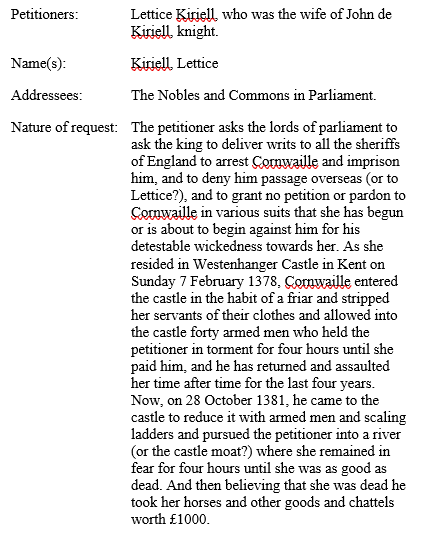
The above extract lists his offences, and is taken from Petitioners: Lettice Kiriell, who was the wife of John de Kiriell, knight. … | The National Archives. You can read extra details of the incidents in the Great British Life link in the third paragraph of this article. In the end Cornewall had to give up. But he was pardoned and even let off a large debt to the Black Prince. A nice spoonful of sugar to help the nasty medicine go down. Incidentally, Cornewall’s son and heir, another Sir John Cornewall, became the second husband of Elizabeth of Lancaster, so he at least did well out of marriage.
At least Lettice had the satisfaction of being left alone after that, but the whole incident shows what the 14th century was often like for women. For old soldiers who squandered their income during campaign and generally lived beyond their means, all problems were solved by the acquisition by any means necessary of a wealthy widow. These men got away with such crimes because Edward III and the Black Prince were always on the side of the military men who’d risked their lives for king and country. To hell with the women’s point of view. I do like to wonder what these men would think if the shoes were on the other foot, so to speak. What if marauding women went around abducting men and forcing them into the marriage bed, and got away with it? An interesting scenario.
Seeing the peaceful Westenhanger of today makes it hard to imagine Sir John Cornewall and his mercenary gang scaling the walls on ladders and causing unsuccessful mayhem within as he tried to abduct plucky Lettice.
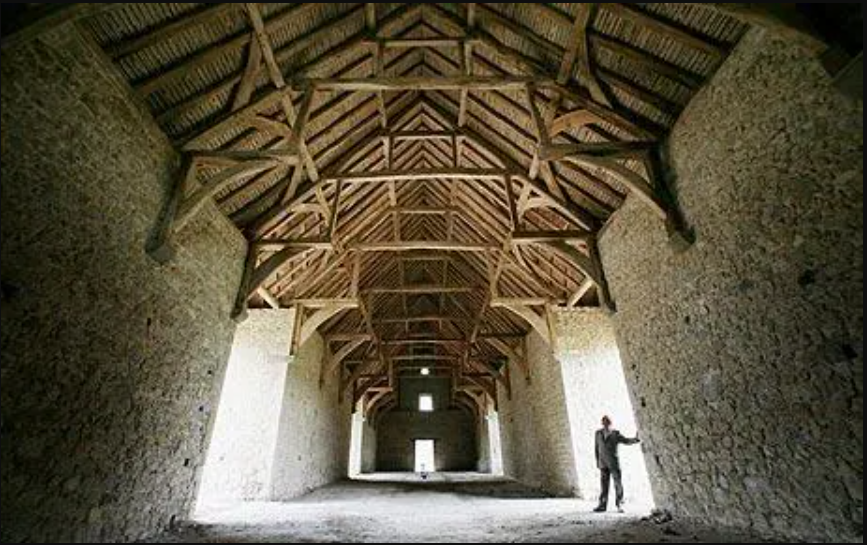
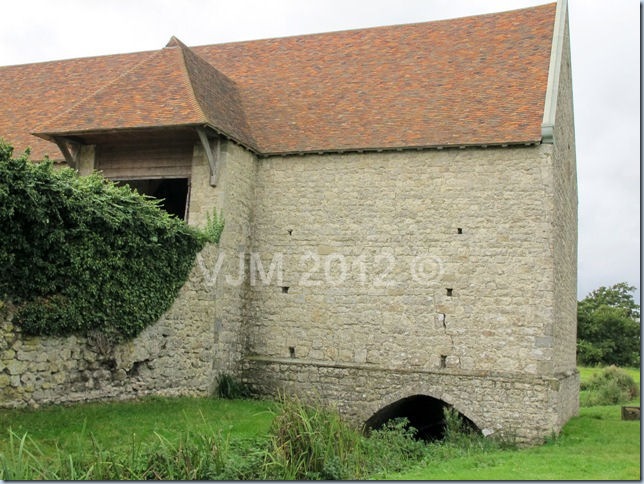
The Elizabethan barn at Westenhanger, with its magnificent hammerbeam roof, is famous because it is a particularly splendid example of quality Tudor building. It is also interesting because the East Stour river flows beneath one end of it. The end in question projects just beyond the castle’s curtain wall and spans the river, see below. So I guess water was never in short supply back in the day. I have no idea what the East Stour was like back then, but today it seems little more than a weed-choked stream. It is also formed from a web of channels, tributary streams and drains that flow through the flood plain.
You can read about Westenhanger and its sister manor of Ostenhanger here The mystery of the vanished manor of Ostenhanger…. – murreyandblue. And the general history of Westenhanger here https://www.british-history.ac.uk/survey-kent/vol8/pp63-78 and here http://www.gatehouse-gazetteer.info/English%20sites/1677.html .
For the abduction of women in general try here Women were abducted in medieval England…. – murreyandblue.


 The New Murrey and Blue blog
Leave a comment