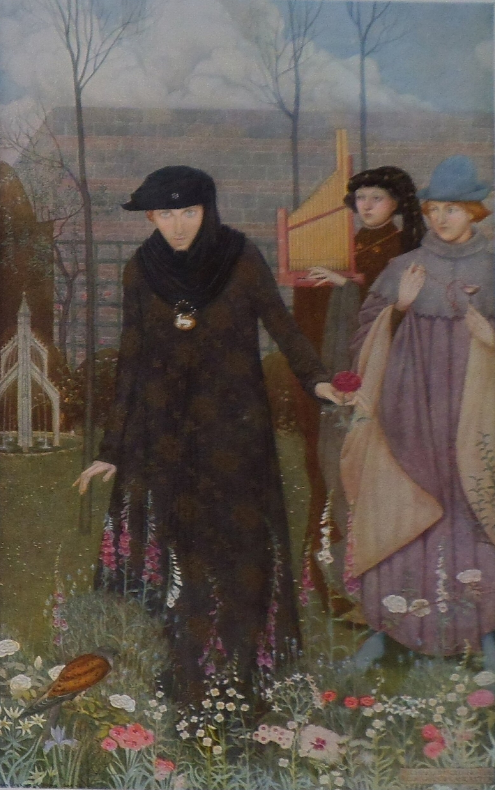
Just when you think you know all the portraits of a particular medieval king, another turns up that proves you wrong. The above painting of Richard II (see here https://en.wikipedia.org/wiki/Richard_II_of_England) is new to me, and I find it fascinating.
Apparently it’s by the British artist Norman Wilkinson, about whom you can read here https://en.wikipedia.org/wiki/Norman_Wilkinson_(artist). Prints of it were recently for sale on Etsy. Eight copies, all now gone. This is all I know of its provenance.
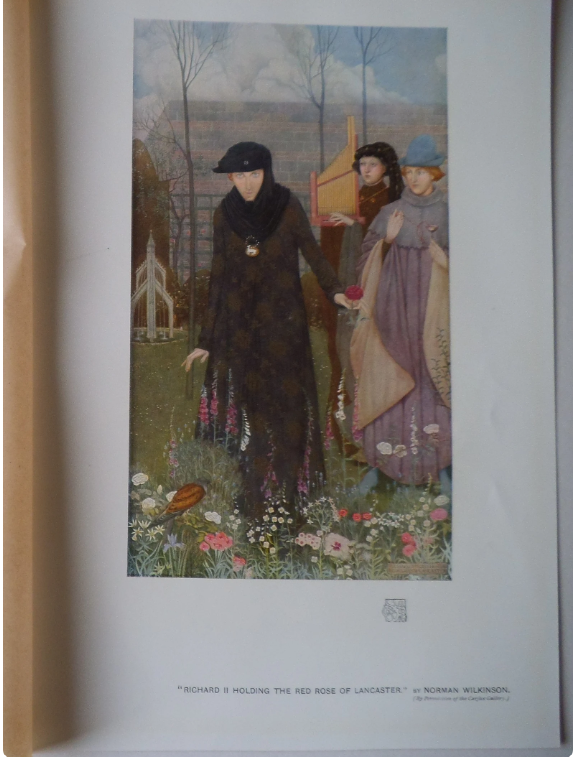
Now I have to judge for myself what the painting is about, so here goes. There Richard is, clad in black. He’s tense and a little hunched, like the personification of suspicion, and he holds the red rose of Lancaster. The black clothes show he’s in mourning and the red rose suggests it’s probably for his uncle John of Gaunt, Duke of Lancaster, who died February 1399, (see here https://www.englishmonarchs.co.uk/plantagenet_34.html). So the picture is set in the summer of that year (judging by the flowers), because early in 1400 Richard himself would be dead. But between the scene of the painting and Richard’s death, he was to make the great error of going to Ireland with his army.
Puzzlingly, the summer flowers are blooming luxuriantly, yet the trees in the background are leafless and there’s a wintry mistiness. The fountain seems to be on the brink between the seasons. Does this suggest that everything is beginning to die around Richard? Everything’s going wrong, slipping from his fingers? Or are they maybe a reference to his lack of children? Or are they just a nod to Gaunt’s death in February?
And again, the figures* in the scene are dressed for winter, surely? So are they actually in February 1399? Or are the figures and background simply indicating the onset of winter because Richard has bungled his reign? And what of the bird among the flowers? A hawk? Gaunt’s son and heir, Henry of Bolingbroke, watching and waiting for an opportunity to strike?
Richard alone stands actually among the flowers. Are they the largesse at his disposal? The ultimate prize, the crown itself? Or are they meant to convey that he is in some sort of personal fairy/cuckoo land and can’t see what’s happening around him? I’m no art expert, so this is guesswork.
But then, there’s another dimension to this scene because the matter of the succession was an ever-more-vital problem throughout Richard’s reign. He had been childless at the death of his first queen, Anne of Bohemia, (see here https://www.englishmonarchs.co.uk/plantagenet_61.html), and had remarried. But his second wife was a little girl, the French princess Isabella of Valois (see here https://en.wikipedia.org/wiki/Isabella_of_Valois). Why choose a child wife when he needed heirs? Why?
From the age of 10, when he came to the throne, the business of begetting heirs would have been impressed upon him. He knew that he’d be married asap and sure enough, when he was 14 Anne of Bohemia became his bride. She was 15. So by medieval standards they were of both an age to consummate their match. But the marriage was barren. We know it wasn’t celibate because Anne had lost babies she had never carried to term. So he was manly enough, in my opinion, just unlucky. Perhaps the fault was his, or perhaps Anne was simply incapable of bringing a healthy, full-term baby into the world. We will never know now.
Like his grandfather Edward III , Richard was a faithful husband. Edward III, fell by the wayside in his later years, but Richard was a young man, deeply in love with Anne, and when she died suddenly he was completely broken.
And now he’d been obliged to marry again, but it would be a good few years before little Isabella was old enough to be a true wife. So, if an accident or fatal illness were to befall Richard, who would succeed him?
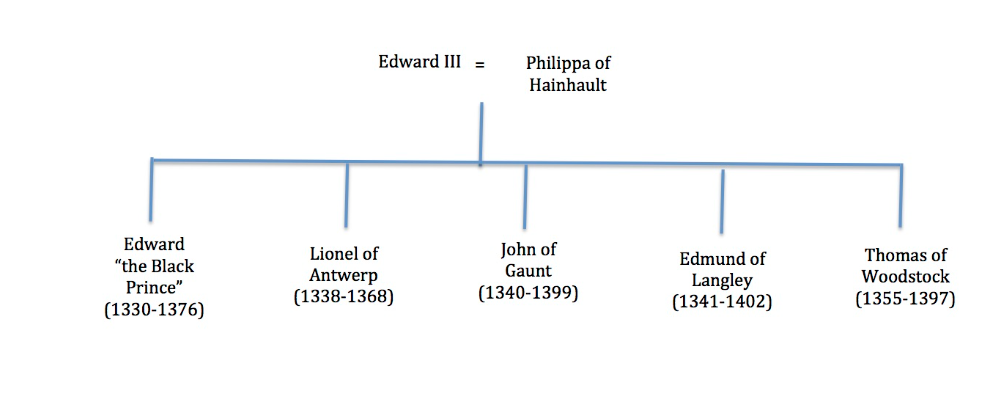
His eldest surviving uncle John of Gaunt (third of Edward III’s five sons, see the table above) wanted the succession to come to his family, the House of Lancaster. But (a) Richard didn’t much care for Gaunt’s eldest son, Henry of Bolingbroke, who had been sent into exile at the time of this portrait. Did anyone care for that Bolingbroke ratbag? Sorry, my loyalties are showing and I digress….and (b) there was a senior rival for this position
The other rival was Roger Mortimer, 4th Earl of March (see here https://mortimerhistorysociety.org.uk/the-mortimers/about-the-mortimers/the-4th-earl/), who was the grandson of the late Lionel of Clarence (see here https://www.englishmonarchs.co.uk/plantagenet_81.html). As you can see in the table, Lionel had been the second of Edward III’s five surviving sons. The eldest was Richard’s father, Edward of Woodstock, known to posterity as the Black Prince (see here https://www.historic-uk.com/HistoryUK/HistoryofEngland/Edward-The-Black-Prince/). Incidentally, the Black Prince was another faithful husband.
Lionel’s only child, Philippa, had married Edmund Mortimer, 3rd Earl of March, and Roger was their son. (Still with me?) But the Mortimers had a habit of dying fairly young, and Roger, 4th Earl of March, was to be no exception, although he left children of his own. They were too young to pursue a claim to the throne.
Nor had Gaunt been sitting quietly by because (as far as he was concerned) the Mortimer claim was through an inferior female line and that wouldn’t do for the crown of England. Oh, no. The House of Lancaster was of male descent and in Gaunt’s hypocritical** opinion, much more important and deserving. To this end Gaunt had worked on Edward III until the old man died, and was still pressing for what he wanted at his own death. Gaunt gave no thought at all for his two younger brothers, Edmund of Langley and Thomas of Woodstock. They weren’t important. Nor were those pesky Mortimers!
So this, I believe, is the background to the painting. No one really knows what Richard intended. There was a time when he was believed to have named Lionel’s grandson Roger Mortimer as his heir, but then Roger died suddenly in Ireland in July 1398. And to this day we haven’t a real clue if he had or hadn’t been Richard’s intended heir. Some firmly believe he was, but others point to the lack of proof.
By carrying the red rose while in mourning, was the king indicating his decision to favour the House of Lancaster? Meaning that his cousin, the loathed Henry of Bolingbroke, would ascend the throne if Richard died without an heir of his own? Or is the rose more an hint of how heavily the Lancastrian problem was weighing on the king’s mind?
Maybe Richard just playing games? He’d done that more than once, and the look in his blue eyes in the painting suggests to me he could be doing it again. On the other hand, is it a haunted look? A heartfelt wish that everything contentious would go away and leave him to rule as he wished?
Matters were to be taken out of his hands soon anyway, because in late 1399 Henry came back from exile with an army and overthrew Richard, who at this very critical time had rather foolishly been away in Ireland with his own army. Completely wrong-footed, Richard rushed back to England but was captured, kept in various prisons and eventually assassinated at Pontefract. By this time Henry had been crowned Henry IV (see here https://www.medievalists.net/2014/12/usurpation-henry-iv-quest-legitimacy-english-throne/).
After that the House of Lancaster occupied the throne until 1461 when the Yorkist Earl of March became Edward IV (see here https://en.wikipedia.org/wiki/Edward_IV). Edward IV represented the House of York (Edmund of Langley, the fourth brother) and Lionel of Clarence. Therefore he was doubly qualified to be king when he took the throne from the weak Lancastrian monarch Henry VI (Bolingbroke’s grandson). Edward IV was both Duke of York and Earl of March, with that all-important blood descent from Lionel through the Mortimers. This clinched his rightful claim to the crown.
If I’m reading the above painting correctly it’s about the situation that was to prompt the Wars of the Roses, lead to the death of Richard III at Bosworth….and the imposition upon England of the House of Tudor.
It’s a picture that tells quite a story.
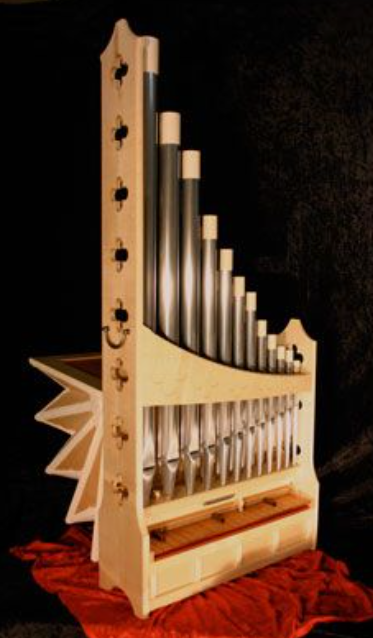
* I do not know what (musical?) instrument one of the figures is holding up, but it might be a version of a 14th century Italian florentine organetto. I wouldn’t swear to it though. Nor do I know if this has any cunning significance in the painting. As for what the figure in grey is holding, I have no idea at all
** In 14th century England there was a lot of royal hypocrisy floating around when it came to female lines. It wasn’t OK for the throne of England, but was fine when it came to Englishmen claiming foreign thrones. Hence, for example, Edward III laid claim to the throne of France through his French mother, and Gaunt himself went after the crown of Castile because he was married to the Infanta Constance (see here https://www.englishmonarchs.co.uk/plantagenet_93.html). How’s that for hypocrisy?


 The New Murrey and Blue blog

Leave a reply to A favourite painting of Richard II inspecting his new hammerbeam roof at Westminster Hall…. – The New Murrey and Blue blog Cancel reply