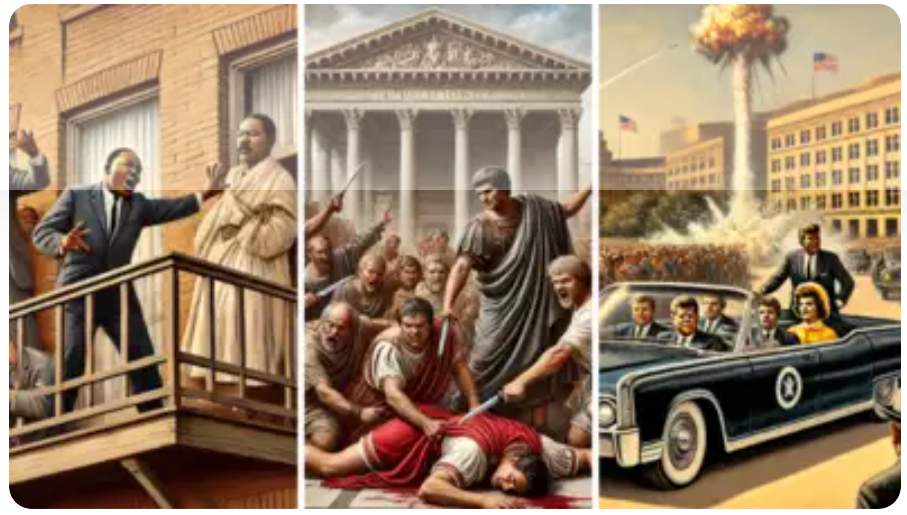
This post has nothing to do with present-day politics or the recent attempt of the life of a former US President. It’s about the word assassination, and whether or not it applies to two of our medieval monarchs. It was prompted by this link: US and World: Latest US and World News | Times of India (indiatimes.com)

Assassination isn’t usually applied when it comes to the deaths of my two favourite medieval kings, Richards II and III, yet that is exactly what happened to them both. Being starved to death, as happened to Richard II, was surely nothing less than slow assassination behind closed doors. And as for Richard III’s death at Bosworth, it certainly wasn’t an accepted part of battle, but downright stabbing in the back by turncoats. The Stanleys were supposed to be Richard’s supporters but went over to his opponent instead, deliberately despatching the true King of England in the process. Therefore, to me, they assassinated him.

The A-word rather puts it in context for me. It’s better than killed or murdered because I think it points a more definitive finger at the Big Cheese skulking behind the scenes, i.e. he who benefited most from the act. In this case two Big Cheeses, Henry IV and Henry VII. Both were Lancastrians who had no birthright to the crown, so they assassinated their way to it. And then applied medieval superglue to their miserable backsides to be sure of staying there!


Subscribe to my newsletter

  1. That sounds right to me viscountessw. Neither Henry’s had a right to the throne. All the talk about Tudswynfort being the son of prophecy is rubbish. Edward IV and Richard III were the sons of prophecy because they were descended from Llewellyn ap Iorwerth. Henry VII was born in Pembroke but I believe, if it was possible to test his DNA, he wouldn’t have a scrap of Welsh ancestry.

    Liked by 1 person

    1. Should be Henrys.

      Like

    2. If H7 is considered “God sent” I’d rather see that as a sign the God wants to punish England

      Liked by 1 person

  2. Okay, I’ll be Devil’s Advocate here. An assassination is defined as a sudden, unexpected, treacherous killing of an important person, usually an official. Death in battle is not considered in this category, because the victim has an opportunity to defend himself. That was what Richard (III) was doing when he was killed. Also the attempt was not secret; Henry Tudor was very open about his rebellion.

    Further, the death of the Princes in the Tower is called a murder by those who believe King Richard was guilty, not an assassination. They were minors, with no true power, even before Parliament had stripped them of their titles, Certainly afterward.

    Richard II, yes. Assassination by any standard.

    BTW, I have been looking up informati on more recent assassinations, including that of Archduke Franz Ferdinand. In 1913 he visited the King of England and the Duke of Portland. While hunting on the Duke’s land, one of the grooms who wss loading Franz F’s guns fell down, & the gun discharged, missing Franz by maybe a foot or so. If I t had not missed, would this have been an assassination (probably treated as such) or simply an accident (as it was?)

    I very much recommend Barbara Tuchman’s history of this period of time. I think the title is “Twelve Days in August,” but not sure. Amazing how close the real assassination of the Archduke in 1914 came to not happening – and scary.

    Liked by 1 person

    1. Well, I regard Richard III’s death at Bosworth as assassination because it WAS “a sudden, unexpected, treacherous killing of an important person”. It was brought about by secret planning by the Stanleys and their cronies, who were supposedly fighting FOR him, not stabbing him in the back. Hardly the same as a good old face-to-face clanging of weapons on the battlefield. And did Richard have an opportunity to defend himself under these circumstances? Not if he trusted them to be on his side. He wouldn’t think he HAD to defend himself against his own supporters! By the time he knew it was too late for him. So I stick with my interpretation of the situation.

      Liked by 1 person

      1. As you said in the 2nd sentence of the article, this has to do with the meaning of the word ‘assassination.’ I stick by Merriam-Webster’s interpretation. Can a suicide, or suicide attempt, be regarded as assassination? ‘Self-assassination,” maybe, which would not be secret or unexpected, and an inherent contradiction In terms.

        The list, it must be noted, was generated by Artificial Intelligence. The bot seems to have thrown in any death (including accidental) that could possibly be classified as violent, stress on the word ‘possibly.’

        Words do have meaning. Anyone who goes into battle takes a risk of being killed, either in battle or by execution. An execution, even if unjust, is a violent death, but, by definition, not an assassination.

        Like

  3. Beth Williams Avatar
    Beth Williams

    Viscountessw, I don’t think you are far off here; I cannot speak to Richard II, as that may well have been straight up murder by his cousin who literally lost his marbles over the ‘revolt of the earls’ including John the duke of Exeter who was Richard’s half brother! (something like 25, 26 men would be executed or hung; it was a grisly list).

    But I can add something to your suspicions about how Richard died. Earlier this year I began to seriously take notes on several YT channels devoted to medieval weaponry, they’re all popular channels that I’ve glanced at from time to time but failed completely to grasp: I am not a reenactor, I don’t have a forge, I don’t collect bollock daggers, couldn’t tell you why rondel daggers are usually single edge (or what that even means) or what pouncing does or what hollow ground is and what sword length has to do with arm length. I was listening to ancient Greek spoken by Martians. But I needed to know – I have been on a couple zoom lectures, one for Bosworth, another for Mortimer’s Cross, and felt that same irritation with myself – it was time to gear up! Well, did I ever. And the more I listened to these podcasts from Tod’s Workshop, Matt Easton, Zac Evans, Blood & Iron, Skallagrim, etc etc, the more it made sense of military academic writing like Michael Prestwich’s works (many do not write in ‘code’ so much as assume you have extensive background in using medieval weaponry or at least some clue about terminology!)

    and this is what I found – the techniques, strategies, mechanics of making blades, their lethal properties AS intended and how they are achieved by design led me to realize that what happened to Richard on that field was not intended to be traditional combat between men-at-war, it was assassination. The use and choice of weapons against him were chosen from desperation, death as quickly as possible, before any relief or support could come to his side – no grappling and parrying, no normal use of arms, just blunt force to unhorse him then wrench the helmet off and kill him – before anyone was at his side who was ON his side. No expectation to allow him to fight back. This was wolves surrounding their kill.

    once I learned 1) how various weapons were made and 2) how they were designed to be used based on their edges, and choice of weapon and 3) what was left to bear witness on his skeleton (especially the skull) it all gives lie to the term ‘battle.’

    quite soon afterwards, even under Henry, when artful ‘historians’ wrote it up, the glaring atrocity of not ‘battle’ but treasonous assassination had to be reworked to exonerate the likes of William Stanley’s Pazzi-like role by describing Richard ‘fighting manfully’ to obscure what was actually done to him. It was a cowardly ravening by Stanley and his thugs, not heroics. Any wonder that boy wonder Henry immediately created a 24/7 personal bodyguard to surround his every movement from the time the dust settled on the field?

    Your instincts are quite right Viscountessw, it was an assassination, just disguised as a ‘rash’ cavalry charge. And I have a bridge to sell you in New Jersey!

    Like

  4. Beth Williams Avatar
    Beth Williams

    Viscountessw, I don’t think you are far off here; I cannot speak to Richard II, as that may well have been straight up murder by his cousin who literally lost his marbles over the ‘revolt of the earls’ including John the duke of Exeter who was Richard’s half brother! (something like 25, 26 men would be executed or hung; it was a grisly list).

    But I can add something to your suspicions about how Richard died. Earlier this year I began to seriously take notes on several YT channels devoted to medieval weaponry, they’re all popular channels that I’ve glanced at from time to time but failed completely to grasp: I am not a reenactor, I don’t have a forge, I don’t collect bollock daggers, couldn’t tell you why rondel daggers are usually single edge (or what that even means) or what pouncing does or what hollow ground is and what sword length has to do with arm length. I was listening to ancient Greek spoken by Martians. But I needed to know – I have been on a couple zoom lectures, one for Bosworth, another for Mortimer’s Cross, and felt that same irritation with myself – it was time to gear up! Well, did I ever. And the more I listened to these podcasts from Tod’s Workshop, Matt Easton, Zac Evans, Blood & Iron, Skallagrim, etc etc, the more it made sense of military academic writing like Michael Prestwich’s works (many do not write in ‘code’ so much as assume you have extensive background in using medieval weaponry or at least some clue about terminology!)

    and this is what I found – the techniques, strategies, mechanics of making blades, their lethal properties AS intended and how they are achieved by design led me to realize that what happened to Richard on that field was not intended to be traditional combat between men-at-war, it was assassination. The use and choice of weapons against him were chosen from desperation, death as quickly as possible, before any relief or support could come to his side – no grappling and parrying, no normal use of arms, just blunt force to unhorse him then wrench the helmet off and kill him – before anyone was at his side who was ON his side. No expectation to allow him to fight back. This was wolves surrounding their kill.

    once I learned 1) how various weapons were made and 2) how they were designed to be used based on their edges, and choice of weapon and 3) what was left to bear witness on his skeleton (especially the skull) it all gives lie to the term ‘battle.’

    quite soon afterwards, even under Henry, when artful ‘historians’ wrote it up, the glaring atrocity of not ‘battle’ but treasonous assassination had to be reworked to exonerate the likes of William Stanley’s Pazzi-like role by describing Richard ‘fighting manfully’ to obscure what was actually done to him. It was a cowardly ravening by Stanley and his thugs, not heroics. Any wonder that boy wonder Henry immediately created a 24/7 personal bodyguard to surround his every movement from the time the dust settled on the field?

    Your instincts are quite right Viscountessw, it was an assassination, just disguised as a ‘rash’ cavalry charge. And I have a bridge to sell you in New Jersey!

    Like

Leave a reply to halfwit36 Cancel reply