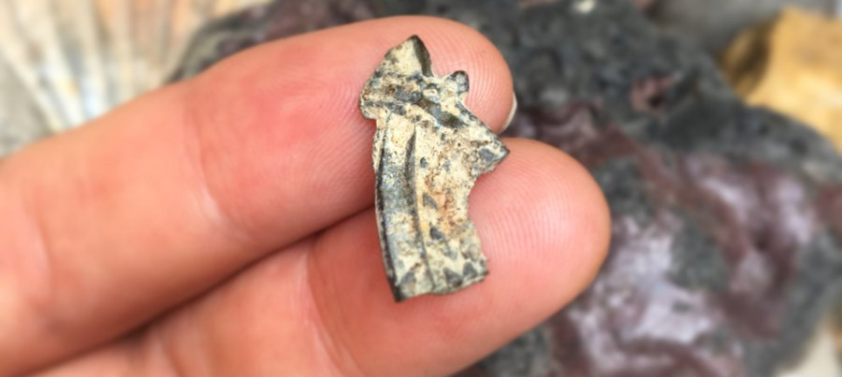
On 2 August 2019 I wrote this post—which contained the following link https://x.com/liz_lizanderson/status/1016611053394976768 concerning a portion of medieval livery badge thought to be that of Henry Holand, 3rd Duke of Exeter. The 3rd duke fought for Henry VI and died mysteriously at sea, it’s thought at the instruction of the very Yorkist Edward IV.
The above x.com link, from which the above image has been taken) contains the following:
“….Found this small piece of lead on the Thames Foreshore while mudlarking last week. Turns out to be part of a crowned wheat ear dating from 1471, made from pewter, the badge of Henry Holland, Duke of Exeter & supporter of Lancastrian Henry VI….”

The Holand (often spelled Holland) family’s rise to prominence began when one Thomas Holand seduced and married the (very young) royal lady known to posterity as Joan, the Fair Maid of Kent. She became Countess of Kent in her own right, and Thomas became the Earl. He rose to be a Knight of the Garter and was a fine, much admired soldier. He and Joan had two surviving sons, another Thomas (who eventually became 1st Duke of Kent) and John (who was to be the 1st Duke of Exeter). When their father died, Joan married Edward of Woodstock (known today as the Black Prince) and their son was to become Richard II. Thomas and John Holand were therefore his half-brothers.
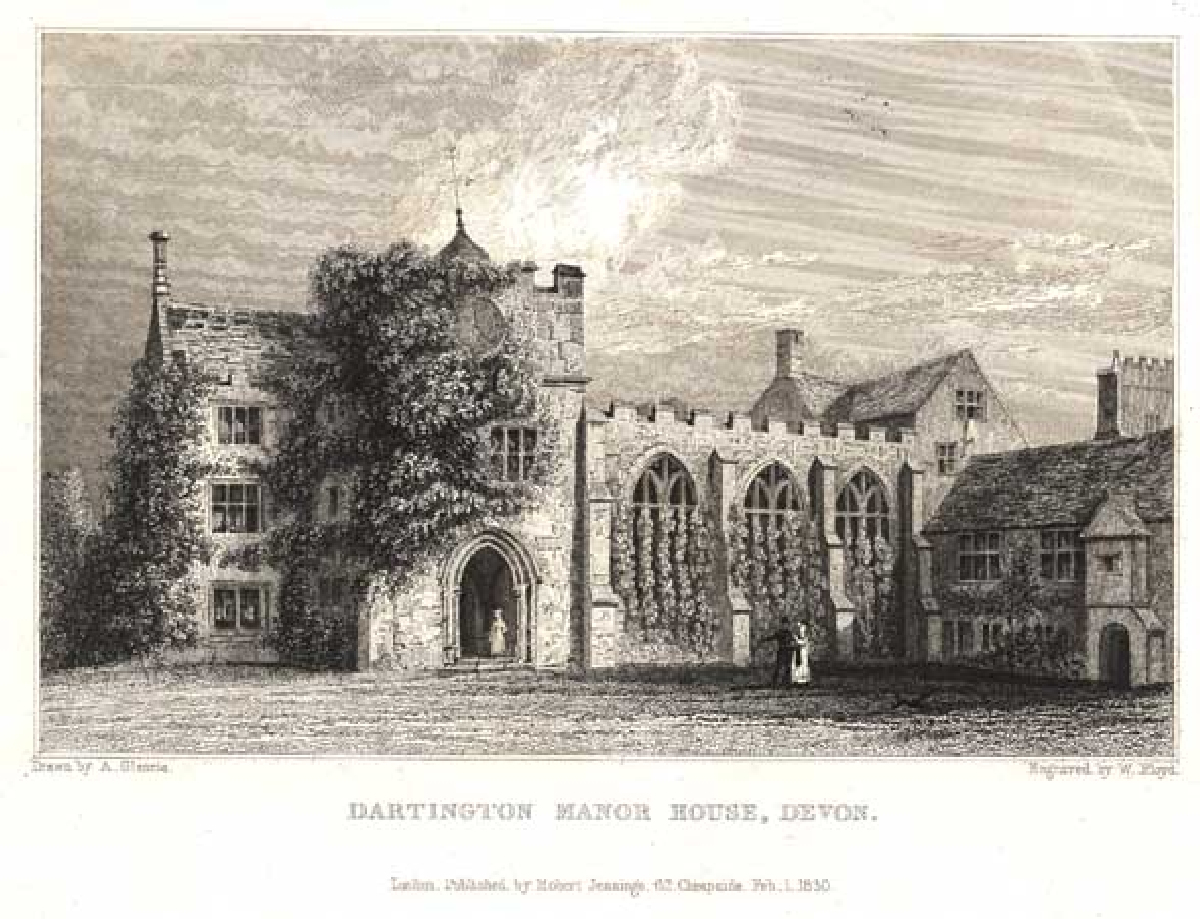
John’s favourite residence was to be Dartington Hall, near Totnes in Devon. He built it from a small, insignificant manor house that had been there before, and today it is both a college and a hotel. It’s also one of my favourite places, and I’ve stayed there a number of times. In the splendid medieval porch there is a ceiling boss that shows the white hart badge of Richard II, surrounded by roses. The roses have been painted red now, but it’s not known what colour they were originally. The same goes for the boss’s golden “trimmings”. The picture below doesn’t show it very clearly, but the golden projections (see on either side of the almost vertical lines at the top) are actually ears of wheat. It’s obvious when you’re in the porch looking up. They provide a very tangible link to John Holand because he had the porch built.
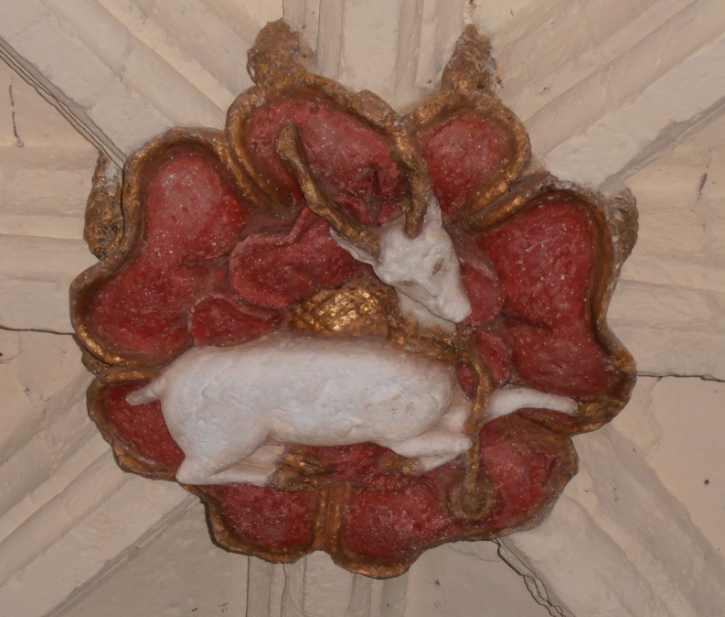
His wheatear badge is also mentioned on a number of occasions in the accounts of his possessions after his death. So there’s no doubt that he was known by this badge. As was his son, the 2nd Duke, another John Holand. His grandson, Henry Holand, the 3rd Duke, seems to have been as well. Now, whether or not the 1st Duke took it from someone else before him is something I do not know.
So the pewter badge found on the Thames foreshore could have been that of any one of the three Dukes of Exeter, not specifically Henry Holand. Unless, of course, there is something about it of which I know nothing and which pins it to him and only him. Maybe the crown? I only know of the 1st Duke using an ear of wheat, with no mention of a crown.
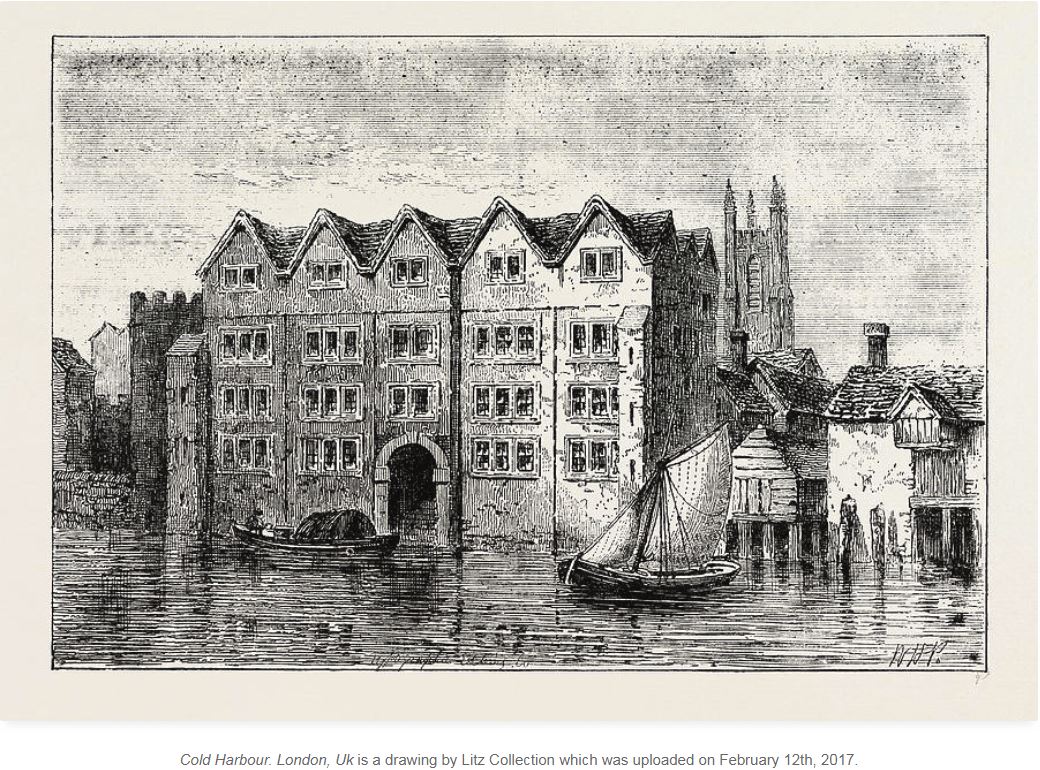
The Holand dukes resided at Coldharbour, of which readers of this blog will know a great deal. Famously, in 1397 John Holand held a grand banquet there for his half-brother Richard II, before they rode off with a force to Pleshey in Essex arrest Richard’s uncle, the troublesome Duke of Gloucester, who soon met a suspicious death in Calais.
The Thames of the medieval period was the great highway of London, and it was both easy and convenient to go by water wherever one wished to be, for example downstream to the Tower or upstream to Westminster. This must have been done countless times by all three dukes, but I know of one particular occasion when one of them took to the water, and it was to flee for his life.
John Holand, 1st Duke of Exeter, being the half brother of Richard II, supported that king throughout. When England was invaded by Henry Bolingbroke, Duke of Lancaster (who’d been exiled by Richard II), Richard was caught and arrested. The next move was to depose him and bundle him off to Pontefract as a prisoner so that Henry could have the crown for himself. He became the first Lancastrian usurper named Henry. And he overthrew a king called Richard. What a coincidence.

Richard’s friends and family soon plotted to reverse these events and put Richard back on the throne that was rightfully his. A rising was planned for Epiphany 1400, but at the last minute, before the plot was put in motion, they were betrayed by the deceitful son of Edmund of Langley, Duke of York. The rebels fled and most of them were caught and killed at Cirencester. But not John Holand, the 1st Duke of Exeter.
John had remained in London throughout the plan, it’s thought to be ready to take London in the name of Richard II when the rising began. But the rising didn’t begin because of the traitor in their midst, and perhaps that same traitor pointed a finger at John. Who knows, but one thing’s certain, John had to escape to save his life.
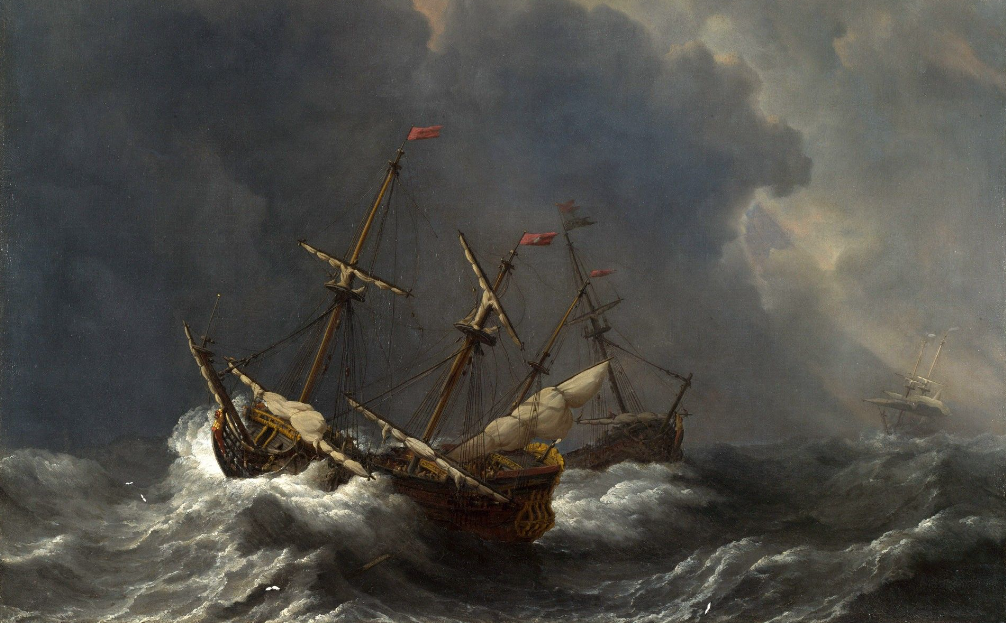
I’ve written of this flight before. It was a filthy, stormy night (see my post https://murreyandblue.org/2017/02/06/what-goes-around-come-around/) and he boarded one of the vessels waiting for him at Billingsgate (perhaps to fool his pursuers into thinking he was still at Coldharbour) and made off downstream, followed by a second vessel. But the night was so foul and the water so dangerous that it wasn’t long before on reaching the open estuary he was driven ashore in Essex. He tried several times to take to the sea again, but in vain. In the end he was caught and hauled off to Pleshey Castle, stronghold of the very Duke of Gloucester he’d helped Richard II to arrest (and eventually dispose of) in 1397. Revenge was the word, and John was summarily beheaded at the castle.
Now what if, in the furore of escape, one of John’s men lost his badge in the Thames? Maybe even tossed the badge overboard to hide his allegiance? Whatever, this flight downriver is a documented example of the 1st Duke trying to get the hell out of London, via the Thames, to save his neck. And as the wheatear was definitely his badge I see no reason why the one that has been found in the Thames should not be his as much as it could be his son’s or grandson’s.
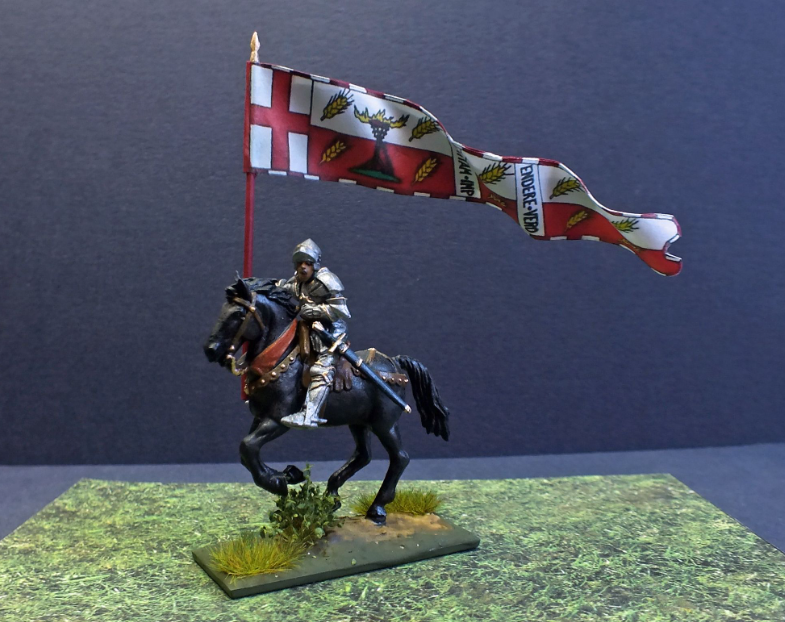
If the badge can definitively be linked to Henry Holand, I will retreat and say no more, but as a footnote I will add the image below. It shows a model of Henry Holand’s standard-bearer. The modelmaker is Robert (on Pinterest) and I know that immense care is always taken to be accurate with the heraldry. As you will see wheatears are shown clearly, and they do not have crowns. Just plain wheatears, such as his father and grandfather used. Dare I rest my case?
 The New Murrey and Blue blog
Leave a comment