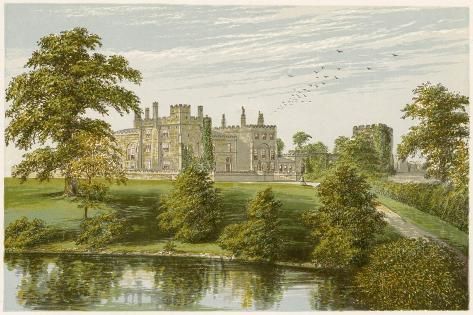
Ripley Castle in Yorkshire will be put up for sale later in the year for the first time in 700 years. If you can scrape up the money in your piggybank, the sale also includes the Boar’s Head pub and several village houses.
The castle has an interesting history. It became a possession of the Ingleby family (now spelt Ingilby) through marriage in the early 1300’s and developed from a manor house into an actual castle.
In 1457, the owner, Sir John Ingleby, did something extraordinary. He suddenly decided he wanted to become a monk. I am not quite sure how his wife, the heiress Margery Strangeways, felt about this momentous decision, but John left to join the Carthusians at North Allerton. The castle became the property of his son, William, who was only five. Margery, who was in the odd position of being declared a widow even though her husband was alive, continued to run the estate and see to the education of her son. She eventually remarried Richard Welles, 7th Baron Welles, but he was executed on the orders of Edward IV only about a year after the marriage. Margery may have then become a nun.
John Ingleby eventually became Prior of Sheen which put him in close contact with Edward IV, Richard III, and Henry VII. He was even the executor of Elizabeth Woodville’s will.
His son William married Katherine Stillington ( a relative of Robert Stillington, Bishop of Bath and Welles) at the young age of fifteen and they eventually had six children, three boys and three girls. In the 1480’s he became a retainer of Henry Percy and later received royal patronage from Richard III, who had summoned him for hearings in the north when William was only in his early twenties.
No one knows for sure if he fought at Bosworth, though it seems unlikely he would have been able to prepare and ride out within the short time given, since York only received King Richard’s request for aid a few days before the battle took place.
Later, in 1486, William, as one of Henry Percy’s men, was one of the knights called to meet Henry VII at a place called Robin Hood’s stone, probably a stone that once stood on the Great North Road. (England has many Robin Hood stones, wells, hills, trees.) William died in about 1501, aged around 46.

 The New Murrey and Blue blog
Leave a reply to Sheila “Spiral Sister” Murrey Cancel reply