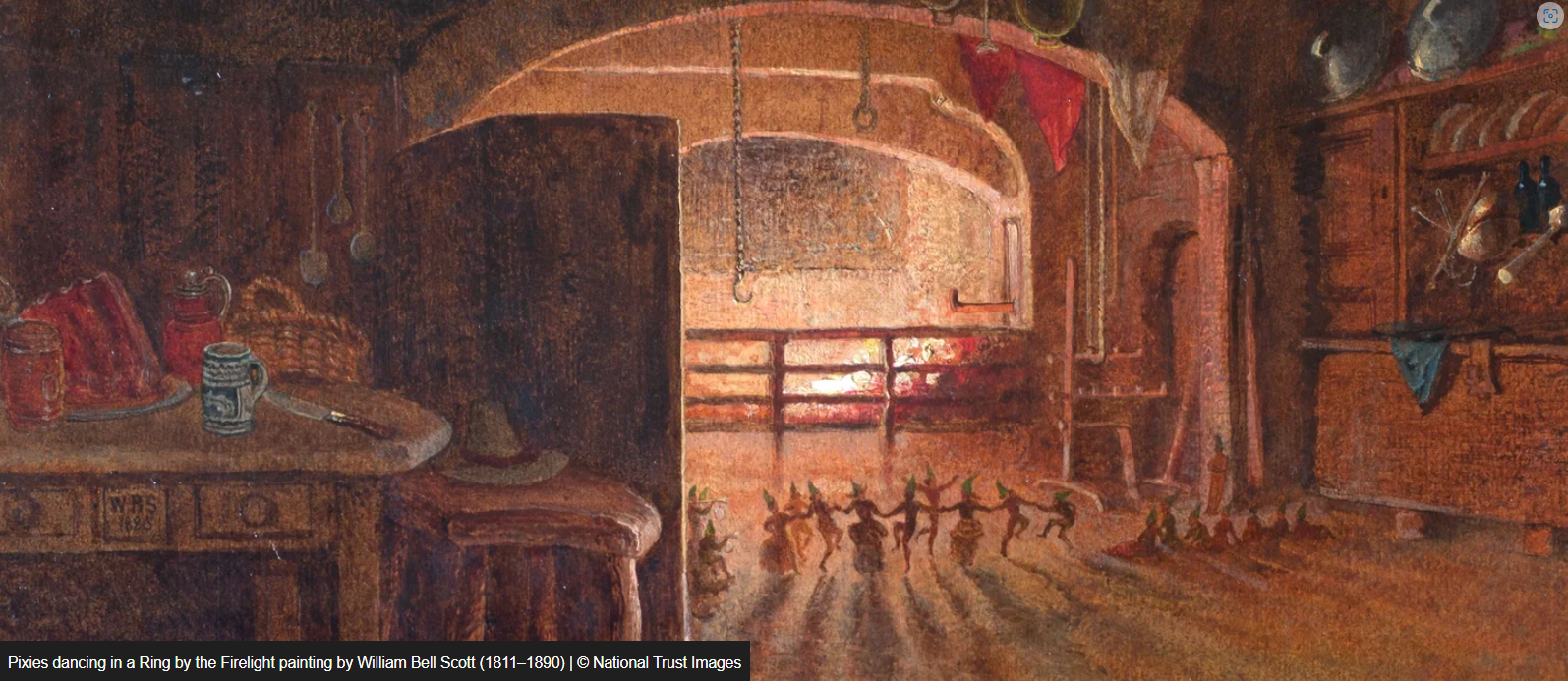
You might wonder what the above 1855 painting (from Gunby Hall, Lincolnshire) has to do with the summer solstice, but it’s taken from this National Trust article, which emphasises the magical aspect of this particular time of the year.
It also illustrates the sort of books I read as a child. Today’s adults underestimate their children, who are much more resilient and shiver-loving than they’re given credit. I devoured stories, and read some pretty gory fairy tales. Grimm is enough to make one’s hair stand on end, but nothing gave me nightmares. To this day I love the likes of M.R. James. I’m quite the little old ghoul. The one thing that did have me waking up screaming was a 1955 film called Lord of the Jungle about a rogue elephant. It terrified me back then, yet I’ve seen it since and can’t understand what exactly got to me. My parents stuck to taking me to westerns after that. Cowboys and Indians dropping like flies was OK by me….but one horrible elephant? Forget it. 😱
However, I wander from the point. The summer solstice has always been associated with superstitious goings-on, albeit dressed up as seasonal festivities. The sun governed everything and it was important to know and respect its cycle through the heavens. The aim of these old practices was to drive away witches and demons and ensure good harvests….as well as promote the fertility of humankind! Stone circles seem to be associated with the solstice, being created so that the sun shines in a particular way on the longest (or shortest) day of the year.

From pagan times it has been the tradition to roll flaming wheels down hillsides, light bonfires to dance around and generally indulge in activities that had nothing whatsoever to do with Christianity. The Church soon learned that as it was impossible to banish these shocking old celebrations, the best thing was to purloin it all for its own purposes. “….After the Christian Church was established, solstice celebrations were combined with St John’s Day, commemorating St John the Baptist. In the 19th century, Christians used St John’s Day to act out the baptisms of children who had died as ‘pagans’….” So spin is not a modern device to influence the people!
It was also the Church that brought about the awkward discrepancy between the summer solstice (20/21 June) and Midsummer Day (24 June). The heavens simply would not comply with the desired 365 days annual cycle. In the Julian calendar (named because it was created by Julius Caesar) there was always an irritating overlap of a few hours—then days. So in 1582 the Church replaced the Julian with the Gregorian calendar (named for Pope Gregory XIII), and eleven days simply went awol. Chucked away for this one year. They were non-days. But the result is that even today Midsummer Day is not the longest one of the year, which common sense tells us it ought to be.
To read much more about it all, try these links, where you will find a wealth of information: here, here ,here and here.


 The New Murrey and Blue blog
Leave a reply to Sheila “Spiral Sister” Murrey Cancel reply