
As you can read here—A Brief History of Pearls -Story of Pearls, Facts about Pearls (americanpearl.com)—pearls have found favour with mankind for a very long time, and rightly so, for they are truly beautiful. That sheen. That cool-yet-warm glow. That delicate shade of….of whichever pearl you happen to be admiring at the time. For they come in a variety of hues, not just the one we generally class as “pearl”. (See this link Understanding Different Types of Pearls | Diamond Buzz.) I’m writing about real pearls, not the cultured pearls that come in such wonderful colours today. Such things weren’t available way back when.
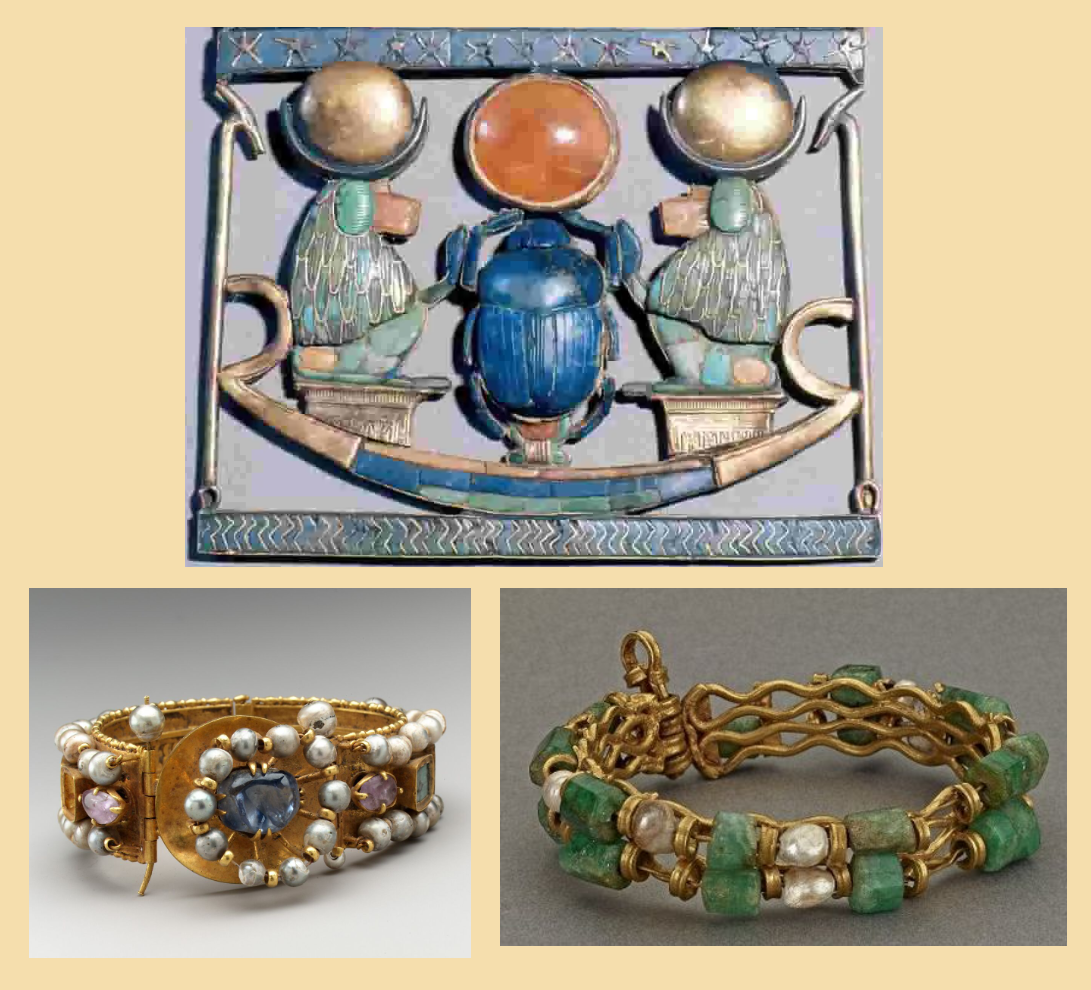
Bottom left: A bracelet with pearls, sapphires and chalcedony excavated in Upper Egypt, 500-700 AD. The Metropolitan Museum of Art, New York
Bottom right: Pearl and emerald Roman bracelet, 1-2 century. The British Museum.
Needless to say, the Chinese, Ancient Egyptians, Romans, Byzantines and many others were prizing pearls way before Europeans, but the magnificent crown pictured at the top of this article is an example of how they were used when they did arrive. It is the Imperial Crown of the Holy Roman Empire and can be seen at the Hofburg in Vienna. It dates from the second half of the 10th century, and the cross is an addition from the early 11th century. The arch dates from the reign of Emperor Conrad II (1024-1039) and the red velvet cap is a mere newcomer from the 18th century.
Below is the exquisite crown of Anne of Bohemia, consort of Richard II of England. Made circa 1370-80, its use of pearls is lavish. It is the oldest surviving Crown of England and is now in the Munich Treasury.

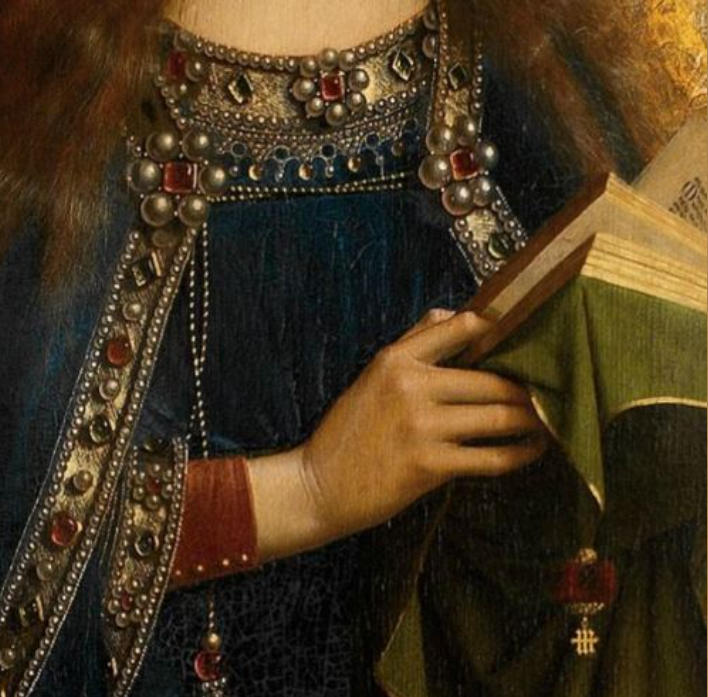
An example from the 15th century is the detail below from the Ghent altarpiece by Jan van Eyck of circa. 1432 Ghent Altarpiece:
And of course they were not only liked by women, as the famous hat brooch of Richard III bears witness.

Pearls were much loved in the Tudor period too, as can be seen by the painting below of Elizabeth I. Her pearls are the size of marbles!:

But it wasn’t only the dramatic pearls that were sought after, because seed pearls were favourites as well, as you can read here All About Antique Seed Pearl Jewellery And The Popularity Of Pearls In – The Vintage Compact Shop

According to this site—Seed Pearl – Antique Jewelry University (langantiques.com)—“….Seed pearls are very small; less than a one-quarter grain in weight, smaller than 2mm in size and off-round in shape. Historically they occurred naturally and were used as a decorative border, as tiny accents in small patterns, or in larger clusters woven together to make up an entire piece of jewelry. A nineteenth-century obsession with pearls is evident in the profusion of tiny seed pearls on every type of jewelry imaginable. Imported from India and China, seed pearls were strung on white horsehair or silk and sewn to mother-of-pearl templates to create elaborate designs….”
There is a very informative article about pearls at this link—Hidden Gems: The Use of Pearls Throughout History | Ancient Origins (ancient-origins.net)—and you can see a video about medieval jewellery in general at Bing Videos
Me? Various cultured pearls are mostly all I aspire to, although from my mother I inherited a dainty necklace of uneven pink pearls that she was told were genuine river pearls. If such pink things exist, I’m thrilled. If they don’t, please don’t tell me.
 The New Murrey and Blue blog
Leave a comment