
When we think of Edward of Woodstock (the “Black Prince”) I doubt if his sense of humour figures very much. He was definitely not known for curling up in laughter or playing pranks, so perhaps it will come as a surprise to find that humour did indeed figure in at least one aspect of his life.
In Goodman’s Joan, the Fair Maid of Kent, pages 74/75, there is a description of the improvements and rebuilding he instigated at his favourite manor of Kennington, just across the Thames from Westminster. The prince loved Kennington, and when he made his undoubtedly shocking marriage to Joan of Kent, a lady of dubious reputation (undeserved, I may add), it was to Kennington that he often took her to live.
When his father granted him Kennington the prince engaged the fashionable architect Henry Yevele to design extensive renovations and rebuilding, which included a great hall that was raised over a vaulted undercroft (probably used as a wine cellar). The hall was to have three chimneys and two spiral staircases at one end, while at the other end the porch had two buttresses and statues (called “images”) standing on “babewyns”.
Babewyns? Well, try as I might, I couldn’t image what this word could possible mean to our modern selves. Well, it seems they were “….a type of figure of fun also found in manuscript illustrations, often monkeys but sometimes other sorts of grotesque figure….”
As Goodman says, perhaps the prince wanted an amusingly decorated doorway to greet his guests and put them in the mood for jollity. And why not.
Today we are all acquainted with the quirky illustrations in manuscripts. They are often thought of as the idle doodlings of the illustrator. We still laugh at the hares in various silly guises, such as the one below, mounted on a greyhound, with a snail-hawk on his gauntleted paw.

Or this monkey playing a stringed instrument:
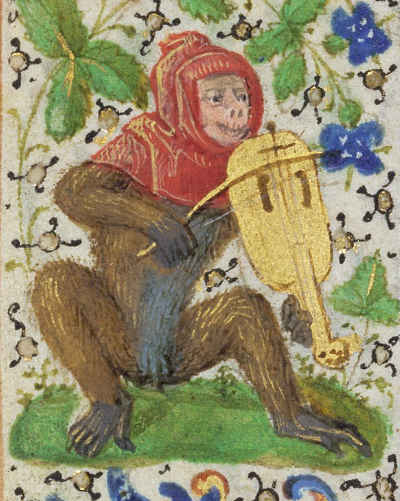
But is it a monkey? Or would medieval folk call it a baboon? Is that what “babewyn” means? Simply the medieval rendition of baboon? Well, lo and behold! I checked “baboon” in Merriam-Webster and found:
Baboon: Middle English babewin, baboin, from Middle French babouin, from baboue grimace; akin to Middle French babine thick lip, babiller to babble, probably of imitative origin like Middle English babelen to babble — more at babble First Known Use: 15th century (sense 1)
So there we have it. The monkey illustrations are baboons/babewyns, and according to Goodman maybe the same word was used overall for similar little figures.


 The New Murrey and Blue blog
Leave a reply to A 14th-century castle and moat unearthed beneath a French hotel…. – murreyandblue Cancel reply