Reblogged from A Medieval Potpourri @sparkypus.com
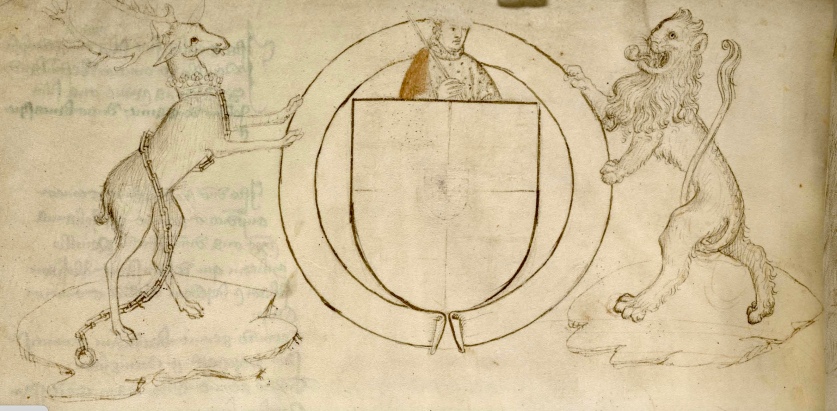
Richard duke of York. Wigmore Abbey Chronicle and Brut Chronicle. Special Collections Research Centre, University of Chicago Library.
As an ardent and unwavering follower of the ‘Coldridge Theory’ – see my earlier posts here and here – I was absolutely delighted to come across this article by historian Dr J L Laynesmith published on the Richard III Society Research blog. Dr Laynesmith has written several books on medieval queens and noblewoman including a wonderful biography on Cicely duchess of York. The article is regarding a medieval manuscript that has come to Dr Laynesmith’s notice which includes portraits of both Richard duke of York (b.1411-d.1460) and his wife Cicely Neville, duchess of York (b.1415-d.1495). Moreover these portraits appear to be attempts at genuine likenesses and not the usual generic offerings. What jumped out at me was the remarkable resemblance of the duke to his young grandson, Edward V – whose portrait can be seen in a window at Coldridge Church, Devon. The story – and theory – has been told elsewhere and remains, at this date, unproven although highly plausible. However perhaps one of the most frustrating arguments against the theory are those that dispute the portrait in Coldridge Church is that of the young Edward V despite its identification by medieval glass experts including Chris Brooks and Martin Cherry (1). For example members of one ‘Ricardian’ forum have insisted it is a Victorian portrait of Edward the Confessor despite the fact that he is usually portrayed as an elderly man. However the uncanny similarity between the portrait of Richard duke of York in the Wigmore manuscript and the portrait of Edward V in the Coldridge window is – I believe – yet another indication that the window is indeed that of the young Edward V and therefore adds strength to the theory – which I live in hope may one day be proven.
Lets look at the portraits again :
Unfortunately the top of the duke’s head is badly faded but he would have been wearing a ducal coronet. He carries a staff of office whereas the young king carries a sceptre. The duke is depicted as a mature man in which appears to be a ‘warts and all‘ likeness with its faint hint of a double chin. Of course the Coldridge portrait is of a young lad – but still bears a strong resemblance to his grandfather especially around the mouth and eyes. In fact when you look at it you can visualise the young man with the passing years gradually morphing into the older man portrayed in the manuscript. I just absolutely love it…
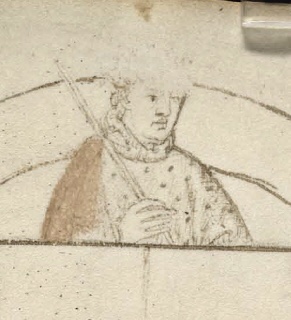
Richard duke of York. Wigmore Abbey Chronicle and Brut Chronicle. Special Collections Research Centre, University of Chicago Library.
 Edward V. St Matthew’s Church, Coldridge, Devon.
To gauge the skill of the artist who drew the portrait of Richard duke of York let’s take a look at the accompanying portrait of his wife, Cicely Neville. Here she is shown as a young woman, her long hair flowing. Compare this to the lovely portrait of Cicely as a maturer woman in the Luton Guild Register.
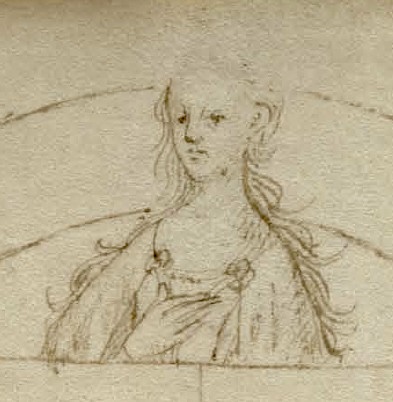
Cicely Neville from the Wigmore Abbey Chronicle and Brut Chronicle. Special Collections Research Centre, University of Chicago Library.
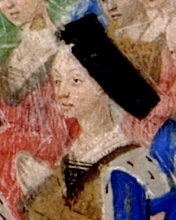 Cicely Neville, duchess of York from the frontispiece of the Luton Guild Register (folio 13 verso). Wardown Park Museum.
To continue reading cliick here.


 The New Murrey and Blue blog
Leave a comment