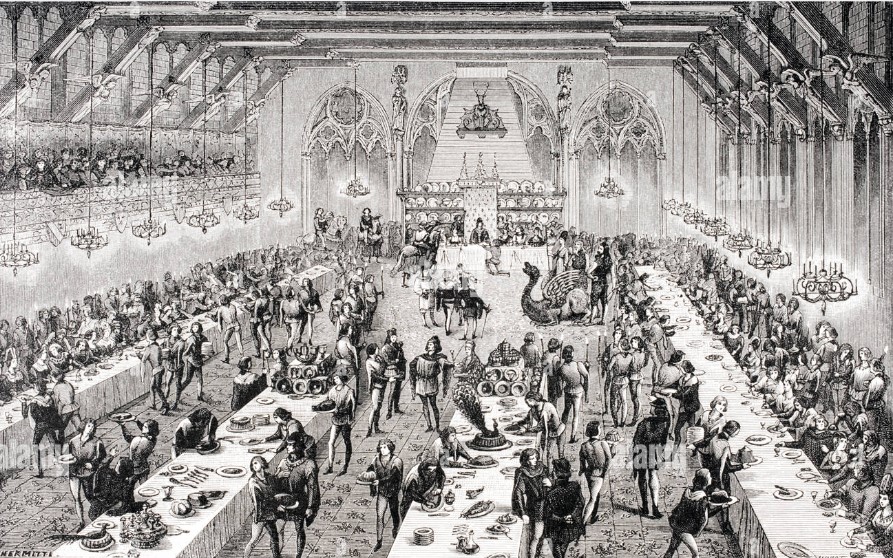
I love the little incidents that I come across in my research ramblings. While trying to find a particular 1377/8 date in Tuchman’s A Distant Mirror, I found myself reading about a banquet held in France by ‘a certain Vidame de Chartres’—a vidame being a noble rank, I understand.
This was quite some banquet, and I think its special effects would cause a great stir—some good, some not so good—among wealthy guests even today. I can imagine the account in Hello Magazine! Well, perhaps not, but you know what I mean.
This event’s date has eluded me, and all I know is that it was held during the life of Enguerrand de Coucy VII, Sire de Coucy, a very prominent French nobleman who was married to a daughter of King Edward III of England and was very welcome and popular this side of La Manche. Well, he was until he decided that his torn loyalties had to be repaired by adhering solely to France. This was the Hundred Years’ War, so he was off some English guest lists after that.
Tuchman describes the banquet thus: “…At a banquet held in Coucy’s time by a certain Vidame de Chartres, the ceiling painted like a sky opened to allow the dinner to descend on machines resembling clouds, which raised the dishes again when they had been emptied. An artificial storm lasting half an hour accompanied [the] dessert, dropping a rain of scented water and a hail of sweetmeats….”
Well the descending/ascending clouds were no doubt clapped and cheered, but half an hour of rain and sweetmeats might have strained the post-prandial atmosphere. Ladies, can you imagine sitting there in your finery, having spent hours to ensure your hair and headdress were just so….only to be drenched like a rat under a leaking gutter? Hmmm….
But these splendiferous effects and showpieces were very much the thing for those medieval grandees who could afford to show off to such a extent. Tuchman also describes the following after-banquet diversion:-
“….For the grand climax, all 800 guests moved to the Hall of Parliament, where the spectacle presented to them, representing the raking of Jerusalem by the First Crusade, was a triumph of stagecraft in which the 14th century excelled. Artificers at banquets, as described in Chaucer’s Franklin’s Tale, could bring bodies of water into the hall, make boats row up and down, grim lions appear, flowers spring from meadows, grapevines grow, and a castle seemingly made of stone vanish, or ‘thus is seemed to every manne’s sight’….”
There was another banquet at which live birds were released so that the hawks that every sensible nobleman worth his salt had on his wrist could be released to do what hawks do when they spy small birds. A little gory for my liking, but apparently it was a huge success. I’m glad that times have change since then. Well, mostly.


 The New Murrey and Blue blog
Leave a comment