Ladies and gentlemen, please remember that this novella is a fictional account of what might have happened to the boys known as the Princes in the Tower. The theory about Coldridge is not my original thought, nor have I done anything personally to help prove it. To my knowledge there is nowhere called Oakhanger in Kent, let alone that it was held by the Earl of Lincoln. I have invented it solely for the purposes of my story. Otherwise, everywhere and everyone in the story does/did exist.
THE BOY WHO HAD BEEN KING
by Sandra Heath Wilson (viscountessw)
The Queen’s hunting lodge, Havering, Essex – the end of November 1499
Clutching his new notebook, King Henry VII hurried toward the great hall, which should be empty of everyone except his queen. The notebook seldom left his side now, ever since his pet monkey, Robin, had ripped the previous one to shreds and thrown the bits in the nearest fire. Then the little pest had run off and hadn’t returned. The creature was lurking somewhere here at Havering, keeping well out of its master’s way. When his anger had subsided Henry regretted his angry reaction because he loved the little animal and wanted it to come back.
But it wasn’t the notebook or the monkey that preoccupied the king at this moment, for he was much more concerned with how to conduct the imminent meeting with his wife. His marital problems usually centred around his interfering mother, who wasn’t the easiest of women as even Henry himself conceded, but recently the arguments between husband and wife hadn’t concerned the King’s Lady Mother, but rather the executions of the Warbeck imposter and Edward, 17th Earl of Warwick.
At forty-two Henry Tudor wasn’t a visual delight at the best of times, and emotion could render him positively ugly. Yet he didn’t have to be so and he had a subtle sense of humour, although it had been conspicuously absent of late. His secretive nature and permanent sense of insecurity and persecution had twisted him into the haunted man he was now.
He was tall and thin, with receding shoulder-length reddish hair, high cheekbones and hooded eyes that made him seem very sly….which was not deceptive, for sly he was. There was an ever-spreading bald patch beneath his black leather hat and he knew that wearing an abundance of jewels and costly clothes made little difference to the air of impermanence that always enveloped both him and his reign. He’d been a fugitive in his younger days and had come to the throne through conquest of his predecessor, so it seemed to him that everyone saw only a fleeting shadow that would be swept aside when…. When what? An equally successful usurper happened along to sweep him away? He didn’t care to ponder the matter, except to know that it was bound to involve the cursed white rose.
Today he was glad to be without his usual gaggle of attendants—courtiers, advisers, physicians, scribes, priests and all the rest, who sometimes made it difficult to even breathe. He had to speak to Elizabeth, whose House he had dashed aside finally at Bosworth. Well, not finally, for there had been that business at Stoke Field, and now there were still pretenders trying to take the throne from him. Damn them all!
He scowled, hunching into his warm fur-trimmed purple robe as he glanced out of a narrow window. Outside it was still raining, as it had for the past month or more. A few miles south the Thames had burst its banks, and word had it there were floods across much of the realm. Oh, it was a truly dismal autumn.
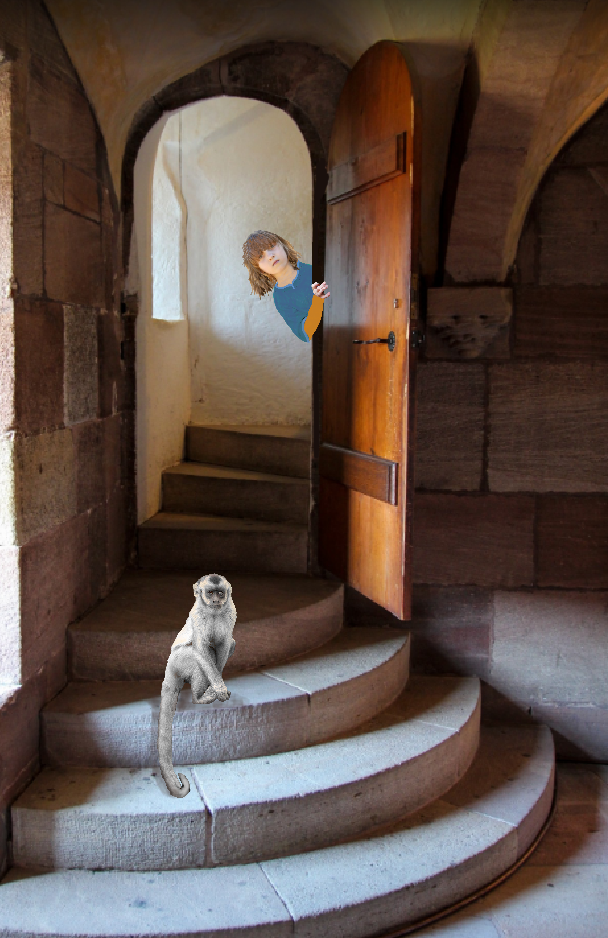
Then he was distracted by the sound of a child’s exuberant laughter, accompanied by some high-pitched monkey chattering from somewhere beyond the open doorway that was halfway up the stone staircase rising to his right. He halted immediately. Robin!
A small grey monkey bounded into sight and halted with a startled squawk on seeing him.
“Come here, Robin, you wretch!” Henry commanded, but his tone was hardly likely conducive to obedience, and the monkey didn’t move.
But the squawk had clearly been a warning, because the childish laughter stopped too and then a boy with long fair hair peered cautiously around the door jamb. Well dressed in blue velvet, he clearly couldn’t be a servant.
Henry frowned. “Who in God’s own name are you?” he demanded.
The boy scowled. “I hate you! You killed my brother and my cousin Warwick!” With that he simply vanished.
Robin bounded back up the staircase as well and silence fell. as if the entire incident had never happened.
But how could anyone simply disappear into thin air? Henry was shaken, not only because of the manner of the boy’s departure, but also because of what he’d said. How dared anyone, least of all an anonymous ill-behaved brat, speak thus to the King of England! As always, Henry’s sense of insecurity came rushing back. Was he going mad? Did he have a fever? Was this retribution for Warbeck and Warwick? Maybe even for Bosworth….?
But then he drew himself together. This was the boy’s fault! Whose offspring was he? Strong words would be had with his father, and a sound beating would be the least of the child’s problems! But….blue velvet? Who could he possibly be? In September the pretender Perkin Warbeck and the traitor Earl of Warwick had been executed for treason and conspiring against the Crown—but who alive could call them brother and cousin respectively?
For at least a minute Henry remained where he was, struggling for composure. He’d deal with the boy later. In the meantime he had to see Elizabeth. Please let his fiercely Yorkist wife be in an approachable mood, for he needed her cooperation. He had to make her see that one word from her would demolish Warbeck’s legacy of lies forever! Warwick was another matter….
**********
Havering was just over fifteen miles north-east of London as the crow flew, in what had once been the royal forest of Essex. The residence known as the queen’s royal hunting lodge stood on a ridge and was surrounded by a landscape of great trees, river meadows and ancient bridges. Its extensive lands reached the Thames, where the royal water meadows were often inundated as now. Exclusive and luxurious, the lodge had an impressive great hall and separate apartments for the king and queen. All in all, it was worthy of royalty, or it would be when the lavish refurbishment Henry planned was complete. It was also very convenient for Westminster and London.
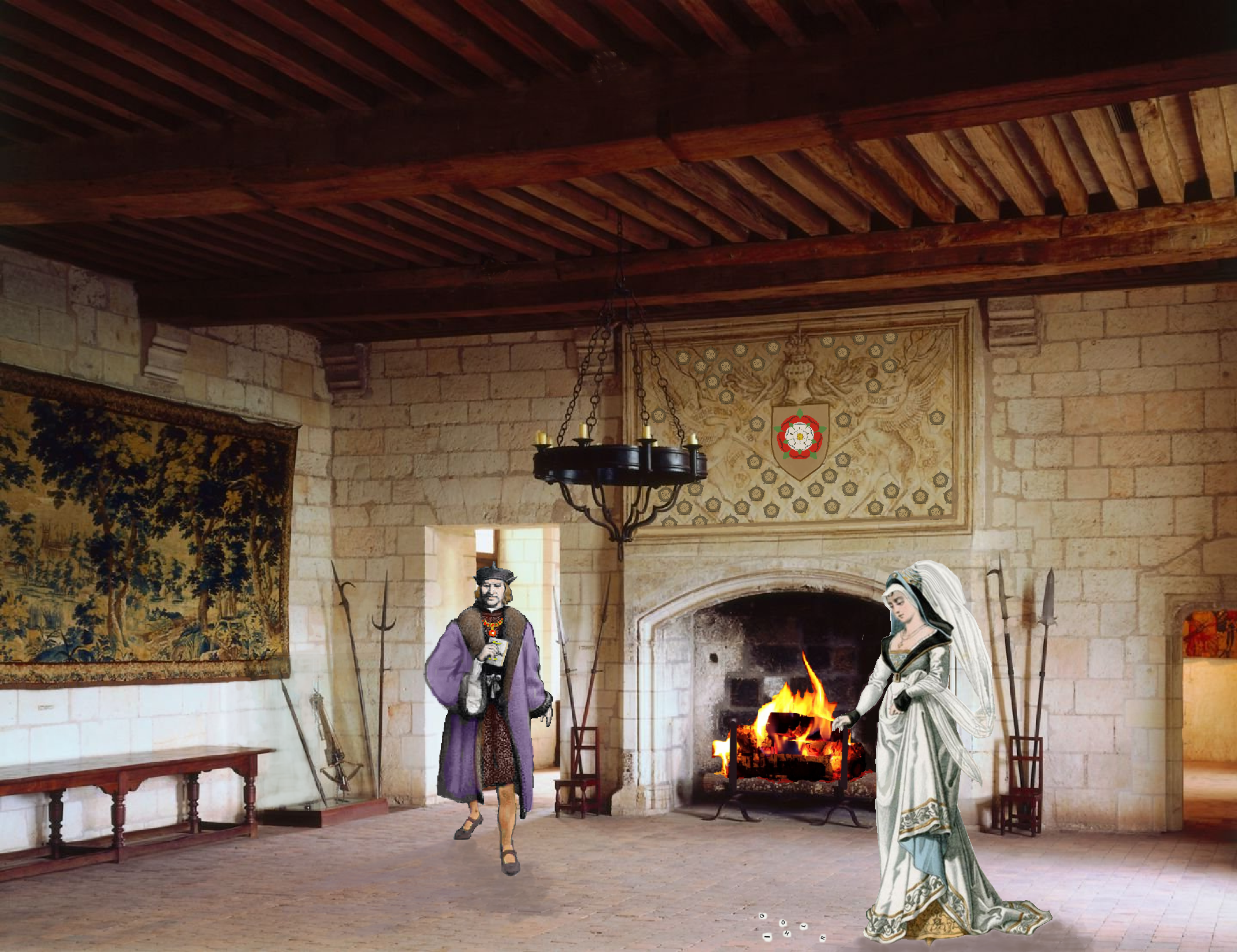
Elizabeth of York, Queen of England, paced slowly up and down in the echoing, otherwise deserted great hall, where the only comfort on such a miserable day was a flickering log fire in the huge hearth. There was nowhere for a secret eavesdropper to hide, which was the very reason Henry had chosen the hall for this meeting.
She was almost thirty-three and after six children was no longer lissom, but she was still beautiful, with a pale, gentle face and large blue eyes that could sometimes fix Henry Tudor to the spot. Her silver velvet gown was trimmed with black fur and worn over a gold brocade kirtle, and her long fair hair was concealed beneath a headdress and flowing gauze veil. When her hair was loose it fell below her waist. Henry liked to see it that way when they were private and in general she was happy to please him because in spite of his many faults, he was a mostly good husband. His two great failings with his wife were his tolerance of his Medusa of a mother, and his increasing tendency to cull the remaining members of the House of York.
Elizabeth lowered her eyes, wishing she and Henry could just be husband and wife, without the political extremes. And without his wretched mother, who always came between them. Lady Margaret Beaufort, now Countess of Derby, was a weasel-faced, pious predator, determined at all costs to be the first lady of the realm. She even signed herself Margaret Regina, when queen she was not, nor ever had or would be! And Henry, usually strong and sensible, allowed her to do so. Anything for a quiet life. It was his misfortune that for looks he took after his mother, not his allegedly handsome Tudor father.
But as Elizabeth’s rich skirts rustled on the stone-flagged floor, her loathed mother-in-law wasn’t uppermost in her thoughts. She was worried about her latest child Edmund, the tiny Duke of Somerset, only born in February. He was very sickly and did not seem long for this world. Henry was worried too, and now she wondered if Edmund was worse and that was the reason for being summoned to this odd meeting. Was it their baby? Her eyes glistened with anxiety and she pressed her hands to her lips in an effort to keep the tears at bay.
The fire shifted in the hearth, sending sparks flying in all direction, and she glanced at the dancing flames. How warm and cosy they seemed, when outside the countryside was enveloped in cloud and rain. It was dismal and depressing and did nothing to raise her spirits. Havering was her property, part of her jointure as the queen consort, but it didn’t feel like hers, because as usual Henry and his mother had taken over and she wasn’t consulted.
Private apartments and residences meant a great deal to her, and at Christmas two years ago the palace at Sheen had been razed to the ground by fire. Sheen had been her frequent home during childhood and youth and losing it had cut deeply into her. She, Henry and their children had barely escaped the blaze. Unfortunately, Margaret had escaped too and she and Henry soon busied themselves planning a grand replacement, to be called Richmond Palace. Work had commenced last year, and Henry boasted that it would be bigger and better than Sheen. It didn’t occur to him that his wife didn’t want something newer, bigger and grander. but simply wanted her old home back, and she was deeply hurt that he paid no attention to her feelings.
Just as she heard his footsteps bustling toward the entrance, something very odd happened. Six fragments of torn white paper fluttered down to the floor at her feet. Startled, she glanced around for whoever was responsible, but there was no one. Each fragment was scrawled with a childish letter of the alphabet. L.R.O.I.G.H. Guessing that they would arouse Henry’s ever-ready suspicions of plots, she felt they had to be hidden and was just about to gather them when Henry entered.
Seeing how hastily she straightened prompted his mistrust anyway and his manner became openly guarded as he saw the pieces of paper. What were the letters? A code? Was his queen, the mother of his children, conspiring against him?
Elizabeth read him as if he were a book and could at least relax about little Edmund. Henry was here about something else. She retrieved the letters and arranged them on the low table that was practically the only item of furniture. “There, make of them what you will. If they are to do with a plot, then I have no idea who, what or where. To be honest, I only saw them a moment before you entered, and—”
“And knew you had to hide them.” His tone was clipped.
“Oh, for Heaven’s sake, Henry. I knew you’d react like this and so I wanted them gone before you arrived. Unfortunately I did not have enough time.”
Henry inspected them and for a moment she thought he actually recognised them. “Henry? What are they?”
He shrugged dismissively, but not very convincingly, and she sensed that he knew at least something about them. “Well, they weren’t there a few minutes ago,” she continued, “but now they are, and as you requested—instructed—me to receive you alone, there hasn’t been anyone else in here. Clearly that must make me as guilty as Beelzebub.”
Something made him turn suddenly. In the passage beyond the entrance, he saw Robin the monkey. There was no sign of the boy, but Henry didn’t doubt the little jackanapes was close by. Did he have something to do with these damned letters?
Robin had already gone again when Elizabeth looked irritably at the empty entrance. “Is she late?” she demanded.
“Is who late?”
“Your dear lady mother.”
His face changed. “Why would I expect her?”
“Don’t be so artful, Henry. She’s everywhere, attached to you like a despotic shadow. I vow that sometimes I expect her to appear between us in bed, telling you what to do!”
“Don’t be absurd.”
She quirked an eloquent eyebrow. “I’ll warrant you had to order her not to come here with you.”
“When I told you it was to be just the two of us, I meant it,” he said.
Her silence was as eloquent as her eyebrow.
He turned away. “Dear God, Elizabeth, why can’t you support me?”
“When you so seldom support me? Henry, you almost always take the side of your mother, who loathes me. So don’t expect from me what you decline to give in return.”
“So you’re simply being obstructive?”
“No, Henry, I’m simply reacting reasonably. I’m a princess of the House of York and the Queen of England and am not here to be trampled over whenever it pleases you and Margaret.”
“I do not trample over you!” he protested, but noted she’d described herself as a princess of York first and then his queen.
“No? Surely you haven’t forgotten already how I had to fight her for the furnishings and decorations of my own apartments! My private rooms are nothing whatsoever to do with her. She’s a miserable interfering cow!”
“Elizabeth!” Then he added. “And I did support you!”
“Eventually, but it was like drawing teeth. Think about it, Henry. Try to imagine what it’s like to be me, always at her mercy because you aid and abet her. You’re actually afraid of her, aren’t you?”
The taunt struck home. “I am not!” But his jaw was tight.
“Yes, you are because she’s a spiteful snake. If you start defending and protecting me against her, I will be the supportive queen you want. Until then, you can—”
“Join Satan in Hades?” he finished for her.
“Yes. And take your mother with you.” She watched how his fingers toyed and fiddled with the notebook, which was a replacement for one that had met with the monkey mishap everyone was forbidden to even mention. Something was definitely wrong now, and she wondered if she could help at all. “What is it, Henry? Why have you demanded this isolated meeting? To interrogate me? Again.”
“Interrogate? Don’t exaggerate, Elizabeth. I merely come to reason with you.”
“And make notes to be used when it suits you or your mother.” She indicated the book.
His instinctive reaction was to hide it behind his back. But he knew it was foolish, and so brought it to the front again. “Well you may laugh, but I value my notebooks.”
“In which you scribble down anything and everything, together with the names of who said, did or seemed to do it. All with the express intention of dragging the matter up when that person next displeases you. It’s like an endless list of charges in court! That monkey did the world a favour. Every courtier in England rejoiced. Robin was fêted as a saviour and fed so many treats he was sick.”
Henry’s cheeks reddened because he knew it was true. But then thinking of the monkey took his thoughts to the boy again, and he scowled. “Don’t mention that cursed monkey!”
She looked at him curiously, for he was suddenly even more agitated and flustered. Something was very wrong. “Whatever is it, Henry? Why are you so on edge? The monkey destroyed the notebook. That’s all. If you weren’t so tense and silly about it, you’d see the funny side too. Because, strange to say, you do have a sense of humour. What’s really wrong, Henry? Please tell me.”
He wanted to, but in his present mood he couldn’t trust anyone. “There’s nothing. You’re turning into a nag, Elizabeth.”
She sighed. “Oh, have it your way. I’ve offered to listen, but you won’t tell me. That’s your problem, not mine.”
He was annoyed. “I’ve come here to ask, again, if you will corroborate Warbeck’s confession.”
“That he was an imposter? You have his signed letter admitting his whole campaign to have been artifice, so you don’t need me. And he admitted everything in front of witnesses, including his wife, which last you regarded as a deserved extra humiliation. Now he’s been executed, so that’s surely the end of it.” But a pang passed through her. She’d made a point of not meeting the man known to the world as Perkin Warbeck, but who’d claimed so convincingly to be her little brother, Richard of Shrewsbury, Duke of York, whom she had known as Dickon. But she more than most knew that Warbeck couldn’t possibly be Dickon….
“You know it isn’t that simple,” Henry replied sarcastically. “Why are you like this to me, Elizabeth? Why can you not bring yourself to help me? Are we not husband and wife? Am I not the father of your children?”
“Yes, you are, but you think only of yourself in this. You want to use me. All you’re interested in is destroying my House.”
“I have to rid myself of all possible Yorkist challengers.”
“Why? Simply so that our firstborn son can marry a princess of Spain? That match never warranted Warwick’s life and you know it.”
Grief touched her heart all over again. The only reason Henry had finally executed her poor cousin—if that was who the executed Warwick had truly been—was to placate the monarchs of Spain, who demanded England be free of pretenders if their daughter, Catherine of Aragon, was to marry Arthur, Prince of Wales. A Spanish princess simply wasn’t worth an innocent man’s life!
“Elizabeth, are you telling me Warwick wasn’t a danger when he was caught plotting against me?” Henry responded bitterly.
“He was lured into something he didn’t understand, Henry, and you know it. Warwick wasn’t Lincoln, he didn’t have the intelligence, sharpness, ambition and determination to rebel. He just wanted you to leave him alone.”
“Which I did until he was caught in a plot.”
“He was tricked into it, and it wouldn’t surprise me that your creatures were behind it all. Lincoln certainly wasn’t, having been dead since 1487!”
John de la Pole, Earl of Lincoln, heir to the dukedom of Suffolk, had been her paternal first cousin, and she’d liked him very much. Her uncle, Richard III, widowed and without a legitimate heir since the death of his son, had apparently intended Lincoln to be his heir.
Henry scowled. “Do we have to start on noble, wonderful Lincoln?”
“Of course not. So let’s concentrate on poor Warwick, who died because of Catherine of Aragon not because he was in any plot! Oh, you’ve always basked in your supposed benevolence toward that Lambert Simnel person, placing him into your kitchens, even making him your falconer, but you weren’t prepared to show the same leniency to Warwick, who certainly didn’t comprehend what he was being involved in. I will not be well disposed to Catherine when she arrives in England, you may be sure of that.” She knew such a threat would have Henry jumping. She was right.
He was alarmed. “Are you going to cause trouble?”
“And give you reason to execute me as well?” she replied acidly.
“Now you are being ridiculous. Oh, Elizabeth, can we at least talk sensibly about everything? There are questions to which I need to know the answers….”
“You want me to tell you things that will give you cause to behead a few more Yorkist lords? Maybe you want me to incriminate Lincoln’s brothers? That would suit you nicely, would it not? How many of them are there? Three? Oh, such a nice clutch to behead in a row! You’ll sleep well that night.”
“All of which implies that you know incriminating things about them” he snapped. “Tell me why Warbeck didn’t claim to be the older of your brothers? Why not say he was Edward—so very briefly Edward V? How long was it for? Twelve weeks? Thirteen? Whatever, you called him Ned, did you not? I cannot understand why Warbeck chose to be Dickon instead.”
“Maybe he was Dickon,” she replied, knowing full well that it was impossible.
He ignored her. “Nor can I understand Lincoln’s Simnel nonsense at Stoke Field.”
“That wasn’t Lincoln’s nonsense, it was yours. Lincoln would never have rebelled for an unknown boy of such an outlandish and patently invented name as Lambert Simnel.”
Henry was sleek. “Simnel wasn’t invented, he was a lowborn boy from Oxford, yet Lincoln had him crowned King Edward in Dublin. Thus Simnel became the Yorkist figurehead at Stoke Field. Why? Oh, how I regret that Lincoln died in the battle, because I had so many questions for him.”
She eyed him. “Don’t be so duplicitous, Henry Tudor!”
“Duplicitous?” Never had Henry evinced more injured innocence.
“You know that Lincoln died without even hearing of Lambert Simnel, let alone having used the fellow as a Yorkist figurehead. You dreamed Simnel up immediately after the battle, no doubt your intention was to ridicule the whole Yorkist rebellion. Well I congratulate you because you certainly succeeded in that.” She halted, watching him as closely as he watched her. “I can almost feel your crafty fingers in the whole business, Henry Tudor. And oh, how saintly you were to the Simnel boy afterwards. You wanted everyone to think you were caring magnanimously for a poor little lad who’d been tricked and coerced by those wicked Yorkists.”
“Well, so he had been. I’ll warrant Lincoln thought long and hard about pretending the boy was Warwick. But I, of course, had Warwick safely in the Tower and could produce him at any moment. So Lincoln decided on your brother Ned instead. At least, so it seems. Who knows? The twistings of Lincoln’s mind were always convoluted. Maybe it was ‘Warwick’ he produced in Ireland.”
“Oh, stop it. You had someone in custody in the Tower. The boy you imprisoned was the one everyone had always known as Warwick, but we were all aware he was probably a changeling, put in the real Warwick’s place shortly after birth.”
She considered the old story. Could anyone swear on Holy Bible, Henry and Lincoln included, that the Warwick they’d always known was the real Warwick? It was said that his father, the Duke of Clarence, her uncle, had feared for his baby son’s fate at the hands of her father Edward IV, and had sent him away to the Continent, replacing him with an anonymous child. With Clarence long since dead, executed by her father, and all tracks completely erased, it was utterly impossible to disprove the changeling story. Maybe the original Warwick had died some time ago anyway. And because of this, there would always be a large question mark over the Warwick held and executed by Henry. Henry had always chosen to take no notice of the story of swapped babies, and paraded his Warwick through London, along with Perkin Warbeck.
Henry was dismissive. “You know I don’t believe the changeling fairy tale.”
“We’ve digressed, have we not?” she answered. “Let’s return to the Lambert Simnel you say you captured at Stoke. You’ve been drawing attention to him ever since to perpetuate the lie that you yourself created. That the rebel Yorkists had no one of consequence at their head, only a feigned prince. You’ve laughed and scoffed that he was really the son of an Oxford organ-maker, or an Oxford joiner…maybe even an Oxford baker! How ridiculous do you wish to be? Are you telling me that the son of an organ-maker would have known exactly how to go on in the highest of aristocratic society and be able to converse convincingly with men like Lincoln? The Dublin boy certainly knew enough to conduct himself perfectly at his coronation. He was educated, even to reading Latin! He was not Lambert Simnel, who was your invention, your instrument. What I haven’t yet worked out is why Simnel was necessary.”
Henry said nothing.
“Why did you capture one boy at Stoke, but produce another boy afterward?”
“It was always the same boy.”
“Liar!” she replied coolly. “I knew Lincoln well enough to be sure he must have believed in the boy he saw crowned as King Edward in Dublin.”
“But which King Edward, mm?” Henry murmured.
There was confusion about the regnal number of the boy upon whose head the crown had been placed in Dublin. Had he been anointed as Edward V or Edward VI? It mattered a great deal. Warwick would have had to be crowned Edward VI because Edward V was her brother Ned, who although never crowned had been king so briefly in 1483.
Henry watched her face in a rather curious way and echoed her thoughts. “Fifth or sixth, mm? Which one, Elizabeth?”
“I wasn’t there so how am I expected to know?” she answered noncommittally. “Be honest for once, Henry, if indeed you find that possible anymore. I sometimes think you were formed from lies. You’ve claimed to know Simnel’s real identity, even to mentioning somewhere along the line that a herald recorded his real name as John. John Who?”
Henry declined to respond.
In her heart of hearts Elizabeth suspected that the boy in Dublin and at Stoke had been her brother Ned, whom she knew—or prayed—was still alive and in hiding. Somewhere. Who else could it have been at Dublin? Lincoln had known both her brothers well, because before Bosworth they, Warwick and other Yorkist heirs had been in his, Lincoln’s, charge at Sheriff Hutton.
Unlike Warwick there had never been any doubt about Ned’s identity, and she believed Lincoln would have supported him because Ned, by then legitimate again because Henry had made him so in order to marry her. Ned was more likely to raise all the necessary support in a bid to retrieve the throne for the House of York. Lincoln would have made a better, stronger king than poor Ned, but Ned had the senior lineage and thus rightful claim.
It was all a mystery, and she would love to have had a few minutes with Lincoln to get to the bottom of it. Henry would have loved those few minutes as well, but—most inconsiderately—Lincoln had allowed himself to be killed in the battle.
However, there remained one glaring question. If the boy at Stoke was her brother Ned, and Henry had captured him, what had happened next? The obvious conclusion was that Henry had him killed, thus removing a very real Yorkist danger. Was the Lambert Simnel charade nothing but a veil to conceal the heinous murder of a child? A vile crime for which Henry had always striven to accuse Richard III?
Henry’s eyes shone knowingly, as if he were testing her. “You tell me who the boy in Dublin really was,” he challenged.
“You clearly know much more than you’re admitting, Henry Tudor. What are you hiding from me? What have you really been up to all these years since 1487? Please tell me,” she begged, suddenly close to tears. Just what had happened to Ned since she’d last seen him?
“I’ll ignore your timely piping. What befell your brothers? Did your precious uncle Richard III have the cherubs smothered in their little beds?”
She strove to be in command of herself again. “No. Richard would never have laid a hand upon my brothers. I know you want me to shout from the battlements that he was a cruel monster, but I will never denigrate his memory in such a way. He didn’t enjoy having to take the throne, he did it because it was what he had to. He was my father’s legal heir.”
Richard III, the predecessor Henry had defeated at the Battle of Bosworth, was a very sensitive subject, not least because Henry’s victory was due solely to Richard having been betrayed on the field. There was another reason too; Henry was jealous to the core of Richard, who had been young, handsome, charming and, most awkwardly, a widower. Henry had always suspected her of wanting to marry Richard, uncle or not. Hence the delay in the marriage that was meant to finally unite York and Lancaster. Henry wanted to be certain she wasn’t carrying Richard’s child, which she would then try to foist upon him. But Henry had been the first and the only man she’d lain with.
Now Elizabeth knew exactly what he was thinking concerning Richard. “Oh, don’t accuse me, Henry Tudor,” she said wearily. “You’re such a hypocrite, because I might as easily accuse you of being much more interested in Warbeck’s wife than you ought to be! You’ve even imposed her upon my household! Perhaps she’s the real reason you were so eager to lop his head!”
Anger brightened his eyes. “No! What else could I have done but send her to you? Release her to be a rallying point? Let her take their son with her? To encourage Scotland to take up her cause? I’m not that much of a fool.”
But he’d reddened too. Yes, Lady Katherine Gordon was too lovely for his peace of mind. Not that he’d done anything about it—well, not really—but it stung that his wife suspected him anyway.
Elizabeth wasn’t impressed. “And I must accept that as the truth of the Gospels? Well, it’s fortunate for you that she and I rather like each other, and I trust her. I certainly don’t trust you, Henry Tudor.”
“I have never been unfaithful to you!” He was genuinely indignant because although he’d tiptoed dangerously close to infidelity, he hadn’t actually committed it.
“Nor I to you, either before or since our marriage, but that doesn’t stop your frequent jealous jibes about my imagined relations with Richard. You’ll simply have to accept that I did not love him as I shouldn’t. I loved him as an uncle. I have no illusions about my father. King Edward IV tricked my mother into a fake marriage in order to enter her bed, and it was only later that she discovered she’d only been his mistress all along, and all her children were baseborn! I didn’t like my father very much, but Richard, when I met him, I did like. He was natural and open.” Then she added. “And when he died he was negotiating Portuguese matches for himself and for me, which is something else you know full well but choose to always overlook.”
“Oh, the honour of finding the Grail should have been his too,” Henry observed sourly.
“You’ve seen to it that terrible things are said of him, even that he was deformed.”
“He was! I saw his bent back!” Henry cried.
“No one would even have known his back wasn’t straight if you hadn’t paraded his naked and abused body through the streets like that of a dead dog. With your sycophants shouting out that the child-murdering usurper was dead! When he was living and clothed no one could see anything wrong with his back.” She looked away. “You treated him with immense dishonour. He was a king, not a common criminal.”
“He had to be displayed, so that everyone knew it was him.”
“His face would have sufficed, and you know it. You could have covered him decently. And you could have stopped the violation of his body.” There was bitter challenge in her bright blue eyes. “Well, you haven’t quite succeeded in labelling him with the murders of my brothers, have you? There are more and more rumours that yours were the guilty paws. Or your dear dam’s.”
“My hands are innocent and lilywhite, and so are my mother’s.” Realising the conversation was in danger of descending into farce, he took a long breath. “Please Elizabeth, can we not be sensible and honest with each other?” He paused to look around, to be certain there was no one within hearing, and then spoke in a lower tone anyway. “I have to persist with blackening Richard’s character, because I know that my right to the throne is based almost solely on his death in battle. And that my victory depended on others—mainly Sir William Stanley and—“
“And your stepfather-in-law, the elder Stanley,” she interrupted.
“Does it matter who? Suffice it that they stabbed him in the back. My lineage gives me virtually no right at all, and marriage to you has helped to make me secure. Like it or not, we have brought Lancaster and York together, and our children are definitely a union of both Houses. There, is that not what you wish to hear me say? An admission of my weak position?”
“I wish to hear you say you regret murdering Warbeck and—”
Henry interrupted angrily. “We’re back to that? I dared not spare them because they were the focus of rebellion and I intend to hold on to the crown! So no, I don’t regret it. I thought of our children’s future, which you should be doing as well. If Warbeck’s death bothers you so, will you tell me why you refused to see him in person?”
“Because I believed he might well be my brother.”
The unexpected answer shook Henry. “Elizabeth, you’ve always insisted your brothers died in 1483,” he said levelly, “and that you were a witness. Are you saying now that you’ve been lying all this time?”
“My full-blood brothers died then, yes.” She met his eyes squarely.
Again his expression changed, but she saw how swiftly he dissembled as she continued. “My father’s exploits between the sheets were legendary, and so Warbeck could well have been sired by him. From the physical descriptions I’ve been given, I’d say yes, Perkin Warbeck was my half-brother. You wanted to use me to justify his execution, well I wasn’t going to be used. You wanted him dead, so yours was the responsibility, not mine. I will never be accused of bringing about the death of my own brother, legitimate or not.”
“Oh, how mealy-mouthed,” he mocked.
“No, how honest, which I think you just wished us to be.”
“We always go around in circles, Elizabeth, but tell me this, will you confirm upon the lives of our children that your full-blood brothers died in 1483, and that you witnessed what happened?”
On the lives of their children? She gazed at him. For a long moment she couldn’t answer him, but then…. Perhaps now was the time to be honest after all. She closed her eyes, paused, and then exhaled resignedly. “No, Henry, I won’t swear it because I cannot. Yes, I saw everything that happened not in 1483, but in January 1484. My brothers didn’t both die, only one did.”
His eyes cleared. “At last! I’ve always known you were lying.”
“And I’ve always known you were. There is something very important that you’re hiding from me.”
“Well, let’s be really childish. I’ll tell you mine if you tell me yours. But as I was the first to ask, you must be the first to divulge.”
It was a glimmer of his wry humour which sometimes reached through her defences. When he was his natural self he could be oddly endearing.
“Well?” he pressed.
“Do you swear upon your mother’s life that you will keep what I tell you to yourself?”
“Tit for tat?”
“Yes, Henry, tit for tat.”
“Then I swear it. No one else will learn what either or us says here today. Will that do? We have a truce, my lady.”
For once she knew she could trust him. Turning away, she allowed her mind to conjure the past, when her uncle Richard III had become king because she and her siblings had been proved to be illegitimate. To reassure her and her mother that Ned and Dickon were safe an unharmed, Richard had taken her to see them in the secret place he’d installed them for their own protection.
“It was at Oakhanger in Kent,” she said reluctantly.
“Oakhanger? Lincoln’s manor in Kent?”
“Yes. Richard wanted the boys out of sight for the time being, until he’d had time to prove himself as king and secure his position, but he knew that he might well be suspected of killing them. When they seemed to disappear he was indeed believed by many to have murdered them, while others thought he’d sent them to his sister, the Duchess of Burgundy, to care for them until it was sensible for them to return to England. He decided that Oakhanger would be unlikely to attract attention, at least temporarily, until somewhere more permanent could be prepared.”
“Where?” he demanded quickly.
“I don’t know. It’s the truth, Henry. I was not told.”
He didn’t look convinced but said nothing more.
“Richard didn’t owe my mother any favours. She’d schemed against him and would have seen him dead, but out of consideration for her, and to reassure her he requested me to accompany him, to see the boys and be able to tell my mother she did not need to worry over them.”
Henry grunted. “Oh, what an amazing paragon he was, to be sure.”
“Don’t start Henry!”
He raised his hands submissively. “All right, all right, go on.”
*********
Oakhanger Castle, Kent. January 1484
The Earl of Lincoln had seldom visited his isolated property at Oakhanger and never actually lived there, but nevertheless the fortified manor, now identified as a castle, was luxuriously appointed as if it were his principal residence. It stood on a spur of land that jutted into a marshy river valley. Across the river the land rose sharply and was covered by the dense hanger wood of ancient oak trees from which the manor took its name.
It was noon on an unexpectedly warm mid-January day when an oddly anonymous cavalcade that didn’t include the earl himself rode along the causeway over the marshes, drawing as little attention to itself as possible, even though King Richard III himself was at its head. He had set time aside from his progress through Kent—necessary to settle recent unrest—in order to effect a very important and exceedingly private meeting.
Elizabeth was the hooded lady at his side, having been coaxed into accompanying the uncle she should fear and despise on this visit to Oakhanger. Who better than the trusted eldest child to confirm the boys’ safety to their anxious mother?
She had been loath to trust her uncle, but there was something about him that made her want to go with him. So far there had been very little conversation, and what there had been was stilted, but now, as Oakhanger itself rose in the distance, she had to bring the simmering distrust to the surface.
“You have not only made bastards of my siblings and me, you—”
“It isn’t yet official and won’t be until I return to London later this month for my first Parliament,” he interrupted.
“Indeed. What do you call it? Titulus Regius? In it you will ruin the lives of your brother’s children.”
“With all due respect, I won’t ruin anything. Your own father did that when he only pretended to marry your mother.”
There was no way around that glaring fact. She knew from her own mother that the marriage had been fake, foisted upon the bride as much as the nation. “But you definitely executed my uncle Rivers and half-brother Grey,” she challenged instead.
“So I have to be accused of something?” Richard replied dryly. He was thirty-one, of medium height and slightly built, with a lean, good-looking face and steady grey eyes, and his wavy dark chestnut hair tumbled to his shoulders. He was as unlike Elizabeth’s father as could possibly be. Edward IV had been well over six feet tall and larger than life itself in so many ways. He’d had a gloriously handsome fair-skinned face and a magnificent physique—at least, his physique had once warranted such a description, but years of laziness and dissipation had ruined him in every way. On top of which there was a very unlikeable side to him which once glimpsed could never be forgotten.
Richard continued to answer her accusation, “Well, I was away in the north, as I almost always was and your father’s demise was sudden, so Rivers and Grey were intent upon getting Ned from his household in Ludlow to London and crowned in order to exclude me from my role as Lord Protector.” He paused. “A role your father designated for me on his deathbed. He certainly didn’t want his wife’s swarm of Woodville kin to have control of both king and country. He’d finally seen the light where they were concerned, although it took him an unconscionably long time to get to that point. By then the damage had been done. The Woodvilles, as much as the House of Lancaster, wished me dead and out of the way, so it was—and still is—them or me. I will never rest my head obligingly on their block. Surely you wouldn’t expect me to do anything other than oppose them?”
She answered with another question. “So if you ever capture my other Grey half-brother, the Marquess of Dorset, you’ll execute him too?”
“Of course,” was the immediate reply. “He’s a traitor, Elizabeth, and has fled to join Tudor.”
She knew he was right, the Woodvilles did want him dead and gone, and had plotted to that end, so she turned to another topic that exercised her mother’s suspicions. “Why aren’t my Uncle Clarence’s children here at Oakhanger too?”
Richard answered her question. “Why should they be? They’re safe in my wife’s household. Your brother Ned was the king-to-be, requiring his own household, and I asked for Dickon to be with him for company. That is all. I haven’t collected them like chickens, intending to wring their necks at the earliest convenient opportunity. That is the version of things advanced by my enemies.”
“Do you believe Warwick is the real Warwick?”
Richard paused and then pressed his lips together. “I’m as sure as I dare to be. If my eventually attainted brother Clarence sent his son away as a baby and put another child in his place, he left no proof. The Warwick you and I know is the only one we’ve ever known, so I have to treat him as the real Warwick. To do otherwise would be to believe rumour and supposition, and I of all men know the danger of that. But I tell you this, I will not be reversing their father’s attainder to make Warwick a legitimate heir to the throne.”
“Because he might not be who he’s claimed to be?”
“That’s one reason. Another is that he isn’t the sharpest of souls. As I think you know. He has a certain innocence that makes him gullible. In my opinion. But most of all, if I were to reverse Clarence’s attainder, then I’d have no business being king myself. My whole premise is that I’m your father’s next legitimate male heir. I wouldn’t be if Clarence’s son were to be freed of the attainder imposed by your father, not by me. As I’ve already explained, there are a number of reasons why the attainder should be left as it is.”
She dwelt on the answer, with which she couldn’t reasonably find fault. “Uncle, I must let you know that I will not lie to you, for you or against you, but will tell my mother only the truth about what I learn at Oakhanger.”
“That’s all I require, Elizabeth. But one thing you should know beforehand. Your brothers—Ned and Dickon—will soon be moved elsewhere, somewhere completely safe. They know where they’re going but have been required not to tell you.”
Suspicion leapt through her. “So, you’ll have me think they’re safe and then you’ll do away with them?”
He sighed. “No! It may not suit you to acknowledge it, but they are my flesh and blood too. I would never harm a hair on their heads. I would never harm any child! Shame on you for thinking otherwise of me.”
There was sincerity in the angry response, and she recoiled a little. “So, you won’t tell me where they’re going because you don’t trust me?”
He paused, and then smiled. “Not trust the woman my great enemy Henry Tudor vowed on Christmas Day morning in Rennes Cathedral that he would marry and thus unite the Houses of York and Lancaster? With me dead and mouldering somewhere unholy?”
She coloured. “My wishes on that marriage haven’t been sought.”
Richard’s lips twitched with amusement. “Having heard a description of your Lancastrian swain, I’m not surprised they omitted to seek your approval. He, on the other hand, hopes to acquire a very beautiful young woman, a true golden-haired Princess of York who will be his passport to a legitimate claim to the throne.”
“You flatter me.”
He shook his head. “It’s no flattery. Elizabeth, and it is my hope that I will be able to find you a grand royal match.”
Her pulse quickened, and not entirely pleasantly. “Who?”
“My mind isn’t fixed yet, but I’m looking toward Portugal.”
“Please don’t make him someone old and awful.”
Richard threw his head back and laughed. “I’ll do my best, for you and your sisters.” He became serious again. “Elizabeth, Tudor has nothing to commend him. He has no worthy blood-right to the crown and needs you to give his claim some foundation. Even his title is stolen, for the Earl of Richmond he is not because that title was forfeit to the crown. He’s a coward who was afraid to put so much as a toe on English soil when my cousin Buckingham’s rebellion failed.” Richard’s tone was contemptuous of both Tudor and Buckingham, who’d betrayed him most cruelly the previous spring.
“Elizabeth, by not telling you where the boys will go from Oakhanger I’m simply not weighing you down with knowledge that must on no account become common fame. You have to tell your mother all you know, and I accept that, but I also accept that she has been taken in once by Tudor’s mother, Lady Margaret Beaufort, and may well succumb again.”
“I doubt that even my mother will be so foolish twice.” Elizabeth looked at him. “Taking away Lady Margaret’s titles did nothing. You even gave her into her husband’s safe keeping! I wouldn’t trust Lord Stanley any more than I’d trust his wife. Or his brother, Sir William. Why didn’t you put her somewhere where she can’t do anything?”
He laughed. “Like the Tower? That isn’t my way with women.”
“Perhaps it should be.”
He met her eyes. “Maybe, but my nature and honour will not permit it. Besides, her husband is an important lord and it doesn’t do to upset important supporters.”
“He’s Henry Tudor’s stepfather! Can’t you see in his eyes that he’s only out for himself? All Stanleys are the same.” Honour had no place in Stanley philosophy. And how much more important would dear Margaret’s husband be in the unlikely event that Henry Tudor swept to power in Richard’s place? Stanleys would always sit on an invisible fence, ready to drop down softly on the triumphant side.
Richard continued. “Suffice it that for present purposes I cannot trust your Woodville lady mother.”
“I suppose you’re right,” Elizabeth conceded.
“In their new abode Ned and Dickon will be safe and at liberty—relatively—and you will be able to write to them. You will know by their own hand and words that they are happy and safe.”
“In England?”
Richard smiled at her. “Wherever they are they will live well, you have my word upon it.”
For the first time she returned the smile, liking him in spite of herself. What a very unlikely monster he was, she thought, although she didn’t really know what a monster should look like.
He reined in just short of the wooden bridge suspended over the castle’s dry moat, obliging the entire cavalcade to halt as well. “Would that your father had been more chivalrous, Elizabeth, because I would much prefer to be Lord Protector to Ned, but I have to honour the law, and by all that is just and true, I am your father’s next legitimate male heir.”
“I know.”
“And my love for my nephews and nieces remains staunch, please believe that.” He smiled again.
Until her father’s death she’d known little of Richard, who’d spent as much time as possible away in the north, which he ruled in her father’s name. But now she’d spent a little time with him….and with this one conversation her loyalty to Richard III was both born and sealed. The truth was second nature to him, and she knew she would always trust him.
The cavalcade moved on, clattering on the bridge and then beneath the gatehouse into the courtyard. Ned and Dickon immediately came rushing from the private apartments, down an external staircase that passed beneath a magnificent trefoil window with elaborate stained-glass and latticed casements. The boys were accompanied by the three noisy hounds that Ned had brought with him from his former home at Ludlow in the Welsh Marches.
Richard laughed. “It seems they’re pleased to see you, Elizabeth!” he cried, swinging a leg over his saddle to slip down to the ground. He came in person to lift her from her dappled mare, and she was immediately beset by her delighted brothers, especially Dickon, who had grown up with his eldest sister always being there. The hounds—a huge mastiff, a lean greyhound and a beagle—were beside themselves with excitement, responding to the happiness of their young masters.
Dickon was ten, a bubbly irrepressible boy who liked to test how far he could go before punishment ensued. He already knew his uncle and was clearly as at ease with him as Elizabeth herself was now.
She didn’t know 13-year-old Ned as much, because he’d been brought up as the Prince of Wales, with his own household at Ludlow. He was much more reserved and serious than naughty Dickon but had an odd appeal that could reach out quite unexpectedly. There was something in him that was neither Edward IV nor Woodville, something different and touching, but he was also handicapped by bouts of almost crippling shyness, which was hardly what a future king needed. Nevertheless he hugged her as warmly as had Dickon.
She cupped his face in her hands. “How are you, Ned?”
“I’m very well, Elizabeth.” He glanced uncertainly at Richard. “I like it here and wish we were staying, but we’re soon to be moved to—”
Dickon nudged him warningly. “We’re not to say anything, Ned!”
“But—”
Richard intervened. “It’s for the best, Ned. The fewer who know, the better. And it won’t be fair to burden Elizabeth with such vital information.” He turned to her. “They will be as well cared for as they are here, and when a little time has passed, and the furore of my accession ceases to raise so many hackles, I will be glad to bring them back to court.” He saw the immediate alarm that flashed through Ned’s eyes, and added gently, “If they wish it, of course. If they don’t then they will be left alone, but certainly not without the wherewithal to live very well indeed.”
Dickon beamed. “I’ll want to come to court again! I love it at court!”
But Ned was visibly reassured by Richard’s words, and Elizabeth’s gaze met her uncle’s. They both knew that Ned was entirely unsuited to be king, or indeed to live a public life. In fact he was frightened by the mere thought of it.
Then Richard shivered. “It’s turning chilly. We will go inside. I trust a suitable repast is waiting because I for one am rather hungry.” He led the way up the staircase.
**********
Late that afternoon, as the January sun was sinking and the shadows lengthening, Elizabeth was resting in her firelit bedchamber, which had a fine view over the darkening marshes to the now mysterious hanger wood opposite.
She’d spent several hours with her brothers, who seemed to be in excellent spirits. They were both well and neither was afraid of Richard. If Ned was more reserved, it was simply his nature. As she lay there she heard the boys’ raised voices in the neighbouring chamber which had the beautiful window above the outer stairs. Something had prompted a heated argument that became more and more physical, and then the ever-present hounds joined in as well. The boys screamed at each other to be heard above the racket of the hounds, which were beside themselves, yelping and baying as if in a hunt.
As she sat up on her bed she realised there was a smell of burning coming beneath her door. Alarmed, she ran to investigate and found the passage filled with foul-smelling smoke. Richard arrived directly behind her, drawn by the same disturbance, and together they saw the smoke billowing from the room where the commotion was centred.
“Sweet God above,” Richard breathed, pushing past her.
Elizabeth followed. There were no flames at all, just thick black clouds from the perfectly steady glow of the log fire. The smoke came from something that was burning on the topmost log.
The boys, both dressed to retire for the night, were only visible as shapes struggling ferociously. Then Dickon pulled away to go to the windows and fling the casements open to draw the smoke outside. Ned was still shouting at him. Dickon shouted back, using words of which no well-raised royal child should even be aware.
Richard seized the collar of the over-excited mastiff and shouted angrily at the boys. “Stop! Behave yourselves this instant!”
But they were beyond reason as with a screech Ned launched himself at his little brother and gave him an almighty shove.
Time seemed to stop as through the swirling smoke Elizabeth saw Dickon totter, caught off balance. Then he tumbled backward, his calves struck the low window ledge at just the wrong angle and with a frightened cry he toppled outside. In the momentary silence, when even the hounds were quiet, they all heard the thud as he struck the stone staircase below. Then the silence became even more hollow and echoing.
Ned froze as Richard and Elizabeth rushed to look out. Dickon lay crumpled and motionless on the lowermost steps. His eyes were closed, and it was clear he’d struck his head. Was he only unconscious? Oh, please let that be so!

Gathering up her skirts, Elizabeth ran from the room, with Richard and a sobbing Ned at her heels. The hounds were too cowed to follow and waited at the doorway of a room that was rapidly clearing of smoke, revealing the perfectly controlled log fire in the hearth, and something stinking burning on the topmost log.
No one else in the castle seemed to have heard anything, and the courtyard was deserted because most of the servants were in the great hall enjoying their evening meal. Elizabeth flung herself down beside Dickon and pulled him up into her arms. He was completely limp, and as his head sagged forward she saw a bloody gash at the nape of his neck, where he’d made fatal contact with the stone step. He wasn’t breathing, and the warm shades of life were already draining from his face. “Oh, Dickon,” she whispered, tears leaping to her eyes.
Ned wept distractedly as he touched his brother’s face. “It was my fault,” he managed to breathe. “I killed him! I killed my brother!”
Richard looked sadly at Elizabeth. “Please take Ned inside. I’ll attend to Dickon.”
She nodded numbly and rose to take charge of Ned, who allowed her to usher him back up the steps. At the top she glanced back down and saw Richard gather Dickon gently into his arms to follow.
The smoke in the chamber had now disappeared, and source of the stink was little more than glowing ashes. Elizabeth went to close the fatal window, and then turned to Richard, who carried Dickon tenderly in his arms. “Where will you take him?” she asked.
“Somewhere private, where he cannot be ogled by all and sundry.” He held her gaze. “You know I didn’t cause this, and I trust you will reassure your mother of that. If, indeed, it’s possible for anyone to reassure a grieving mother concerning the loss of a beloved son.” In his mind’s eye he could picture his wife, Queen Anne, should anything like this happen to their only son, the little Prince of Wales. She would be inconsolable. And so would he.
Elizabeth nodded and watched as he bore his sad little burden away. Confused emotions swirled through her, like an ever-widening whirlpool. Tears soaked her cheeks. Poor little Dickon…. If she closed her eyes she could see his cheeky grin and hear his impish laughter.
Then Ned’s distress halted her thoughts and she went to comfort him. “It was an accident, Ned. An accident,” she insisted, pulling him into her embrace.
“But I pushed him! I pushed my brother out of the window! I killed him!”
There was such anguish in his voice that the hounds whined, pushing their nose into his hands and doing all they could to be one with him.
Elizabeth felt helpless too. “No, Ned. You pushed him, but you didn’t deliberately push him out of the window. That is just where he happened to be. Uncle Richard and I both saw what happened,” she said gently. “Please don’t blame yourself.”
“Uncle Richard will!”
“No, you’re wrong. Ned, if there’s one thing I’ve learned about our uncle it’s that he’s kind and can be trusted. He will solve this, I’m sure.”
It was some time before Richard returned, and the strain was visible on his face. “Dickon rests in the castle chapel for the time being, and it’s locked, to prevent anyone else entering. The priest is sworn to secrecy. All appropriate and necessary arrangements have been put in hand.” He looked at Ned, who was still distraught. “Listen now, Ned. You are not to shoulder the burden of blame. It takes two to make an argument, and you and Dickon were both culpable.”
“But, if I hadn’t pushed him so hard—”
Richard held up a hand to halt the flow of guilt. “Ned, my brother Clarence and I had many an argument, I even managed to punch him once. He too staggered backward, but there wasn’t an open window behind him. If there had been, he too might have tumbled out and been killed. Brothers argue and boys fight. Nothing will ever change that.” He glanced at the fireplace. “What caused the argument in the first place?” he asked.
Ned sniffed. “Dickon threw water over my favourite hat and then hurled it on the fire. It was the hat with the long red feathers. I couldn’t rescue it and I was furious with him.” His voice trembled and he bit his lip in an effort to stem his tears. He’d been brought up to be king, and to be in command of himself at all times, but this was different. So different.
“Wet feathers. Now I recognise the stench. So this was all over a damned hat,” Richard murmured sadly. “Well, for the time being you should both know that everything will be attended to properly—and according to the rites of the Church—I will have Dickon laid to rest secretly at Windsor with your father. You have my word upon that. But I will not make anything public. I won’t confirm anything but will let it be rumoured that I’ve sent you both to my sister Margaret, the Duchess of Burgundy. She will say nothing to disprove the rumour.”
Elizabeth was bitter. “This is all my father’s fault!”
Richard raised an eyebrow. “Well, although he was certainly responsible for a lot, I cannot go so far as to blame him for this.” He came to put a hand to Ned’s cheek. “Listen now. I’ve requested the kitchens to provide you with a calming draught of herbs. They think you are simply feeling unwell. I understand there’s a very knowledgeable wisewoman who has forgotten more things about such things than the rest of us have ever known. You are to drink what she prepares and go to your bed. And be sure to let the hounds join you, for they need reassurance too and will be a comfort you. They’ve lost Dickon too, remember.”
Elizabeth stroked Ned’s hair. “I will sit in your room tonight, so you won’t be alone.”
Ned put his arms around her waist and held her tightly. “Thank you.”
Richard ruffled the boy’s hair. “Weep all you wish, for no matter what, you’ve lost your brother, but you did not kill him on purpose. Please remember that. And tomorrow morning you and I will ride out to the woods, where I intend to talk to you about some very important matters.” He looked at Elizabeth. “And to avoid any unwelcome conclusions being drawn, I wish you to come too.”
“Yes, Uncle Richard.”
“I’ve already had to deal with rebellions and attempts to abduct the boys, because there are many who do not agree with my rule. So tell me, if you hadn’t been here to witness what really happened, would you believe I had nothing to do with it? Or would you think both your brothers were meant to perish in a highly suspicious ‘accident’? Answer me that.”
She couldn’t.
He smiled ruefully. “You see? I’m going to be condemned no matter what, but I am better able to weather such things than is a boy of Ned’s age. I don’t want him to be laden with guilt for the rest of his life. But, Elizabeth, I do want you to tell your lady mother the whole truth.”
Mother. Only then did the shock of what had happened finally overwhelm Elizabeth. No longer able to control the tears, she hid her face in her hands and wept for the little brother she’d loved so much.
There were tears in Richard’s eyes too as he comforted her as best he could. They all three stood in an embrace as they shared their sorrow. The crestfallen hounds waited nearby, heads low, tails still.
**********
The next morning four anonymous riders set off from the castle across the relatively small deer park and then out into an open countryside of wide fields for sheep and ancient hedges punctuated by mature trees. Richard, Ned and Elizabeth were alone except for a groom to care for the horses, and the atmosphere was sombre. This this cold morning light it didn’t seem possible that anything so very terrible had happened the night before. They were subdued, and both Elizabeth and Ned had cried themselves to sleep.
Once they were well away from the castle, but still on Oakhanger land, they halted at a fallen tree, blown down in a recent violent storm. Elizabeth stayed with the groom and horses as Richard and her brother went to the tree, where Ned sat on the horizontal trunk while Richard stood nearby.
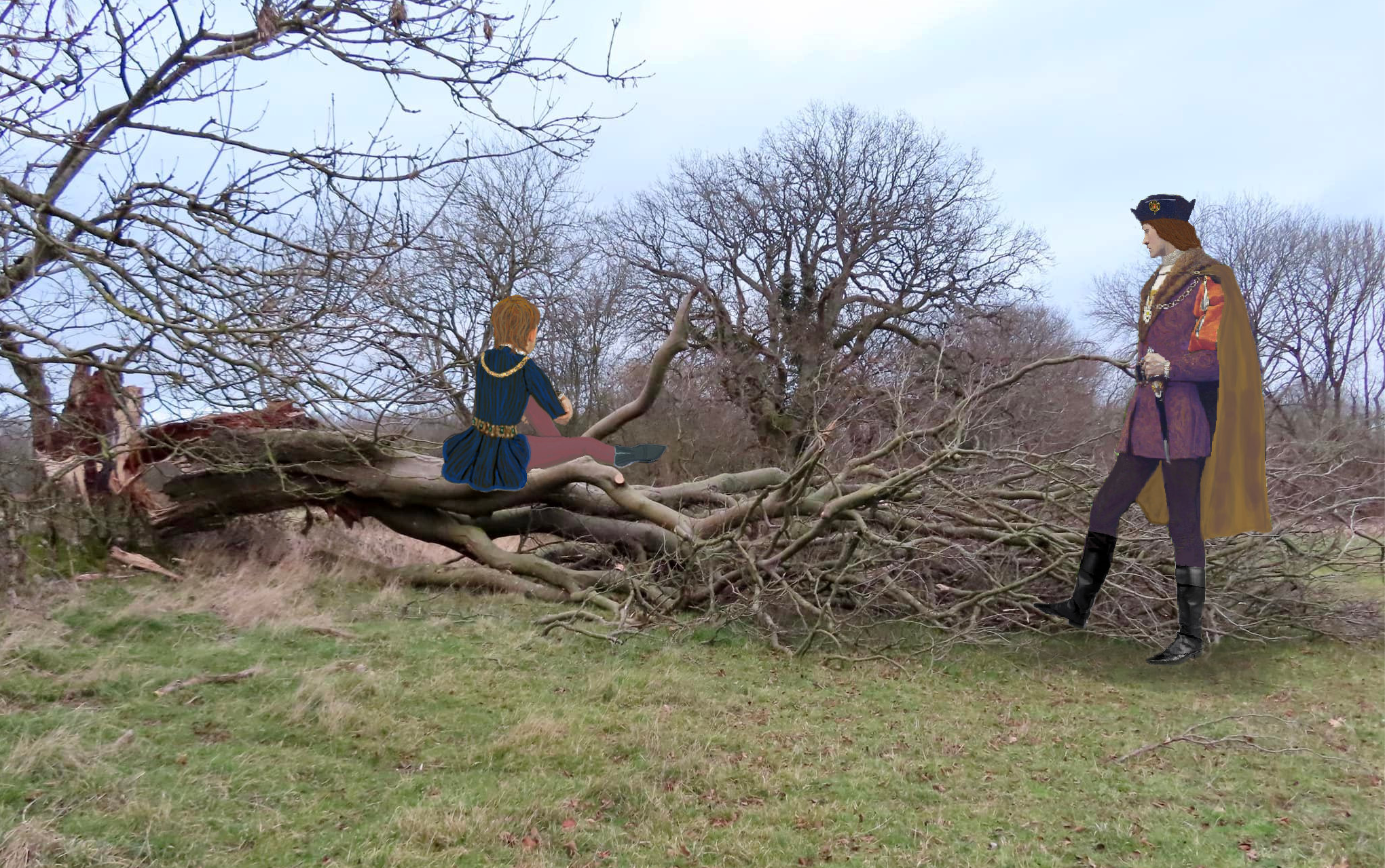
“Tell me, Ned, have you ever wanted to be king?”
“It…was my duty,” was the cautious reply.
“That isn’t the same as wanting to be king. If all had gone as your father intended, would you have accepted the crown?”
“Yes. Of course.”
“Why?”
The boy glanced at a nearby ash tree, where a woodpecker was at work. “I was always told I would be king, and I’ve been brought up to be just that, but….but I’ve always dreaded having to make decisions upon which the fate of England might rest.”
“So, it’s a role you fear rather than desire?”
“Yes. But you cannot possibly understand that.”
Richard laughed. “Oh, but I do understand, Ned. Do you really think I prefer what I am now to the happy, relatively quiet life I enjoyed with my wife and son in the north?”
Ned searched his uncle’s face in surprise. “You don’t want to be king?”
“The fact that your father didn’t marry your mother truly means that I am his next legitimate male heir. So I’ve done my duty and what the law demanded of me. Do you understand?”
“Yes. Elizabeth spoke of it to Dickon and me yesterday.” Ned swallowed and bowed his head for a moment at having to mention his brother.
“Ned, the position I found myself in meant that I couldn’t scuttle back to the north and the life I’d loved before. But you now have an opportunity to have the life you do want.”
“What do you mean?”
“That I’m giving you an opportunity to really disappear into anonymity and seclusion. Forever, if that is your wish, which I rather think it is.”
“How can I do that?”
“By seeming to have died at the same time as Dickon.” The words fell into a silence broken only by the woodpecker’s hammering and an occasional snort from one of the horses.
Ned’s eyes widened. “You…you’re going to kill me?”
Richard’s brow darkened. “For pity’s sake, that’s the Woodville in you talking! Of course I’m not going to kill you! I could never do that. You’re my brother’s child! I even tried to save my other brother Clarence from execution, and God knows he really had pushed your father too far. So no, I’m not proposing your untimely death, rather am I proposing your timely escape from everything you clearly loathe. A peaceful country life. You and Dickon were both going somewhere together until the fuss had all gone away, but you can still go there, and not just for the time being. I can make it possible for you to take up an entirely new life for good, with the comforts your blood demands. All you have to do is take up a different identity and forget about everything that has gone before.”
**********
As Elizabeth finished relating those long-gone events, Henry’s voice intruded upon the memories that had been so deeply buried. “Elizabeth?”
She met his eyes. “I’ve told you all I know.”
“Dickon is buried at Windsor with your father?”
“I believe so. It was what my uncle said he would see to. I wasn’t there for the interment, which was very private. Not even my mother went. The only other thing I can’t tell you is where Ned is now, or even if after all this time he’s still alive. It’s been fifteen years, and he stopped writing. Besides, even if I did know his whereabouts, do you honestly believe I’d tell you? I’d be signing his death warrant, just as I would if I’d identified Warbeck.”
An odd light passed through his eyes before he decided to blame Richard again. “I still find it hard to believe Richard didn’t do away with your brothers.”
She stiffened. “Which means you think I’m lying now? Not only that, you’re suggesting I colluded with Richard even though I knew he’d murdered my brothers.”
Henry was startled. “I didn’t say that!”
“Not in so many words, but it’s what you’re implying. I’ve told you the truth, and you either accept it or have me arrested as Richard’s accomplice in two vile killings.”
He took a long breath. “I don’t think any such thing, and if I’ve thoughtlessly given that impression, I apologise. I loathe your uncle, and you know why.”
“Yes. You’re jealous of him.”
He nodded. “I admit it. It would cut my soul in two if I ever learned he was the first with you.”
“Richard wouldn’t commit incest any more than I would. Oh, Henry, why can you not accept that you now know everything I know? We’ve just made a pact here, and I vow on our children’s lives that I haven’t lied about or omitted anything.”
He put a gentle finger to her chin, raising her lips toward his. “If it weren’t for York and Lancaster, do you think you and I could ever have….been content with our marriage?”
It was something he’d never voiced before, and it caught her off guard. She gazed at him, so tall and thin, so unlikely and unhandsome a king. And yet there was something about him to which she felt bound. “Maybe, Henry.”
He moved away with a wry smile. “At least you haven’t produced a dagger and hurled it through my black heart, so I must be content with that.”
“Our pact entailed you telling me your secrets as well, she reminded him.
“So it did.” He went to the table and rearranged the pieces of paper. H.O.L.R.I.G. “Contrary to your confession of what happened, this is where you’ll find Ned, alive and well, not buried with Dickon in your father’s tomb at Windsor.”
So this was what he’d been hiding from her for so long! She recoiled as if scalded. “Oh, Henry, you allowed me to tell you my version of events when you knew all along that—“
“I so wanted you to really tell the truth,” he said quietly.
“How long have you known about Ned?”
“I’ve known since Stoke.”
Elizabeth was shocked, but then her gaze slid to the letters and she asked the only thing she could think of in that numbing moment. “You say this Holrig word is a place?”
“It’s better known now as Coldridge in Devon, which Richard removed from your half-brother Dorset, to whom I have now seen fit to return it. Dorset walks on eggshells with me because I don’t trust him not to defect again. I never trust those who’ve turned traitor once.” There was immense feeling in Henry’s tone.
“As Sir William Stanley discovered when you had him executed,” she responded. “So much for having won Bosworth for you.”
Henry’s eyes flickered. “Precisely. Anyway, as you know, I wasn’t the one who originally sent Ned to Coldridge. That was Richard in 1484, and apart from an absence in Dublin and at Stoke, Ned’s been there ever since.”
Her head was spinning. Ned was the boy in Dublin and at Stoke. She’d known it, she’d known it!
“You’re clearly shaken, but at the same time you don’t seem all that surprised that I already knew of Ned’s survival,” Henry observed.
“I’m shocked about your hand in it all, but I’d already concluded that it had to be Ned at Dublin and therefore Stoke.” She studied Henry. “Why did you invent Lambert Simnel?”
Henry drew a heavy breath. “I didn’t know who I expected to find when I had the boy’s helmet removed after the battle, and I was truly shocked when he was identified by others as your other Edward. After all, you’d always insisted that both boys were dead. The last thing I wanted to do was produce to the world the real Edward V, whom I had made legitimate again in order to marry you. He had more right to the throne than me! Surely you can understand that?”
She nodded reluctantly.
“So I invented Lambert Simnel, but the boy who played him wasn’t coerced into the deception. He was anxious about the survival of his widowed mother and ten siblings. So in exchange for his services as the Stoke Field imposter, I paid very handsomely indeed for his needy family to be amply and comfortably supported.
“And then let Ned return to this Holrig-Coldridge place? Forgive me, Henry, but it doesn’t sound very likely. You, who have spent your reign so far exterminating the male Yorkist members of my family, have spared the one who is the greatest threat of all? Admit that it seems very unlikely indeed.”
“You’d rather think I murdered your brother on the spot, to be finally rid of him?”
“I would, except that it seems he’s still alive, which presumably you can prove.”
He gave a sad little smile. “You think I have no soul or understanding, no sympathy or honest emotion. Even after all this time, you still do not really know me. Yes, I allowed Ned to go back to his life in Coldridge, under Dorset’s dubious aegis. Richard had granted Ned the stewardship of the royal deer park there, a prestigious position that suited him down to the very ground. He was under tutelage at first, of course, first with Richard’s men and then with those of my choice, for I wasn’t about to leave Yorkists in charge of a boy who’d been the Yorkist king. That aside, he was quick to learn and was soon able to be in charge himself. He’s very successful. His name now is John Evans, although I’m not too sure it’s a wise name.”
“So that’s why your herald identified Ned as John.” Then she looked at him. “Why isn’t it a wise name?”
“Because I have a fancy it encourages suggestion and hint. Forget the John because he’s actually Edward. But Evans can be shortened to EV. Et voici, you have Edward V.”
“Henry, I think such reasoning is more your convoluted mind than the truth. You’re so suspicious of the world that you see new secrets and plots with every breath you take.”
“With some justification,” he replied.
“Perhaps. But I still think you’re wrong. If Richard was responsible for the John Evans identity, he certainly had no more desire than you to remind the world of who Ned really was. He and Ned wished to forget about Edward V.”
“You may be right. Anyway, when I interviewed Ned after Stoke I soon realised he hadn’t wanted to be prised out of anonymity in Coldridge and taken to Dublin. You know yourself that he didn’t want to be king, that he actually dreaded it. You’ve told me here today. Maybe Lincoln didn’t know or didn’t care, but he dragged the boy from coronation into battle all the same.”
“Lincoln wouldn’t understand,” she replied. “To him duty was everything, and therefore Ned—by then legitimate again—was honour bound to be king.”
“Knowing Lincoln, I believe you. And I must in turn confess you’re right that when I found Ned in my clutches I also saw a perfect opportunity to ridicule the Yorkist rebels with an absurd imposter. And yes, I was successful.” He smiled philosophically. “I also took the precaution of making the boy swear a solemn oath, in the name of the Holy Trinity, never to reveal his identity of rise against me in the future.”
She watched his face. “I’ll warrant there was more to it than just an oath.”
He smiled. Yes, there had been. He’d threatened to harm the boy’s siblings if the oath were broken. But when he spoke it was of Lincoln. “I have always wondered why Lincoln didn’t promote his own claim to the throne. After all, didn’t Richard, by then a childless widower, intend to name Lincoln as his heir?”
Elizabeth nodded. “It seems so. As for pursuing the crown for himself, fond as I was of Lincoln I know he could be hard when it came to what high birth entailed, and never more so than for kings and their heirs. The fact that he didn’t proves suggests to me that the main purpose was to reinstate the House of York no matter what. Lincoln was the better candidate, a man, strong and clever, well able to rule, but he wasn’t vain enough to believe he would gain the same overall support that my father’s legitimated son and heir would. So Lincoln cast his lot with Ned.”
“Well, whatever Lincoln wanted or expected, all Ned longed for was a return to the life your uncle provided for him, and I understood enough to let him do so. I also understood Richard’s reason for doing it in the first place, because I do know that he was an unwilling king himself. You see, I remember what it was like to be hounded by the House of York when I was a boy, always having to leave at a moment’s notice to escape capture. I hated it, and yes, I hated being expected to be king. But as you’ve noticed, my mother is a very determined and forceful woman. She had it in her head that I was to be king, and she worked tirelessly toward that end. Not even Stanley stands up to her.”
“You didn’t want to be king?” She was taken aback.
“No. Nor, right up until the moment Richard fell, did I expect to be. At Bosworth I’d reached the point of no longer caring. In fact, if I’d been dealt the fatal blow on the field I’d have been relieved that it was finally over. Perhaps that’s how Richard felt too. He’d lost his wife and child and was surrounded by sycophants and traitors. Nothing but strife and grief for the two short years of his reign. Why bother anymore? Hence that fatal but magnificent final charge. I admired him then and I still do. He went down fighting like the warrior he was. A coward he was not. Unlike me, mm? I go to great lengths not to expose myself to danger on battlefields, and now I am king, I intend to die in my bed after a long reign.”
“I had no idea that was how you felt.”
His moment of self-revelation was at an end, and he took a brisker tone. “I’m told that when Ned returned to the manor house that is his home, he was so exhausted he collapsed fully clothed on his bed with his beloved hounds and fell asleep for a whole day and night.”
Tears stung her eyes as she envisaged the scene. “Yes, he would. Poor little Ned.”
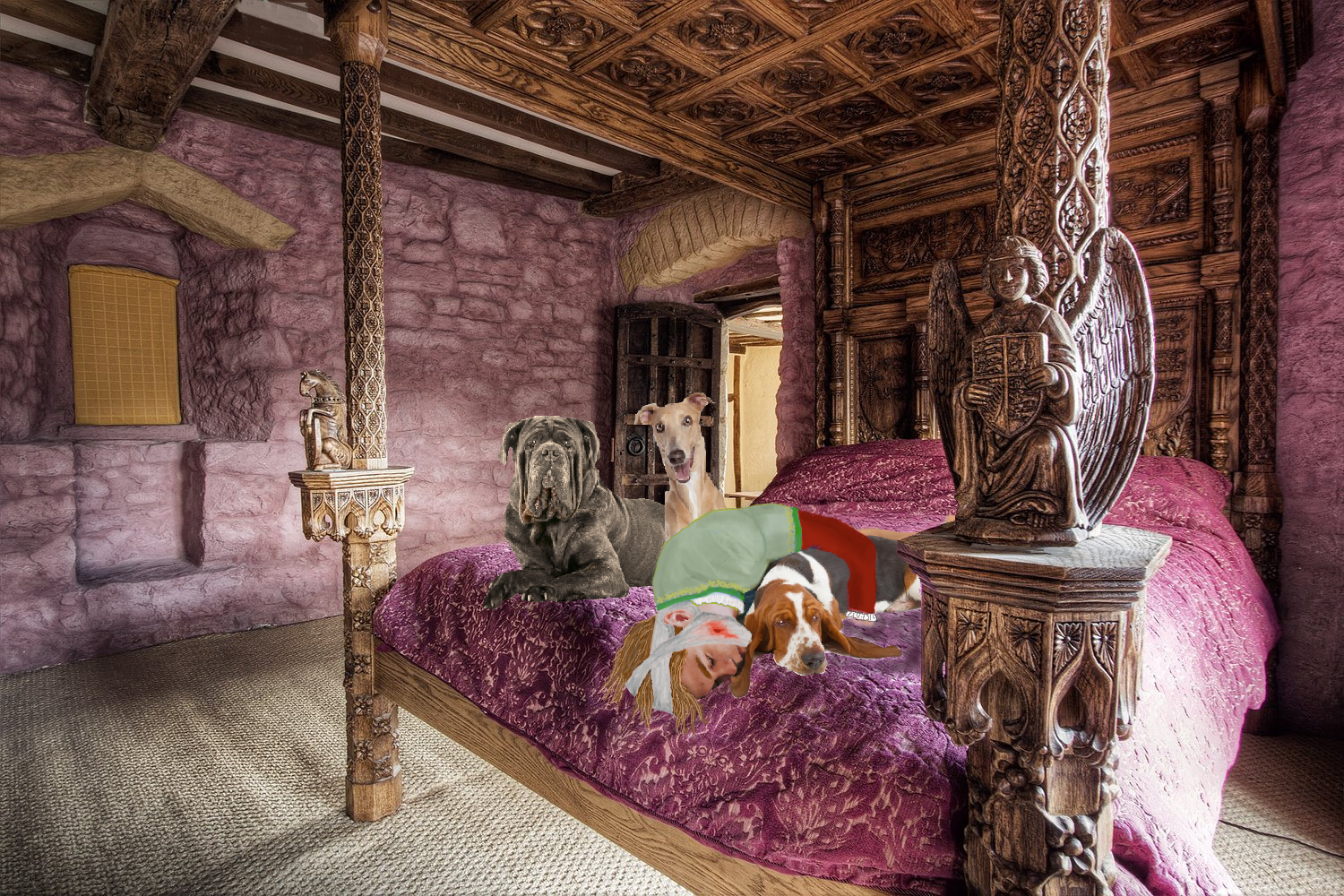
“Poor little Ned is now twenty-nine, a muscular six feet tall and married with a son. Visually he’s Edward IV’s offspring, of that there’s no doubt. His new family has no idea at all that he is actually the missing King Edward V. To them he’s simply the man who has charge of the royal deer park. The parker, I believe is the correct term.” Henry hesitated. “There is something else you should know. In the course of the battle, or while being captured, he sustained a wound to his face. Well, the side of his chin. It was deep and affected his ability to speak. He can only make strange noises. Well, some words, but only with difficulty.”
Elizabeth’s eyes flooded with tears and she pressed her hands to her mouth.
“It renders him a virtually impossible candidate for the throne. No one is going to rally to support a man who cannot even speak properly and who looks like something conjured in a nightmare.”
She turned away tearfully. “Don’t, please…”
He came to take her by the arms tentatively. “That isn’t why I felt able to let him return to Coldridge. Please believe that. I would have allowed it even had he been whole. I admit to having done things of which I’m not proud, but I wasn’t guilty of this. The injury was accidental, the result of battle, not intentional. Please, Elizabeth, in this I am innocent. Think about it. If I’d wanted to, I could have eliminated him completely. He was still a boy, yes, but—”
“But boys grow up and then you execute them.”
His hands fell away. “Only when they’ve been proven to be involved in fresh plots against me, as Warwick was.”
She struggled for composure. “You’ve known all this and yet kept it from me?”
“Elizabeth, you kept insisting your brothers were both dead. Years and years of hiding secrets from me, like a little Yorkist squirrel. So I became a Tudor squirrel. It wasn’t until today that you finally admitted that Ned had survived in 1484.”
She coloured and hid her guilt behind a jab at his mother. “I suppose dear Lady Margaret has known all along too? How sneering and superior she’s been feeling!”
“No, Elizabeth. Contrary to your belief, I do not tell my mother everything. Nor will I be telling her what you’ve said here today. Please believe me. And believe me too when I say that I hope that from now on you and I can trust each other more.” Turning on his heel, he began to leave the room.
But she called after him. “Henry, if you knew in 1487 that you have Ned in your clutches, you must have questioned him about Dickon. So you’ve known all along that Dickon died in 1484.”
“Not quite. Yes, I had Ned, but no, he didn’t tell me about Dickon. In fact he said that as far as he knew Dickon had gone to your aunt in Burgundy. That was why I was so taken in by Warbeck. I thought he was Dickon.”
So Ned had adhered to what Richard said that chill January day by the fallen tree.
“Is there anything else?” Henry enquired.
“Yes. These pieces of paper…. How are they here? Who did it? Do you know?”
“I have a strong suspicion.” He hesitated, clearly uncertain whether it was the right moment to confess about the mysterious rude boy. Then he saw Robin sitting on the floor in the entrance. “Ah, my faithless monkey has condescended to return.” Where was the boy? Not far away, Henry guessed, for the two clearly went together.
Elizabeth saw the monkey too. “Robin?” she called, and the little creature dashed toward her. Studiously avoiding Henry, it leapt into her arms and crooned as she cradled it. She tapped its nose. “You are not to go near Henry’s new notebook, is that clear?”
“That monkey seems to belong to everyone except me,” Henry grumbled.
“You shouldn’t have been so beside yourself with rage when the other notebook met with its doom.”
“So it’s my fault he’s turned his back on me?”
“Yes.”
“I might have known.” He sighed resignedly but a movement in the entrance told him the boy had appeared again.
Elizabeth saw how he looked at the doorway. “What is it?”
As the boy treated him to a mocking grimace and a very insulting waggle of the posterior, Henry paused for such a long moment that she thought he wasn’t going to answer, but then he scowled and pointed. “Do you know that boy?”
Elizabeth saw nothing. “What boy?”
“You can’t see him?” Henry’s heart sank. He was imagining things?
Elizabeth was uneasy. “Are you feeling unwell, Henry?”
“I wish that were so, but I’m in perfect health. There’s a boy standing there, and this is the second time I’ve seen him today. The first time he simply disappeared in front of me like that.” Henry snapped his fingers.
She was nonplussed. She didn’t doubt that he’d seen what he described, because Henry Tudor wasn’t a man to invent such odd things. He’d invent tall tales about his enemies, like a spider spinning a web, but peculiar anecdotes about seeing boys? No. “What is the boy like, Henry?”
He gave her a description.
Dickon? No, it couldn’t be….! Shocked, she looked at the doorway again, but there wasn’t even a shadow there. “Henry, the boy you describe is exactly like Dickon,” she said at last.
Henry’s face changed and he gaped at the boy, who was now grinning and clapping his hands. “Elizabeth, it would seem you’re right. He is Dickon. Or at least he thinks he is.”
The boy scowled. “I am Dickon! I am!”
Only Henry heard.
She had hastened to the doorway. “Dickon?”
Henry watched. “You passed right through him. I fear he’s only making himself known to me. He said earlier that he hates me because I did away with his brother and cousin. I didn’t understand who he could be then, but after all you’ve said to me today, it’s as clear as day. He also says that the deaths of Warwick and Warbeck are the reason he’s come back. He wants you to know Ned at least is still safe and well, so that you can tell your mother and sisters. Of course, you already know because I’ve just told you myself.”
She was in tears. “Dickon? Please appear to me as well! Please!”
But there was only silence.
“It’s my opinion,” Henry continued, “that he is also responsible for the pieces of paper. Is that not so, Dickon?”
The boy shuffled, but then nodded. “I ripped a page from your new notebook when you were asleep.”
His new notebook had been desecrated? Henry looked as if he could personally throttle the cheeky brat.
The boy continued. “I can’t speak to Elizabeth so it was my way of trying to tell her where Ned is,” he explained. “Uncle Richard called the place Holrig, and I thought that was the name. I didn’t know it was now Coldridge.”
Still hearing and seeing nothing, Elizabeth felt foolish as she reached around in the empty air, hoping to touch her long-lost brother. “You’ve come here like this, Dickon, so do you go to see Ned as well?” she asked at last.
The boy shook his head, and Henry told her of the response.
She was swift to seize the opportunity. “But you can if you want to, can’t you, Dickon? I know you can.”
Dickon looked guiltily at Henry and then nodded. “Yes, I think I can. But I don’t really know.”
Henry relayed the words dutifully, and Elizabeth smiled at the thin air. “Dickon, please tell him I love him, that our Mother loves him and our sisters do too!”
Henry added a swift qualification. “But no one will actually visit Coldridge, Elizabeth. Ned is safe as he is but will not be if his royal relatives descend upon him.” Another thought gave him pause for thought. “Elizabeth. If Ned rose against me, which of us would you support? Mm?”
“I’d support the father of my children. As I did at the time of Stoke.”
“She said without hesitation,” he murmured.
“Oh, be sarcastic again, but if it came to a choice between your darling mother and the mother of your children, who would you choose?”
“I will not dignify that with an answer.”
“Making it clear enough you’d choose her.”
Henry met her accusing gaze. “No, Elizabeth, I wouldn’t. You’re precious to me, and you have no idea how much I wish I could trust you through and through. But I always have to fear with whom you may be in contact, of what plot you know, to whom you may have sent finances. I love you. Yes, I do, and it’s my burden, because although you’re my queen, I’m not your king. That honour goes to a dead man.”
With those final few words all the understanding that had embraced them both at last was washed aside as his old jealousy of Richard swept back like an immense tidal wave.
Then, before she knew it, he’d gone, his steps hurrying away beyond the entrance. She knew that Dickon had gone too, for the empty air was suddenly emptier. Even Robin leapt from her arms and scurried off in the invisible boy’s wake. She was alone. Confused and distressed, she closed her eyes and drew a long breath.
If Ned were to return to claim the throne, what would she do? Support her brother at the expense of her children? Was that not what she now thought her own mother had done? And to support Ned she, Elizabeth, would have to risk condemning Henry to death. She wanted to hate the man she’d had to marry, but sometimes, sometimes he could reach her heart. Now was such a time. Yes, he loved her. He didn’t want to, but he couldn’t rule his heart.
Could she rule hers? “Oh, Henry…” she breathed softly.
**********
Now completely entrenched in his identity as John Evans of the king’s deer park at Coldridge, the man who as a boy had so briefly been King Edward V rode through the crisp morning air as he inspected the park that was his kingdom these days.
At twenty-nine Ned was now far from the unhappy boy who’d come to Devon in 1483, and many would no longer recognize him due to the terrible scar on his face, the result of the sword strike received in 1487. He spoke as little as he could and then only when he had to.
At first the unsightly injury had caused consternation among the local people, even alarm, but now everyone accepted and liked him. His post gave him many powers, but he took after his uncle Richard more than his own father and was always fair in his actions. He was married, his wife’s name was Margaret, and he had a son he’d named Richard, after his long-lost little brother and their uncle. Did he miss his former life? No, because he was happy now. The pressures of having charge of the king’s deer park were as nothing to the pressures of being the king himself or the heir.
He often thought of his sisters, especially Elizabeth. He wondered if she was happy as Tudor’s wife, or if she yearned for the Portuguese marriage their uncle had been planning.
It was his horse that sensed something at first, suddenly shying and refusing to continue. Ned looked around but could see nothing. But then he saw a splash of blue and red, hazy at first before becoming clearer. A boy, wearing blue with red hose! A familiar boy. No, it couldn’t be, he was imagining it because he’d been thinking of his old family.
But then the boy waved in that exuberant way Ned remembered across the years. Dickon? Could he possibly be seeing Dickon?
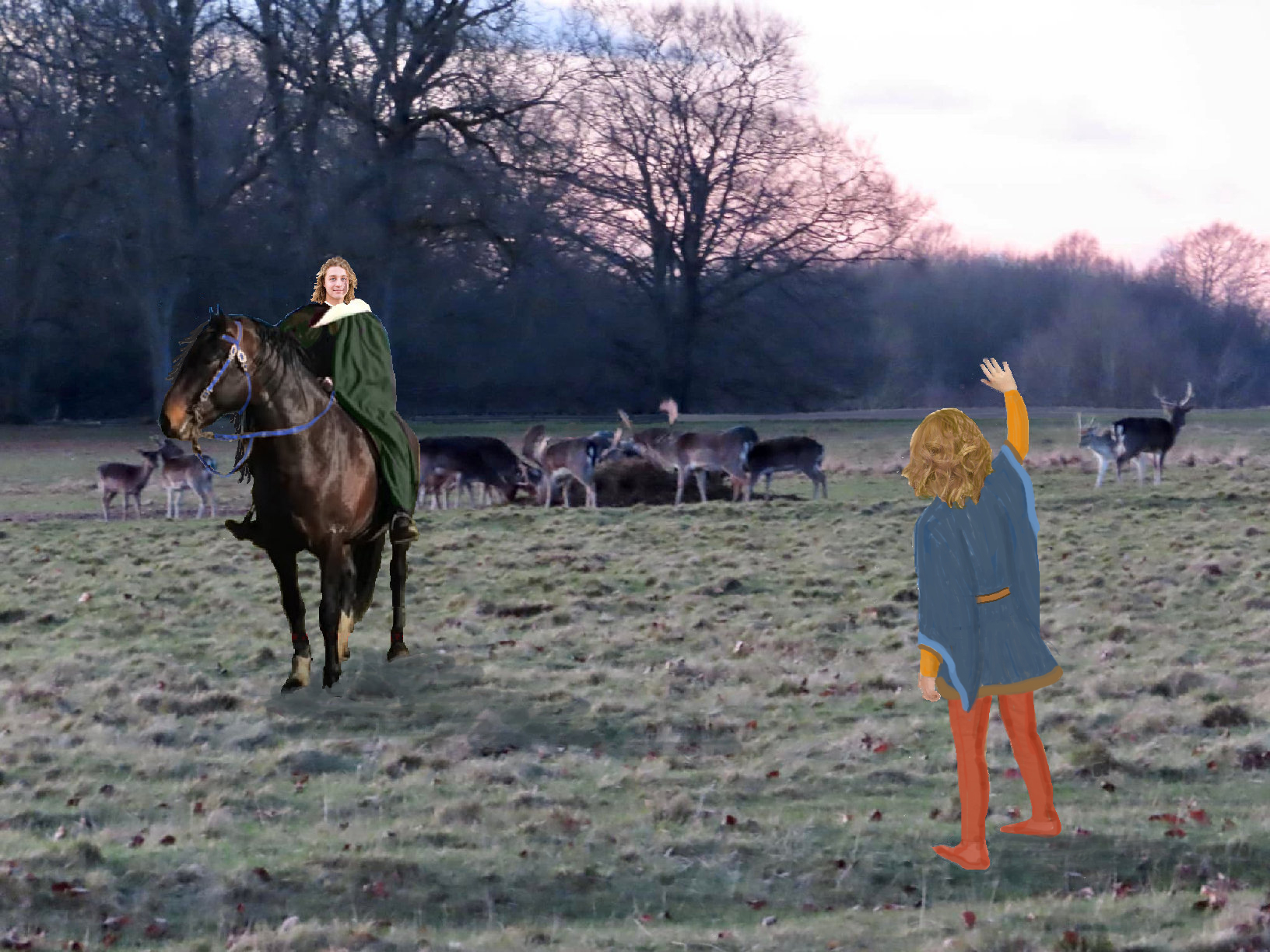
The boy began to run toward him, still waving excitedly. The horse shuffled but no longer seemed afraid. Its ears pricked and it made a soft whickering sound as it sensed only love and friendliness.
Ned dismounted slowly and tried to speak clearly. “Dickon? Is it really you?”
The words were hard to decipher, but Dickon understood and had never been less of a ghost as he ran to fling himself into his brother’s arms. He was visible, audible and tangible to the man who as a boy had for thirteen short weeks been King of England.
“I’m sorry I threw your favourite hat in the fire, Ned!” the little boy cried, sobbing.
Ned’s arms tightened around him. “And I’m sorry I pushed you,” he managed to say through his own tears.
—The End—
List of Illustrations:
Figure 1: The setting is from Free Images : architecture, wood, staircase, arch, castle, interior design, upgrade, emergence, gradually, stone stairs, observation tower, man-made object, ancient history 2687×4182 – – 898843 – Free stock photos – PxHere
Figure 2: The setting is the Royal Lodge, Château de Loches sud-Touraine, France. The figure of Elizabeth of York adapted from French Noblewoman, C.E. Doepler, middle of the 15th century. Henry is from Look and Learn.
Figure 3: The setting is Dartington Hall, Devon. The figure of Dickon is adapted from the painting The Murder of the Sons of Edward IV (1835) by Theodor Hildebrandt (1804-1874)
Figure 4: The background is from my daughter’s Chilly Cotswolds album. The figure of Richard is adapted from the painting A Call to Arms by Edmund Blair Leighton. The figure of Ned is a much altered modern photo of a boy in T-shirt and jeans, source mislaid.
Figure 5: The setting is from https://www.medievalaccommodation.com/?fbclid=IwAR2knb9sB-i_WrTJe0j-Ef2ph-s2Ezyrm5Nlvhe_mEM7Fv5nLtorOZz8w5w
Figure 6: The setting is my daughter’s photograph of deer at Barrington in the Cotswolds. The man on the horse is adapted from- https://www.youtube.com/watch?v=JOGQ2NcZzKs. The boy is a much altered modern photograph, no source available.
—Definitely the End!—
Published 29/01/2023By viscountessw EditThe boy who had been king….
Categorized as battles, buildings, law, religionTagged “confessions”, “Lambert Simnel”, “Oakhanger”, “Perkin”, “Princes”, attainder, Battle of Bosworth, Battle of Stoke, bigamy, Catherine of Aragon, Coldridge, Devon, Dublin Cathedral, Edward of Warwick, Edward V, Elizabeth of York, Essex, executions, fiction, fire, George Duke of Clarence, Havering atte Bower, Henry of Buckingham, Henry VI, Henry VII, hunting lodges, illegitimacy, imposture, John Earl of Lincoln, Kent, Lady Catherine Gordon, Lady Margaret Beaufort, Lord Protector of the Realm, Ludlow Castle, Margaret of Burgundy, notebooks, Oxford, Portuguese marriage plans, Richard III, Richard of Shrewsbury, Richmond Palace, Sheen, Sir John Evans, Sir William Stanley, Spain, Thomas Grey Marquess of Dorset, Thomas Stanley, Titulus Regius, Tower of London


 The New Murrey and Blue blog
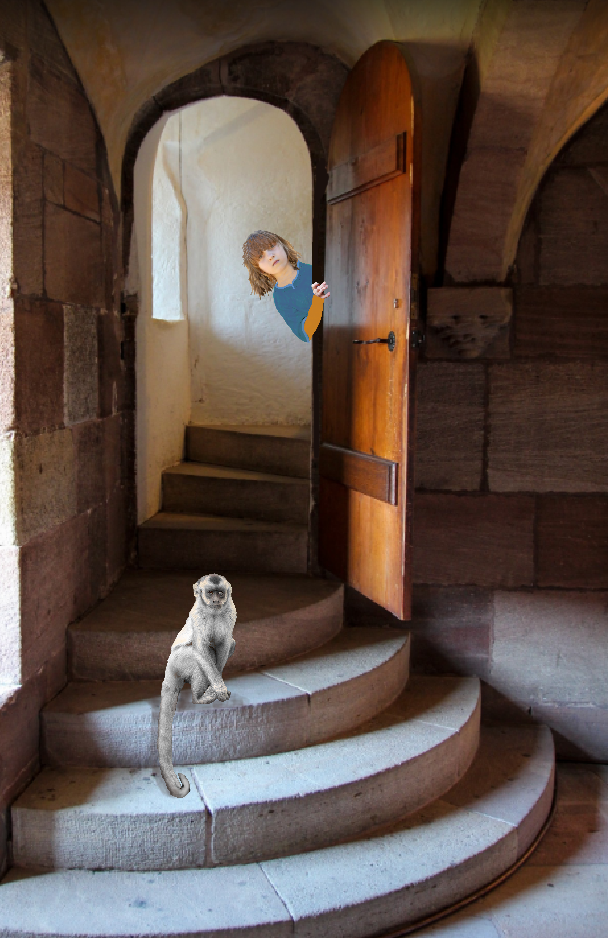
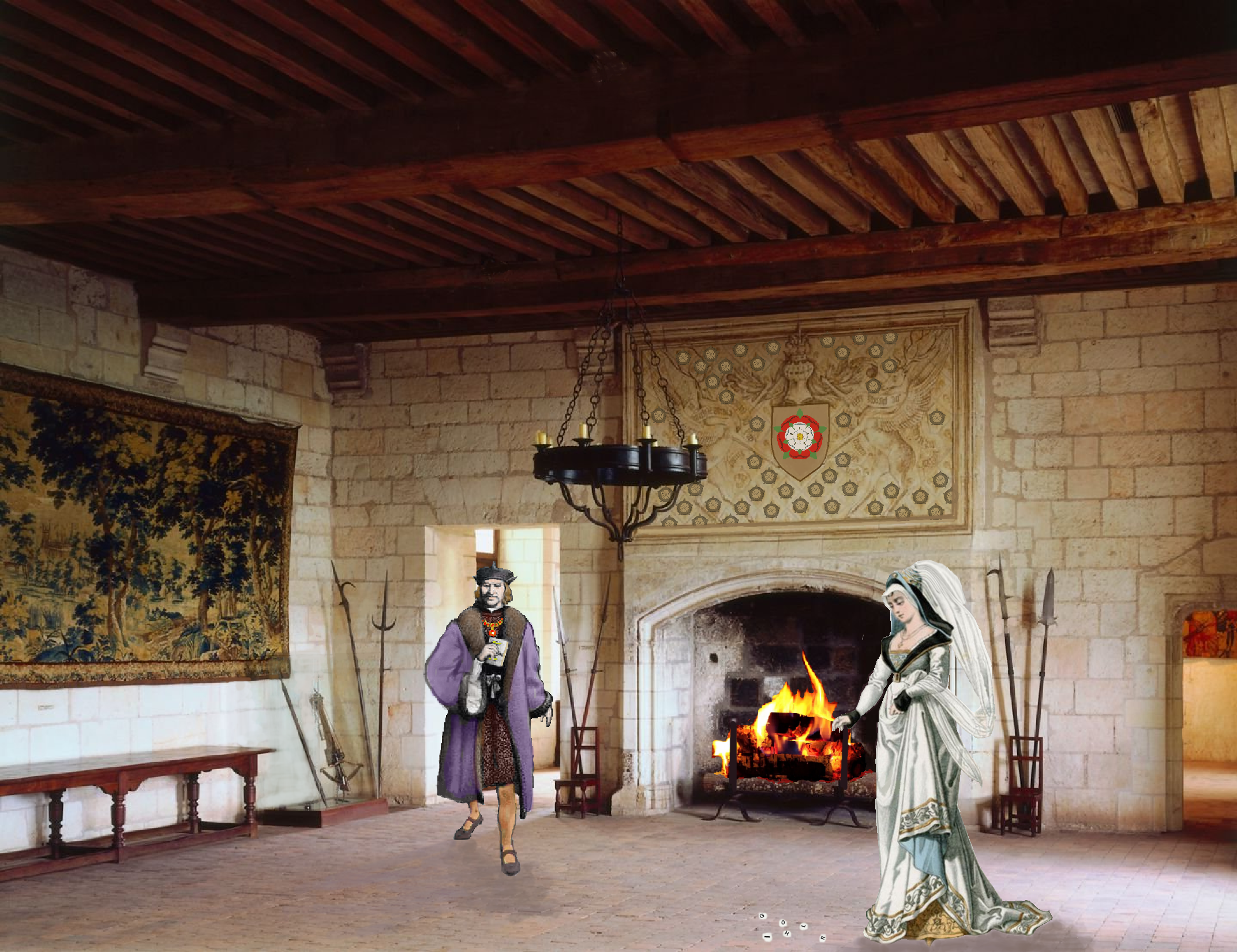
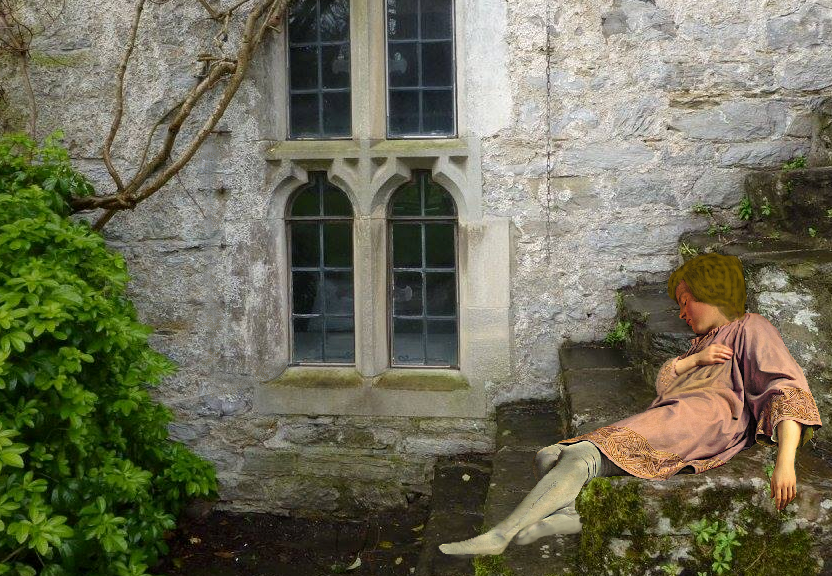
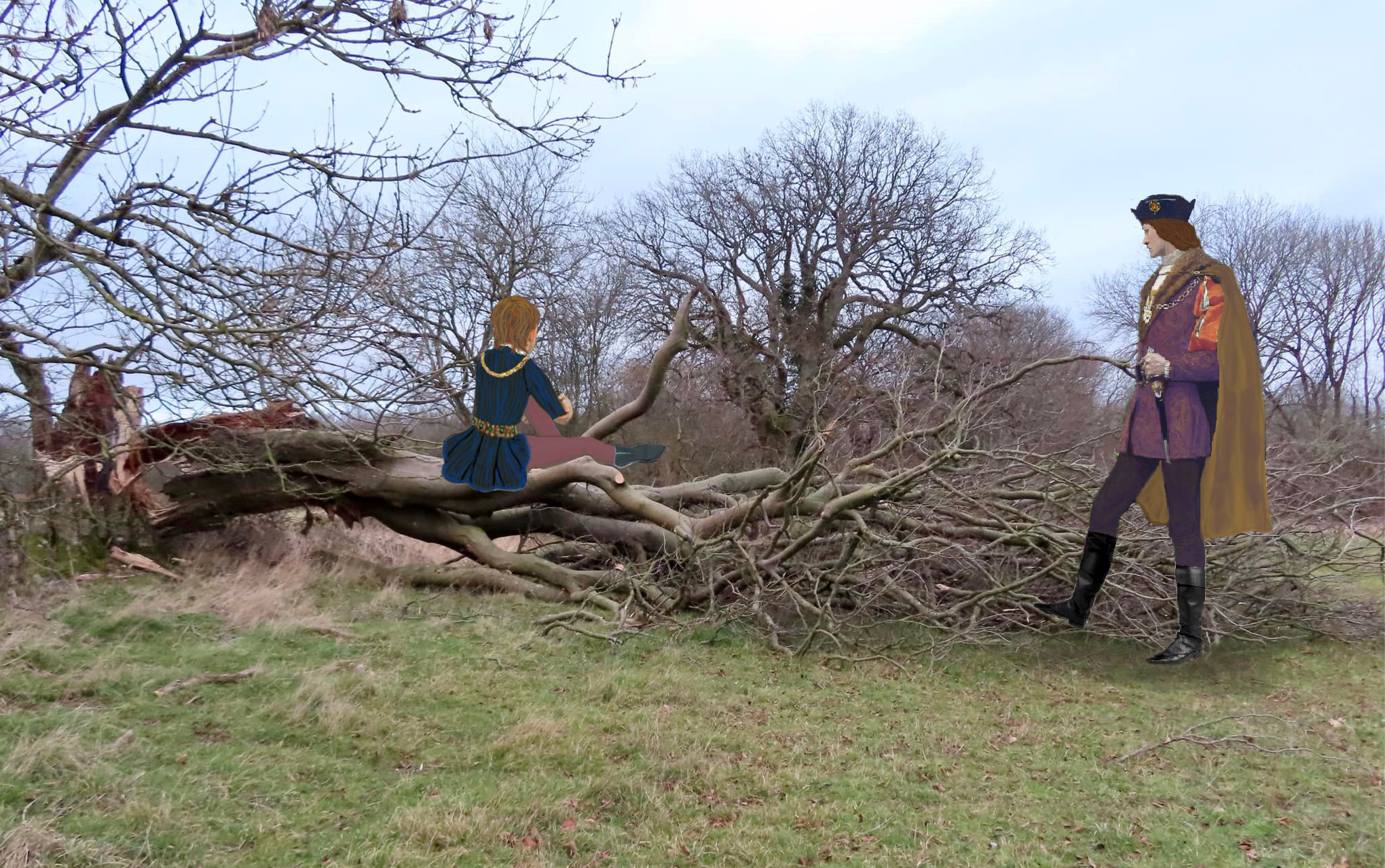

Leave a reply to More TV delving into what happened to the boys in the Tower…. – murreyandblue Cancel reply