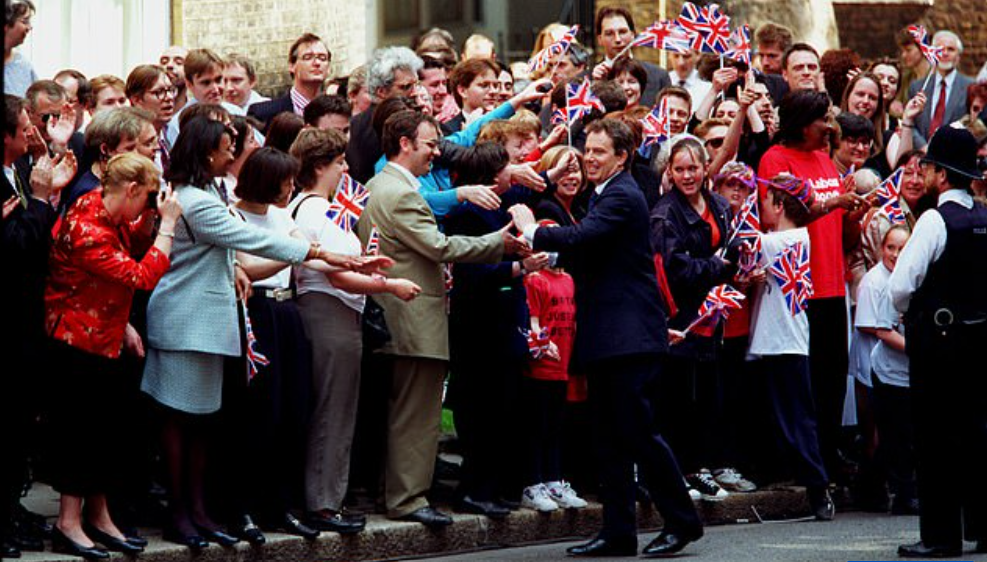
At first glance you’d think this article by Peter Hitchens of the Mail Online is going to be in praise of Tony Blair, especially when you also see the above photograph. But the former Prime Minister only comes into it to illustrate how at least one modern myth sprang up.
The article goes on the explain why Hitchens no longer takes anything at face value, but always delves further to get to the truth. To begin with he draws attention to new myths that are already taken as gospel, including the following story about Tony Blair:
“….the film of people gathered in Downing Street in May 1997, waving Union Jacks as the Blairs walk up to the front door of No 10. It is still quite often shown on TV, without comment or qualification, to suggest a great wave of public joy at the arrival of New Labour in power….Yet a moment’s investigation reveals that in May 1997, Downing Street was closed to the normal public, and that the ‘cheering crowds’ were composed of Labour loyalists rounded up and issued with Union Jacks to wave (which I suspect most of them must have rather hated)….”
Hitchens mentions other instances—not all involving Tony Blair, I hasten to say!—but then comes to the reason why he, Hitchens, views “face value” with deep suspicion.
It goes back to his school days, when a schoolteacher gave him “a small green book” that turned out to be a copy of Josephine Tey’s The Daughter of Time, which he, Hitchens, describes as “in a way the single greatest detective story ever written”. It also uncovers the most abhorrent lies that have been taken at face value for centuries.
We Ricardians know this wonderful novel inside out and back to front, of course, but in his school days Hitchens was new to it. Like most other people at the time (and now, sadly) he believed Richard III was an evil old child-murdering, hunch-backed monster, and like the main character in Tey’s book, one Alan Grant, a police detective laid up in hospital, he has his mind changed and his finger directed at the likely real culprit, one Henry Tudor.
Grant embarks on “the piece-by-piece demolition of the case against Richard, and the growing mountain of evidence against his sly successor, Henry VII, which piles up as the case proceeds”. You betcha it piles up! The Weasel was capable of anything. Horrible man!
The dogged detective also “develops an absolute hatred for the man he starts to call, with relentless sarcasm, ‘The sainted Thomas More’”. (By the way, I too now refer to More as the Sainted More, so something in that wonderful book certainly penetrated my youthful skull!)
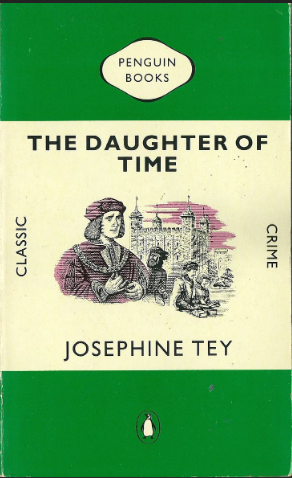
Hitchens, again like Grant, comes down in favour of Richard and his “just and largely happy reign”. Oh, if only Richard had been on the throne infinitely longer than fate dictated. If only the Weasel had been crushed at Bosworth.
But “if only” must be among the two saddest words in the English language.


Leave a comment