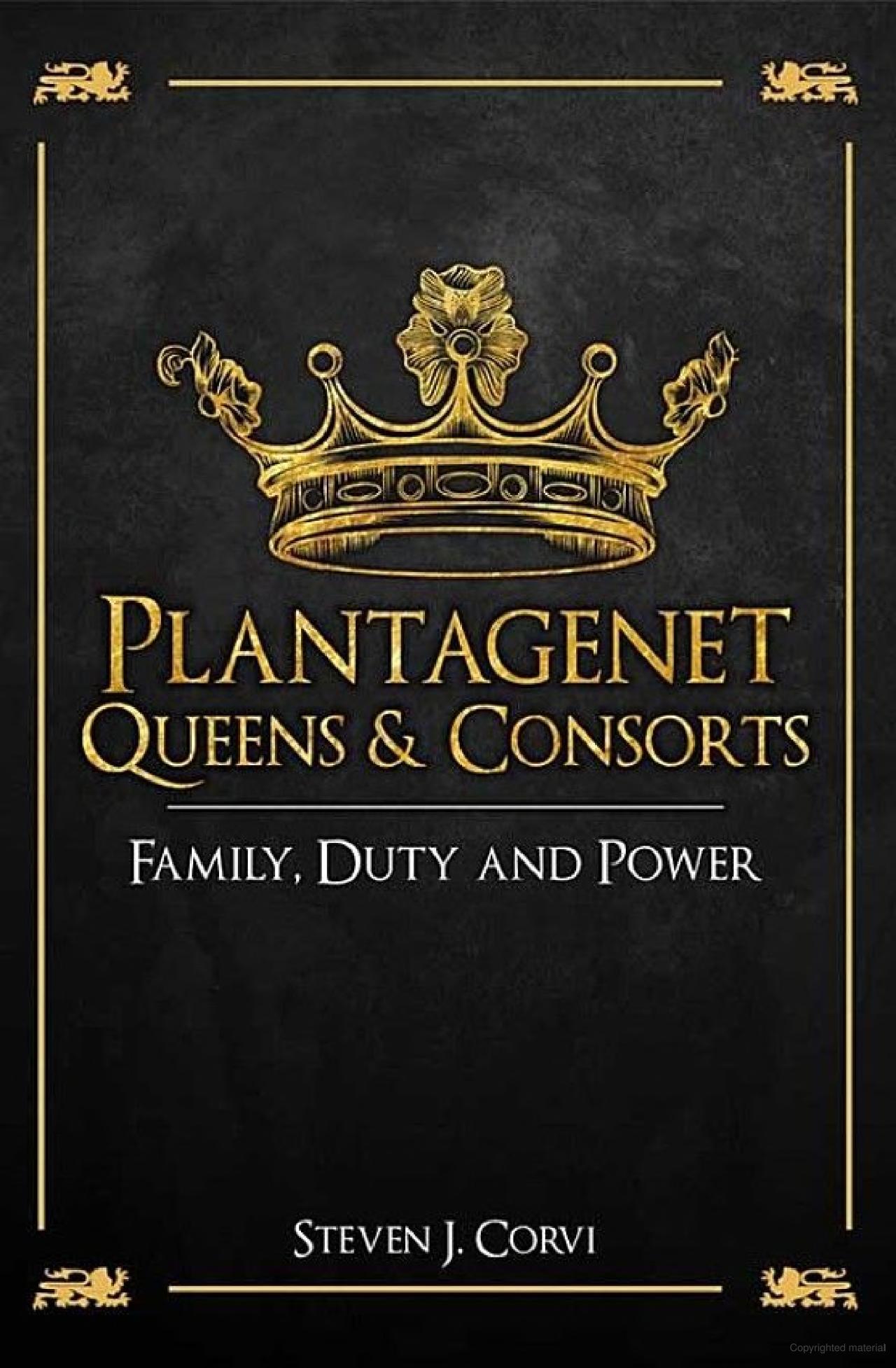
A review of Plantagenet Queens and Consorts by Steven J. Corvi
I am always partial to a good book on medieval English Queens. History being what it is, these women often get overlooked and sidelined unless they did something that was, usually, regarded as greedy, grasping or immoral. Therefore when I saw Steven J. Corvi’s book ‘Plantagenet Queens and Consorts’ I thought that sounded right up my alley and might redress some of the imbalance
I expected that each Queen, from Eleanor of Aquitaine onwards, would have her own chapter, even if only a brief one. Instead, there were chapters seven Plantagenet Queens, starting with Eleanor of Provence, the wife of Henry III, and ending with a queen who WAS a Plantagenet herself, but was not a ‘Plantagenet Queen’ —Elizabeth of York, the wife of Henry Tudor. Weirdly, Joan of Kent , mother of Richard II was included, even though she was never a queen, and the same goes for Katherine Swynford, wife of John of Gaunt and mother to the Beauforts who were forebears of both the House of York and the Tudors . Disappointing, however, were the omissions: Edward I’s wives, Eleanor of Castile, and Marguerite of France, Richard II’s wife Anne of Bohemia and…Anne Neville, consort of Richard III. This omission surprised me, as both Elizabeth Woodville and Elizabeth of York had their own section, and the flow of the historical data is lost without the ‘bridging’ part in the middle.
I understand that very little concrete is known about Anne but a short recap of her life might have been advisable for completion. Either that, or the author should have concentrated on a smaller number of historical figures, maybe 4 or 5, or omitted Joan and Katherine, and put in those who were, you know, actual Queens that were married to PLANTAGENET KINGS (not, ahem, a Tudor!)
Other errors include referring to Edward IV’s relationship to Lady Eleanor Talbot as an ‘engagement’. A pre-contract is not an ‘engagement.’ Corvi also asserts that it was unlikely Elizabeth Woodville would be connected to the ‘Lambert Simnel’ rebellion because she’d ‘worked so hard to marry her daughter to Tudor’ and says ‘that there is strong evidence that Henry ever seriously doubted Elizabeth Woodville’s loyalty’. (Oh yeah, just packed her off to Bermondsey!) Interestingly, the author then goes on to admit Henry wasn’t particularly kind to her–Well, tell me then…why was that the case?
So the book is a bit disappointing overall, although I did enjoy the chapter on Joanna of Navarre (who often gets overlooked as a consort) and the author did make a few amusing statements about Henry VII that were less than flattering and certainly didn’t paint him as some kind of ‘saviour’ as some books do!

Missing in Action: Queen Anne Neville!


 The New Murrey and Blue blog
Leave a reply to Q Cancel reply