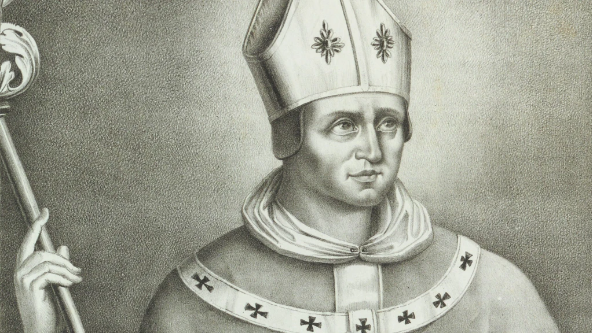
Becket wasn’t the only troublesome priest in medieval England, because in 1244 came another, Boniface of Savoy (see here and here) who became Archbishop of Canterbury. Boniface was the younger brother of Amadeus IV, Count of Savoy, and one of their nieces was Henry III’s queen, while another was married to King Louis IX of France, so I suppose we can guess how Boniface got the job. The medieval chronicler Matthew Paris said that Boniface was “noted more for his birth than for his brains”. And given the story I am about to relate, I think he was probably right.
Boniface wasn’t very popular in England because he was a foreigner and appeared to be more interested in furthering the ambitions of his continental family than being head of the Church in England. In fact, of the twenty-nine years he was archbishop, he only spent fourteen in England.
On this day (14 July) in 1244, shortly after being appointed, he visited the friars of West Smithfield Priory (St Bartholomew’s) which had flourished because a vision of St Bartholomew had appeared to one Friar Rahere/Rayer/other spellings, see here. A large number of “miracles” ensued, widely thought to have been contrived by Rahere. Whatever the truth, the priory arose and its coffers filled very nicely.
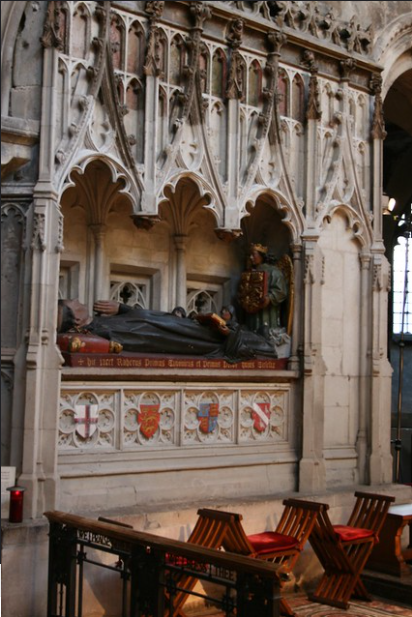
When Archbishop Boniface arrived at the priory gate he was received with great pomp and ceremony, which displeased him. He said he was there as part of the duties of his office, not to be treated like visiting royalty (or words to that effect). Then, according to British History Online :-
“….The canons, irritated at his pride, replied that having a learned bishop of their own, they desired no other visitation. The archbishop, furious at this, smote the sub-prior on the face, crying, “Indeed! indeed! doth it become you English traitors so to answer me?” Then, bursting with oaths, this worthy ecclesiastic fell on the unfortunate sub-prior, tore his rich cope to shreds, trampled them under foot, and then thrust the wearer back with such force against a chancel pillar as nearly to kill him. The canons, alarmed at this furious onslaught, pulled the archbishop on his back, and in so doing discovered that he was armed. The archbishop’s Provençal attendants, seeing their master down, fell in their turn on the Smithfield canons, beat them, rent their frocks, and trod them under foot. The canons then ran, covered with blood and mire, to the king, at Westminster, but he refused to interfere. The citizens, by this time roused, would have rung the common bell, and torn the foreign archbishop to pieces, had he not fled over the water to Lambeth. They called him a ruffian and a cruel brute, and said he was greedy for money, unlearned and strange, and, moreover, had a wife….” (Oh no! The ultimate ghastly sin!)
After which Boniface promptly left the country and didn’t return for five years. Heavens above. Can you imagine our present Archbishop of Canterbury becoming embroiled in such a shocking display? No, nor me.
You can read about Boniface’s career here. He is not to be confused with his nephew Count Boniface of Savoy, the son of Amadeus IV. During a visit to his native Savoy, Archbishop Boniface died at the castle of Sainte-Hélène-sur-Isère on 14 July 1270, exactly twenty-nine years to the day since he’d become archbishop in 1244. (Some sources say he died 18 July.)
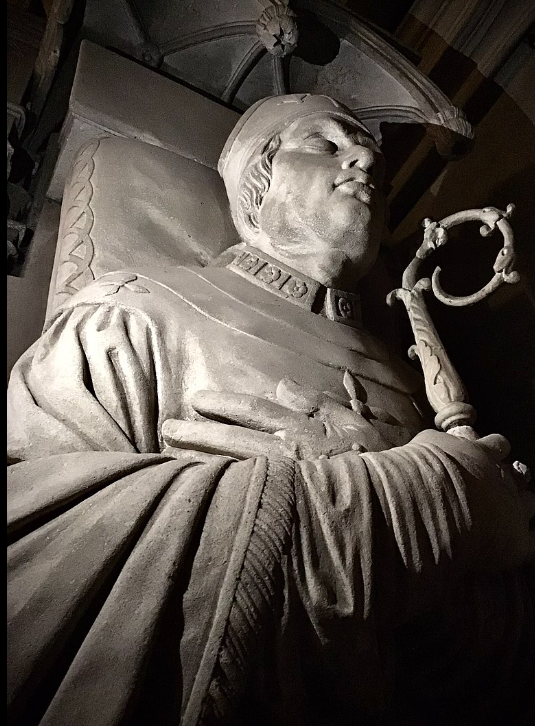
My, if that’s his right hand on his breast, it looks enormous! If he’d started swinging around with that, he’d have flattened everyone within reach. I’m put irresistibly in mind of the late great Kenny Everett’s Brother Lee Love! Except that being loving to his flock doesn’t appear to have been Boniface’s strong point.

 The New Murrey and Blue blog
Leave a reply to H.J. Hill Cancel reply