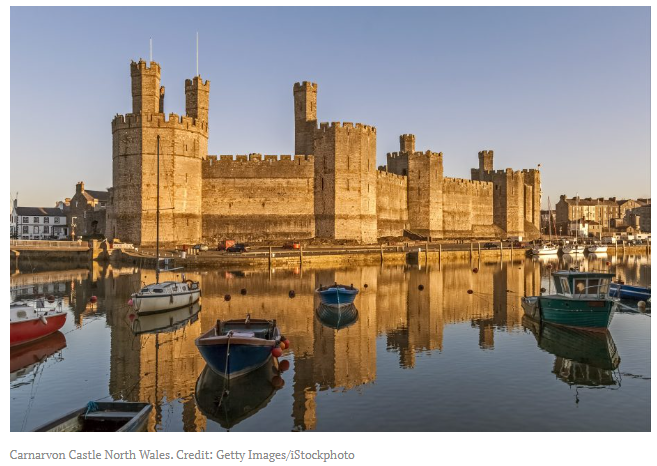
The great fortresses built by Edward I to subdue the rebellious Welsh are all spectacular and have survived the centuries. Now they are considered beautiful examples of medieval workmanship and have become great tourist attractions, which isn’t really what old Longshanks ever intended!
One of the finest of these fortresses is Caernarfon which is always made even more photogenic by its position right where the Afon Seiont river runs out into the Menai Strait. Of course, this means a close proximity to Anglesey, which had Tudor connections, but Caernarfon Castle is safe from such contamination (😊). Edward I wasn’t the first to fortify this situation, for it was a Roman fort before the castle, and the first castle (also the work of Edward I) burned down too, but Edward rebuilt it and left us what we have today.
When Longshanks considered he had subdued the Welsh, he insulted them further by presenting his new-born son, the future Edward II, to them and saying the baby was the Prince of Wales. I’m sure the Welsh had much more legitimate princes of their own, thank you very much. But such is the way for winners and losers/.
I remember seeing the now King Charles III being invested Prince of Wales in 1969, but it seems we are not to see Prince William similarly invested. Such great ceremonies cost money and this one is probably unnecessary. We all know already Prince William is now the Prince of Wales.
The above was inspired by this article which also contains a link to the castle’s own website.


Leave a comment