A short story by Sandra Heath Wilson (viscountessw) Please remember, ladies and gentlemen, that this story is fiction.
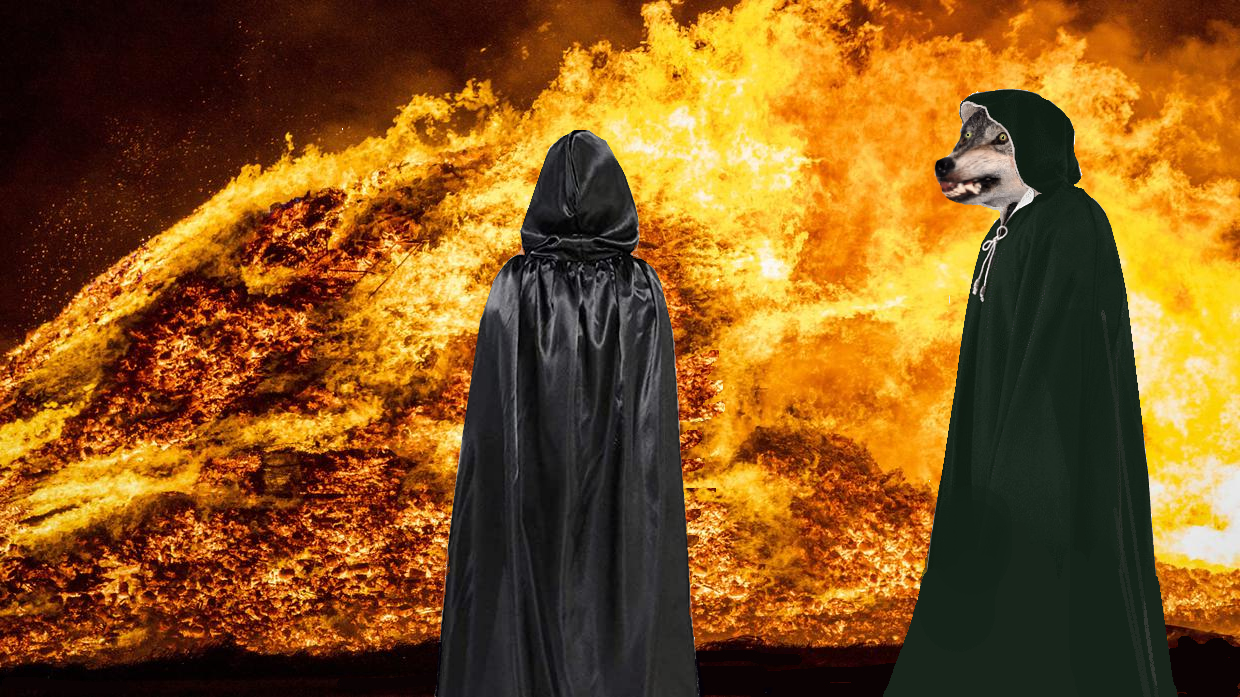
The great midsummer bonfire crackled and roared, and sparks billowed high into the dark sky. It was encircled by thirteen hooded black-robed figures, and the face of the youngest was pale as he accepted the carved wooden cup from the leader, who was called the Blithe Lord and wore a wolf’s-head mask.
The boy knew the liquid in the cup was noxious but had to drink. Somehow he managed not to choke….or worse throw it up. Then he repeated the oath as instructed. “I serve the Master and only the Master.”
The Blithe Lord’s hand rested momentarily on his head. “That is good, my son. When my life is forfeit, your fifteen years will commence and during your reign it will be your divine duty to always seek vengeance. The Master demands it. Do you understand?”
The boy nodded. “Yes.”
“Before you take my place you will have taught and initiated your own successor, as I have taught and initiated you.”
“How will I know my successor?”
“You will know. Beyond all shadow of doubt. There is one other thing….”
The boy waited.
“Every Blithe Lord has to be killed by his successor.”
“I….I’ll have to kill you?” The boy’s eyes filled with immense dismay.
“Yes. It has to be thus.”
**********
Saturday, 23 June, 1459, St John’s Eve, or Midsummer Eve….
England was not a peaceful land. The friction between the Houses of York and Lancaster no longer simply simmered but had broken out into war. The mentally ill and frequently indisposed Lancastrian king, Henry VI, left much to his formidable queen, Margaret of Anjou, and her lieutenant, Henry Beaufort, Duke of Somerset. Margaret had a son that she claimed was King Henry’s, but many believed that handsome Henry Beaufort was the culprit, because Henry VI wasn’t physically capable of fathering anyone.
The hostilities boiled over in 1455 at the Battle of St Albans, Where York and his ally the Earl of Warwick trounced the royal army. An uneasy truce had followed, but Margaret and Somerset couldn’t help conspiring against York and Warwick. As the royal army marshalled at Coventry, York retreated to the safety of Ludlow castle, his stronghold on the Welsh Marches. His many supporters were gathering there too, ready to go to battle again. They still awaited the arrival Warwick and his considerable force.
At Ludlow the atmosphere was tense and York was aware of his men’s need to relax from constant preparations for both defence and war. It was Midsummer Eve, 1459, and a great stag hunt was arranged, to be followed by a feast in the castle’s great hall. In both the castle, town and surrounding countryside there’d all the midsummer celebrations upon which the Church frowned as being too pagan. When darkness fell bonfires would be lit everywhere, especially on hilltops, and fiery wheels would be rolled down slopes, to drive dragons away, or so it was said. Dragons were believed to be abroad on this night above all others, poisoning wells and doing all manner of other evil things.
The midsummer sun was hot as the royal hunt cantered down the steep slope down through Ludlow from the castle toward the tumbling River Teme. Three fashionable young men led the way, but one of them stood out dramatically, for he was not only well over six feet tall and muscular, but also more handsome than any one man had any right to be. At seventeen Edward, Earl of March, son and heir of the Duke of York, was not only a commandingly attractive figure, but also promised to be a brilliant warrior for one so young and was possessed of an abundance of what the Bible called charism, or the gift of God’s grace. Fair-haired, blue-eyed, spirited and sociable, he drew men and women as if to a magnet and many claimed he was the handsomest man in Europe. The badge he chose to display was the white rose of York.
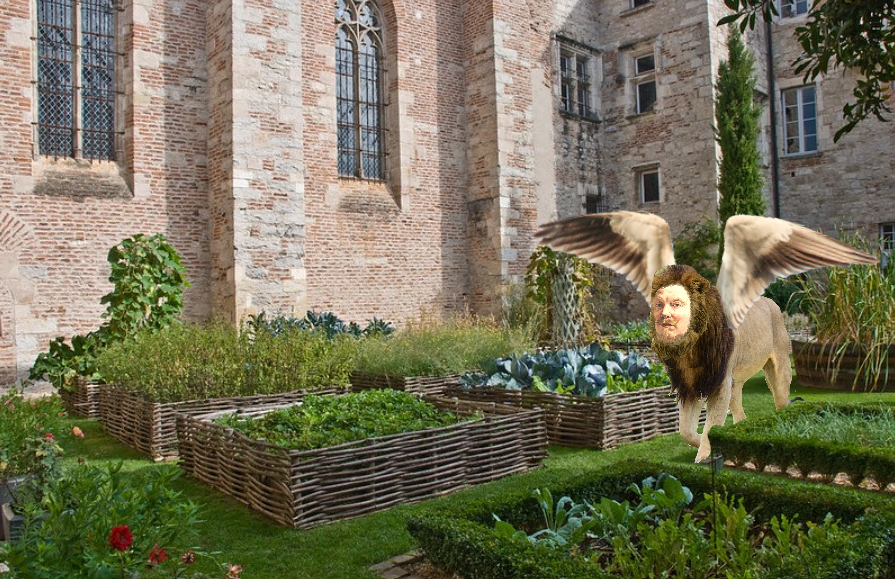
But Edward of March wasn’t the entirely chivalric figure he seemed because he was also immoral and unscrupulous, especially with women, and in that he was aided and abetted by the man riding to his right, his distant kinsman, William Hastings. William was twenty-nine and far from handsome, with large protruding ears, a long crooked nose that drooped at the end, and nut-brown hair that fell forward over his forehead in rather lumpy curls. He had large teeth that were revealed—upper and lower—when he smiled, although his smiles often seemed to be leers. Nevertheless he was possessed of immense charm and humour, which brought him success with the ladies…if not to the extent of his dashing royal cousin. His most favoured badge was the manticore, a winged lion with a man’s face, and Edward joked that such an odd mythical creature suited him perfectly.
William was High Sheriff of both Warwickshire and Leicestershire, and a fervently loyal retainer of the Duke of York, who had recommended him to Edward. Now no one was closer to the future Duke of York. William aided and abetted the young earl where the fair sex was concerned and was said to even procure women for him. The two were well matched in spite of their ten-year age difference, both loving to joust, hunt and indulge in all the other manly pursuits that were expected of their kind. They shared complete trust in each other, and no one had more influence with Edward.
At least…. Recently a large fly had appeared in William’s otherwise flawless ointment, and that was the slender young man on Edward’s other side. In age Gervase la Vallée was midway between Edward and William, and darkly handsome, with clear grey eyes and coal-black hair to his shoulders. Unmarried, exceedingly wealthy and of old Norman heritage, he exuded an air of danger that drew women like bees to nectar, but in fact he was always ready for a laugh or joke, enjoyed a drinking session and was very much a social creature, all of which made him very agreeable to Edward, who now permitted him the privilege of addressing him as Ned.
Gervase always dressed in dark clothes, displayed a collar and pendant of his personal hound’s-head badge, and rode a black stallion that even Edward envied.
It was exactly a year to the day since he’d come into Edward’s circle, having on the sudden death of his father moved into the la Vallée family’s ancestral residence at Castell Du—pronounced Castle Dee and meaning Black Castle.
William remembered the day quite clearly, because midsummer or not, heavy snow had fallen. There had always been something about Gervase that made the Hastings skin crawl. No, that wasn’t honest. It was more that William was jealously aware of a threat posed to his own position.
Edward showed the newcomer a great deal of favour, and slowly but surely William felt he was being edged aside. Now he was constantly on guard, always observing and assessing the unwelcome new rival, and always evincing friendship. Of a sort, because so great was his resentment that he found it almost impossible to be genial.
The hunt entered the forest beyond the Teme. Hounds bayed, horns blasted and men whooped and whooped as the sport began. The trees, glades and valleys were extensive and the hunt had miles to cover, all of which took hours, so that it was approaching sunset when riders and hounds at last returned to Ludlow.
But three men were missing. Edward, William and Gervase had become separated from the rest. No one was particularly worried because it had happened before because Edward was ‘otherwise occupied’. It would be several hours yet before the Duke of York thought it necessary to send men out to look for the missing men.
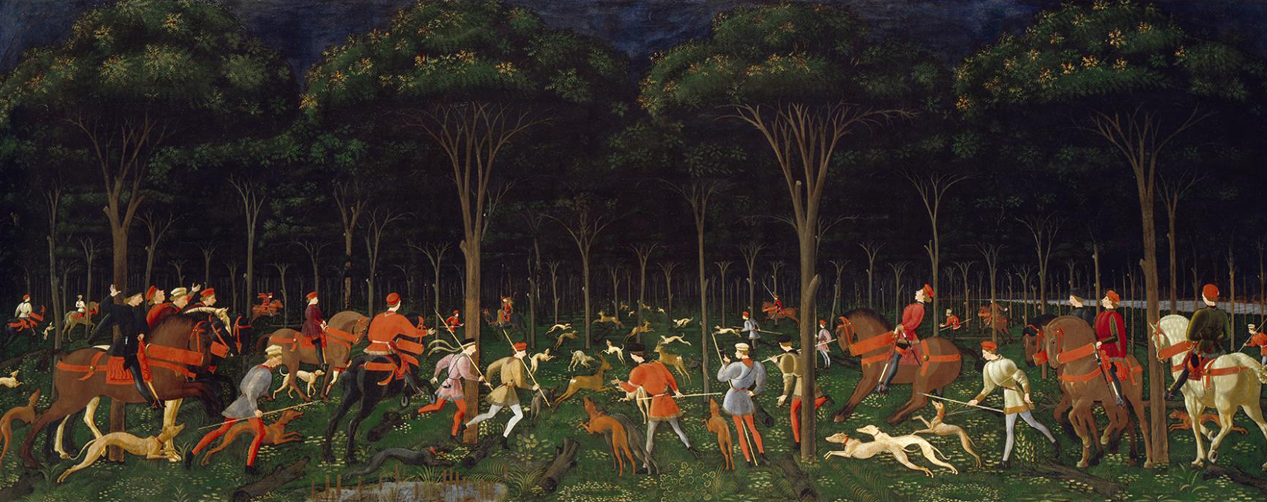
Except that this time it was different. The missing trio really was lost among the endless trees. The barely perceptible track ahead dipped into a winding valley and there was no sign of human life, not even a distant candle in a woodman’s window. Shadows were deepening and lengthening as the sun sank beyond the horizon, and the heady scent of wild roses and honeysuckle hung in the still air. High above, the sky glittered with countless stars, several of which seemed to arc down toward the earth.
It was a truly magical Midsummer Eve, but such magic could also be frightening. This was a night of superstition, when the boundaries between life and death were thin and souls could wander from their bodies. It was believed that if anyone sat up fasting all night in a church porch, he or she would see the spirits of those of the parish who were to die in the coming year. The spirits would line up at the door and knock to enter, passing through in the order they were due to pass away. It was further believed that the one who fasted in the porch would gain the power to see the wandering spirits of those who merely slept. Seeing one’s own spirit in the line at the church door was a sign of one’s own imminent death.
But such things weren’t on the minds of the three lost huntsmen as they paused to debate which way to go, because—using the sun—they had believed they were making their way toward Ludlow, yet now it was clear they were going away from the town.
Then their attention was caught by a subtle movement among the trees. A figure in a dark cloak and hood appeared between them and the sunset, and then halted on realising it had been seen.
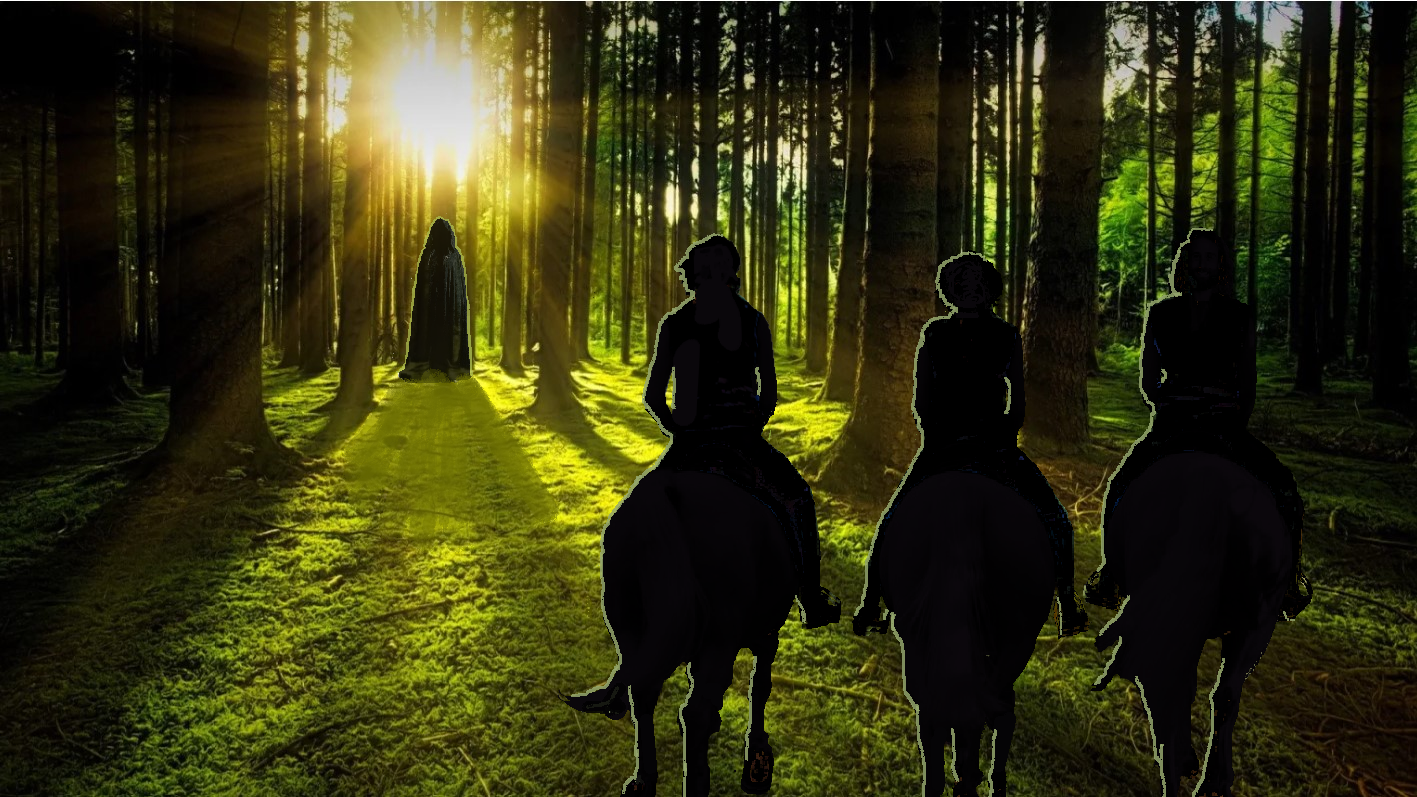
Suddenly as motionless as if carved from stone, the figure—surely a man—was outlined by the intensity of the glowing orb on the horizon. It was then that the three realised they could almost see through it. Almost. It was illusory. Wasn’t it? They glanced uncertainly at each other, their scalps crawling because of the unearthliness of the moment. Time itself seemed to be standing still, but then the figure moved, dashing away until it was lost in the shadows and dense forest.
William recovered enough to shout after it. “You there! Help us find our way!”
Edward was shaken but managed to conceal such unbecoming weakness. “Well, whoever it was must have something to conceal. A poacher perhaps? Your castle isn’t that far from here, Gervase. Do you have poachers?”
“Who doesn’t?”
William frowned. “Maybe, but do your poachers scurry around in hooded cloaks at midsummer? It’s too bloody hot for cloaks!”
Gervase smiled at him. “I wouldn’t know. I have keepers and woodsmen to deal with such miscreants.”
William wasn’t amused, rightly perceiving the response as mockery, but he said no more. I’ll get you yet, you clever little bastard!
“But there is a so-called coven of witches,” Gervase added.
The other two stared at him. “Witches?” William repeated.
“Well, some such thing. They’re led by a fellow calling himself the Blithe Lord. At least, I think that’s what he’s called. It’s entirely inappropriate because blithe he certainly is not. At least, not according to local fame.”
Edward’s brows drew together. “Why blithe I wonder?”
Gervase shrugged. “I have no idea.” He grinned and looked directly at William. “And before you challenge me with being this fellow, let me add that such a coven has been hereabouts for at least two centuries, whereas I’ve been here for around a year. I came on the death of my father. And if the Blithe Lord and his coven prance around tonight it won’t be anything to do with me because I’m here with you. But they’re dangerous and the local folk know better than to interfere with them. Again, so I’m told.”
William managed a smile that only just fell short of a grimace and looked at the other’s pendant. Now he studied it again, it didn’t look like any hound he’d ever encountered!
Edward laughed and pretended to punch Gervase’s arm. “Somehow I cannot even imagine you with a coven of witches prancing around a bonfire at midnight!”
Gervase laughed with him.
Then Edward glanced around again. “I don’t know how we’ve managed to go toward the sunset when we made a point of riding away fromit. We must have gone around in a circle.”
Gervase nodded. “I agree. So, if we go that way,” he pointed away from the sunset, “and make a real effort to stay in a straight line, hopefully….?” He didn’t finish, because at that moment they heard shouts. His eyes brightened. “They’ve sent men to look for you, Ned!” he cried.
Once again the use of Edward’s nickname so grated on William that he wanted to lean over to smack the impudent upstart.
Edward stood in his stirrups and yelled in response, and within moments they saw lanterns bob as the Duke of York’s men rode toward them, led by a local man who knew the forest as well as the back of his own hand.
Half an hour later, in the dark, they crossed the Teme again and rode up into Ludlow, which spread over a hillside and was crowned by the huge castle on its cliff above the river. The midsummer festivities were already underway in the countryside, with torchlit processions around the fields and another such procession in the town, past houses that were lit with lanterns and candles. There were men dressed as giants, morris dancers and minstrels, and people with garlands of nine different flowers in their hair. Singing and dancing, the townspeople were set upon enjoying themselves to the full. It was all blatantly pagan masquerading as the rites of St John.
The hills around flickered with bonfires and the flaming wheels. When Edward remarked upon them, Gervase offered more explanation. “The wheels mark the highest point of the sun, which is now turning. The bonfires will be tended until sunrise, which not only light the way for the souls of the dead, which roam on this night, but also please the fairies and ward off evil spirits.”
Hastings also looked at the hilltop fires. “Is one of them being danced around by your Blithe Lord and his witches?” he enquired coolly.
“How should I know?”
“Because you seem to know a lot about such things,” Hastings remarked.
“I only know the Norman traditions of my family. The Blithe Lord and his gang are only known to me because I was told recently. Last Hallowe’en, to be precise. Their bonfire was a little too ferocious and kindled part of the forest, including a wooden bridge for the repair of which I had to pay because it was on my land. It was in my interest to pay because the bridge carried the main route to Castell Du from the west. Certain unruly elements among the Welsh use it to enter my lands and causes trouble and I pursue them to take revenge. The bridge is therefore a mixed blessing, but on the whole I prefer it to be there and intact. And so do the Welsh, of course,” he added wryly. “Anyway, the dragons you mentioned some hours ago can best be driven away by foul-smelling smoke, so the bonfires should be piled with all manner of stinking things.”
“Oh, do tell more,” Hastings invited rather sourly, winning a rather quizzical look from Edward, who could see no reason for the continuing acidity.
“Are you really interested, Will?” Gervase enquired, with one of his winning smiles. “Very well. You see the wreath of flowers on top of the town bonfire? Well, come the morning the remains of the flowers will be taken home to protect from pain and disease, and charred sticks from the fire itself will be used to ward off thunder for the coming year. And at sunrise, as the bonfire burns right down low, farmers will drive their animals through it to keep them safe from sickness until next midsummer. There, am I not a fount of fascinating facts?” He laughed.
Edward laughed too, and when William didn’t join in, he frowned. “Come on, Will, don’t be such a misery. Aren’t you feeling well?”
William seized the excuse. “My head aches abominably.”
“Then we’ll get back to the castle. Will you be able to join us for the feast?”
Suddenly William had no desire to watch Edward and Gervase sitting cosily together for the rest of the evening. “I fear not. By your leave, I’ll retire.”
“Of course.”
Gervase smiled. “I’ll select a platter of the finest morsels and have them brought to your room.”
William managed a smile in return. “You’re very thoughtful.”
“Another of my many adorable little ways.”
Edward burst into laughter.
William summoned a smile from deep within his boots. “Will you be retreating to your lair tomorrow, Gervase? To enjoy your traditional Norman festivities?” he enquired hopefully.
“I will, and I trust it will not be impudent of me to invite you both to join me at Castell Du? It will be my birthday.”
Edward grinned. “You’re a midsummer babe?”
“I am indeed.”
William’s brows drew together. “Didn’t your father die that day a year ago?”
“Yes, he did.” Gervase paused, and then added. “If you come tomorrow you can meet my sister.”
Edward was startled. “You have a sister? You’ve never mentioned her before.”
“Elaine is recently widowed and has only just joined me.”
“Widowed, you say?” Edward enquired. “Would I be likely to know her late husband?”
“Ah, that’s a little sensitive.”
“Why?”
“Because he was on the other side,” Gervase replied uncomfortably.
William thought he saw a chink in the la Vallée armour. “Meaning what, exactly? He worshipped Satan?”
“Good God no!” Gervase chuckled at the thought. “His name was Bertram FitzThomas and he was retained by the Duke of Somerset.”
“Ah, a Lancastrian,” William declared, pleased by Gervase’s discomposure and obvious unwanted connection to Edward’s enemies..
“And he was a brute,” Gervase responded. “When I learned what a vile husband he’d been, I wished I’d been able to strangle him before the robbers did.”
“Robbers?” Edward pressed.
“Yes. It seems a notorious gang selected him because of the fine rings he always wore. Anyway, Elaine is free now, and I intend to take care of her. In spite of such a marriage she really is an innocent. I protect her.”
Gervase glanced away. William saw the emotion reflected in his eyes. “She’s fortunate to have such a caring brother,” he observed, honestly this time.
Gervase’s strange eyes swung back to him. “You’d have to ask her about that. But I do hope you’ll both join me tomorrow. I can promise some fine food and excellent entertainment.”
Edward was eager. “I look forward to it. We both do, don’t we William?” Then he added a warning. “And I trust you’ll be in a better mood by then.”
“I pray so.” But William glimpsed the momentary disappointment in Gervase’s eyes. The fellow had been hoping the Hastings manticore would stay away.
**********
Sunday, 24 June 1349, the Feast of St John or Midsummer Day
Castell Du acquired its name because it nestled in a wooded valley where in winter the sun only penetrated at midday. In midsummer it was drenched in sunshine and presented a handsome sight, its battlemented towers rising out of the trees beside the small but deep river that shielded it from incursions by the Welsh, to one of whose princes it had once belonged. Now, thanks to the efforts of Gervase’s father, once within its great curtain wall it was a sumptuous modern residence with every luxury imaginable. It wasn’t in the large, dominating mode of Ludlow Castle, but for many reasons it was highly desirable.
There was a nearby hamlet of the same name, and today, as the visitors approached the gatehouse with its two great round towers, it seemed that the citizens of every village and settlement in the neighbourhood was coming to enjoy Gervase’s hospitality. They were all decked in costumes, from animals to mythical creatures, with garlands in their hair, and the atmosphere pervading Castell Du was almost otherworldly. Here it was only too possible to believe in the Blithe Lord and his coven. And in the wandering souls of Midsummer Eve.
As darkly handsome as ever, Gervase came out beneath the portcullis as his guests’ horses clattered on the drawbridge, but before reaching him Hastings glanced down at the moat in time to see the flash of….of….a mermaid? “By all the saints!” he cried, reining in abruptly.
Edward reined in too. “What’s wrong?”
“There….there’s a mermaid down there!”
“Eh?” Edward peered over at the still water.
Gervase hurried to join them. “Is something amiss?”
“Will saw a mermaid in your moat.” Edward’s voice shook with suppressed humour.
Gervase was amused too but offered a mundane explanation. “You probably saw our famous pike, Will.”
“Does your pike have arms and bosoms?” William demanded testily, glancing at the badge on Gervase’s golden collar. He’d be damned if it was a hound’s head!
Edward groaned. “Don’t tell me you’ve brought your wretched headache with you today as well.”
“No….it’s just well, I know what I saw.”
Gervase patted William’s horse’s neck. “Too much of that special mead I had taken to you last night,” he said. “It was a little strong, I admit.”
Edward eyed William. “There, now we know why you’re seeing mermaids!”
Gervase took the reins of both horses and led the way into the castle courtyard, where it seemed every inhabitant was enjoying the castle’s hospitality. The outer courtyard was full of people for whom a lavish supply of food and mead was provided in praise of God for his benefits bestowed on them. At least, that was the reason given to the local clergy, but everyone else was enjoying the not-so-Christian delights of Midsummer Day. They were all merry, clergy included, and the arrival of the dashing young Earl of March was greeted with loud cheers.
Gervase explained the lavishness. “It’s always been my family’s custom to throw open the castle’s gate to whoever wishes to come. It’s believed that when everyone eats and drinks well, they’ll serve the la Vallées more gladly for the coming year. Midsummer is a time of merry-making, of settling differences between neighbours, and giving to the poor.”
“How noble and quaint,” William murmured, glancing around at everything. The fine decorations of the previous evening and night were still much in evidence, with every door and window ledge adorned with green birch, long fennel, St John’s Wort and such like. The many lamps were dull now, but throughout the night they’d made a brave sight. It all seemed like something seen in a dream….and for some reason he was reminded of the strange encounter with the cloaked figure.
Gervase conducted them into the castle by way of the small but beautifully laid out garden, with its raised oblong beds that were surrounded by low wattle fences. Both herbs and flowers filled the air with fragrance, and Gervase put a hand on his dagger hilt and looked to Edward for permission to use it, for it didn’t do to simply draw a weapon in the company of so important a lord.
Edward nodded. “By all means, unless you mean to plunge it into my heart.”
“Indeed not! I merely wish to cut a pink rose for Elaine. They’re her favourite flower.”
“Then by all means, but I claim the right to present it to her.”
“She’ll be greatly honoured,” Gervase replied, cutting the rose and giving it to Edward.
William had watched carefully, because he’d noticed before that although Gervase was right-handed, when it came to his dagger he always used his left hand.
It was then that yet another peculiar thing happened. Something that increased William’s sense of the otherworldly. He saw a lion. No! He saw a rather doleful winged manticore walking between the flowerbeds and apparently preparing to take to the air. Heart racing, he closed his eyes, determined not to react this time and be taken for a hungover fool. When he looked again there was nothing there, only the path between the flowerbeds. But he felt Gervase’s eyes upon him. Knowing eyes, as if he too had seen the manticore.
The hall’s admittedly luxurious furnishings were oddly old-fashioned, a fact that puzzled Edward. “Why so out of date, Gervase? You’re supposedly a veritable Croesus, and yet—?” He didn’t finish, but instead swept an arm to encompass their surroundings.
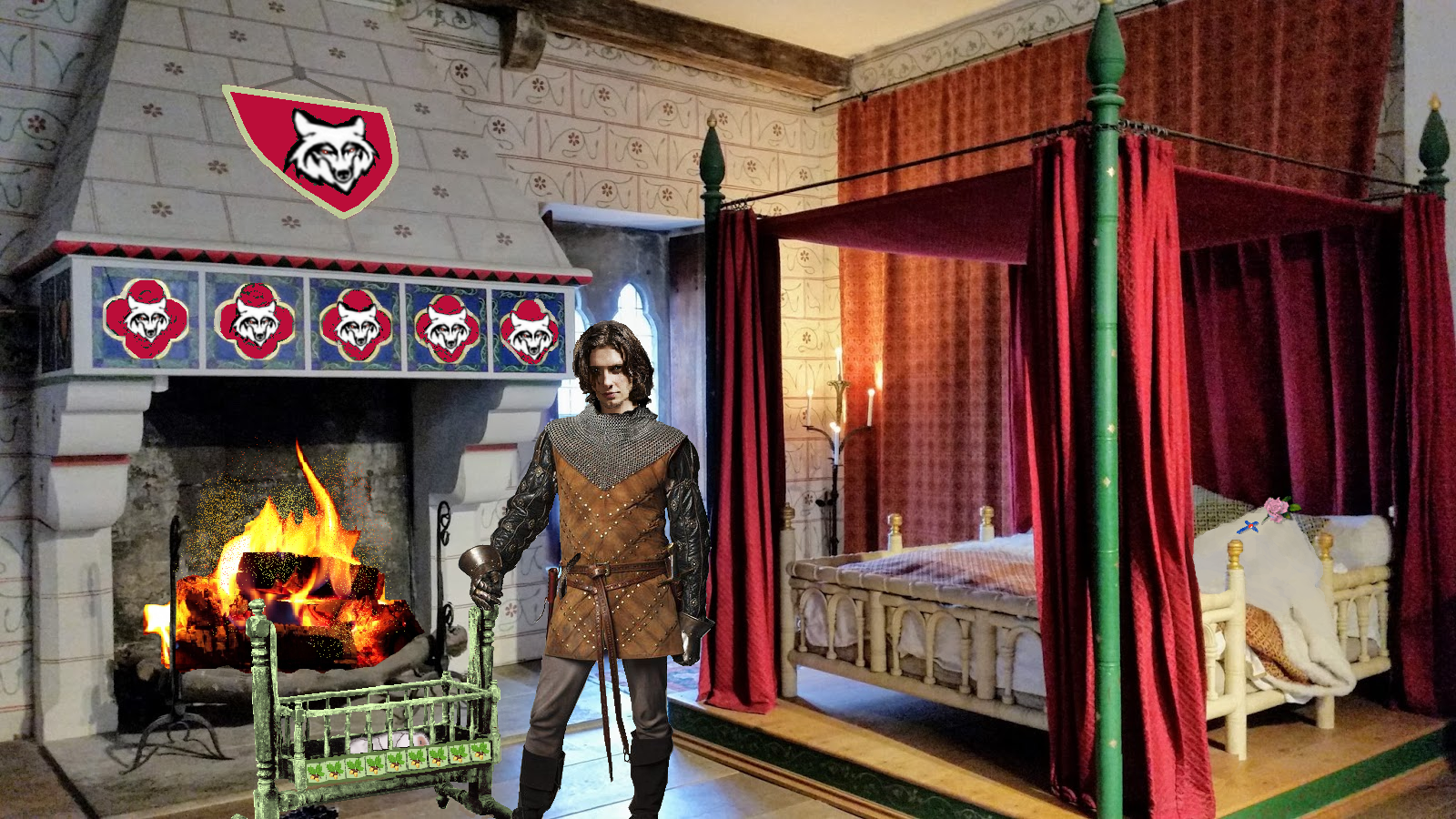
“Ah. Well I fear you can blame our first King Edward for that. He stayed here once and the hall and his bedchamber—now my sister’s—were redecorated to his personal taste. Out of respect the la Vallées haven’t changed anything since. I now fear to alter anything for fear of bringing some curse or other down upon me. I imagine a Longshanks curse would not be something to risk lightly.” Gervase smiled charmingly. “Besides, if it was good enough for Longshanks, then it’s good enough for me.”
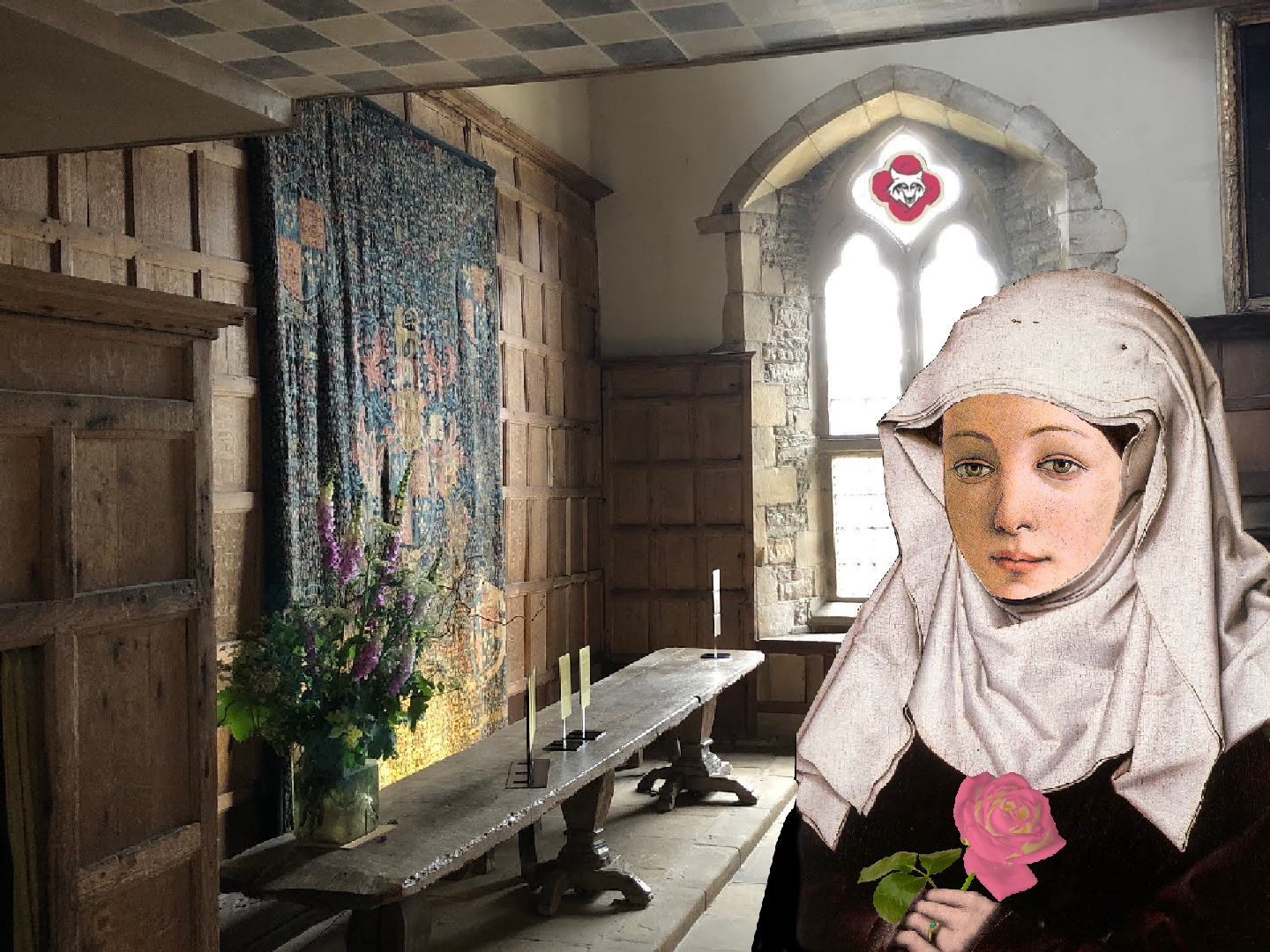
Elaine, Lady FitzThomas, waited on the raised dais at the far end of the great hall, while all the castle servants were ranged along the lower floor. She was clad in black, which made her pale face seemed even paler, but William had to concede that she was very beautiful. And yes, as Gervase had said, there was an air of innocence about her. She seemed like an untouched widow, if such a thing were possible, although from what he’d made it his business to find out about the unloveable Bertram FitzThomas, untouched she definitely could not be.
William observed the armorial badges newly painted on the overmantel. Gervase’s personal badge, not the traditional coppiced willow of the la Vallées. A so-called hound’s head on a red ground? No. What was on display now was definitely a row of wolf’s heads! Why did Gervase pretend otherwise? Might it be that he was indeed connected with the Blithe Lord and his coven? Now there was an intriguing thought.
Gervase made so bold as to hurry ahead to greet her, kissing her tenderly on the cheek, and William saw him take her hands reassuringly.
William watched the look on Edward’s face on seeing her. That look meant only one thing; Edward, Earl of March, itched to bed Gervase la Vallée’s sister! Oh, that wouldn’t do at all for dear Gervase, who was most unlikely to stand by while Edward toyed around with his beloved Elaine before deserting her, as in the end he deserted all his women. William hid a sly smile, deciding that he’d do all he could to assist Edward in his latest lust. It seemed to be a sure way of alienating Gervase la Vallée.
Gervase turned as Edward drew near. “My lord, may I have the honour of presenting my sister, Lady FitzThomas? Elaine, allow me to present you to the Earl of March.”
Edward stepped up to the dais, exerting the full force of his fascination as he smiled into Elaine’s demurely lovely eyes. “My lady?”
“My lord earl.” She sank into a graceful curtsey, her black weeds rustling in the silent hall.
Edward touched her shoulder to signify she should rise again., and when she did he smiled warmly into her shy eyes and held out the pink rose. “I’m told this is your favourite flower?”
“Yes, indeed, my lord earl.”
“It cannot rival its recipient,” Edward said softly.
William glanced up at the hall’s rafters, having heard that line before. But the die was now cast. All that remained was to ease Edward into the lady’s innocent little bed. Without Gervase la Vallée knowing of course. Not yet anyway. The deed had to be well and truly done before the watchful, protective brother found out.
**********
But the seduction of Elaine, Lady FitzThomas, didn’t prove as simple a matter as the vain, over-confident Earl of March anticipated. Even with William’s considerable assistance—by distracting Gervase under the guise of a genuinely warm change of heart—Edward’s secret assignations with her at an isolated cottage on the Castell Du, conducted behind Gervase’s back, achieved nothing more than kisses, and even these were very hard won. Gervase had not exaggerated when he described her as an innocent. None of the many lengths to which Edward went produced the required progress. Her gentle but determined resistance served only to intensify Edward’s now white-hot desire. He couldn’t sleep for thinking about her, and when he was with William she was all he talked about.
Elaine wasn’t being artful, or merely flirtatious, she simply held honestly to the rules under which she’d been raised. These rules demanded that she be chaste at all times…except in the marriage bed. She certainly wasn’t indifferent to her ardent admirer, but her rules were her rules. It was the marriage bed, or nothing.
Seeing Edward at all like this troubled her conscience and so she was more than willing to say nothing to Gervase. But Edward too needed to be secretive, and she accepted his excuse that he had to find the right moment to tell his father about her. She was, after all, not exactly the exalted bride the Duke of York required in a daughter-in-law. So silence suited both participants in the strangely unproductive liaison.
Then Edward formed a plan. The one sure way to Elaine’s bed was to marry her….well, not quite. What he had in mind was a secret but fake ceremony that would convince her. The necessary arrangements were put in hand and a man was hired who was capable of pretending to be a priest and who was given half his price in advance, the other half to be handed over when the ceremony was complete.
But that was when the plan went wrong, because on the planned day of the ‘wedding’—of which Gervase knew nothing, of course—the false priest fell ill. He was in no condition to carry out his obligation and was desperate to have the other half of the promised sum of money, so he turned to his identical twin brother, who was glad to help. The problem then was that the brother really was a priest, so the romantic secret wedding that Edward went through with Elaine wasn’t fake at all. It was real! When Edward at last slipped between the sheets with her he consummated a marriage that made her his Countess of March. He, of course, was under the impression that he’d merely tricked his way into her bed.
There was another very important flaw in the unworthy scheme; when it came to religion, the priest sat on the proverbial fence. He performed his Christian duties but was also one of the Blithe Lord’s coven. It hadn’t been until the actual ceremony that he’d realised who Elaine was and now he was frightened of the implications. So after the ignoble union, he sought a forest meeting with the Blithe Lord.
The hooded figure waited in the sunlit clearing and heard the man’s frightened confession. When the man had finished his confession he cowered on his knees. “Forgive me, my lord! I did not know!”
In response the Blithe Lord placed a hand on his shoulder. “See that you write down what you have done and secure the marks or signatures of whoever else was there to witness. Then give the letter to me here at the same time tomorrow. Show it to no one else, is that clear? Disobey and the Master will demand revenge. I will have to destroy you.”
“Yes, my lord.” The man quaked visibly, for he knew it was no idle threat.
“Now go.”
The man was only too eager to leave, and once he’d disappeared among the trees, Gervase removed the wolf’s head, and the sunlight shone on the ugly fury staining his face. He returned to Castell Du, determined to confront Elaine. The only reason he’d introduced her to Edward was with marriage in mind. But he’d wanted a true, open union that was honourable. Not this grubby matter that lacked all trace of chivalry! Edward was going to rue the day he decided so casually to seduce the sister of Gervase la Vallée.
**********
Elaine broke down in tears when Gervase faced her with what he knew. It didn’t matter that she really was the Countess of March, only that Edward laughed at the success of the ‘deception’ and had no intention of ever acknowledging her. She was so broken and humiliated that Gervase could only hold her close and forgive her. He even agreed to say nothing to Edward, on condition that she too remained silent about the true legality of her marriage. He had no desire at all to have her name bandied around the court with all the accompanying crude laughter.
Elaine consented, if only because she wouldn’t be able to bear the expression on Edward’s face when he found out he really was her husband. He’d be furious. It was acceptable for him to deceive, but definitely not acceptable for him to be the deceived! On top of that, she was afraid of what he might do if cornered by his own dishonesty, not that she said this to her doting brother.
Gervase hated to see her so under Edward’s unkind spell, but there were many forms of love, and he loved his only sister with all his heart. It was true and pure, and he would have done anything for her. So he agreed to be all that was customarily amiable and friendly toward Edward.
But toward dawn he slipped away from Castell Du. Deep in the woods he took the black hooded robe and wolf’s head mask from its hiding place and donned them before going to take command of his urgently summoned coven.
Edward of March’s troubles were about to begin.
**********
It began with minor incidents, the loss of a seal, the failure of a prize stallion to beget the expected progeny….and a broken toe when said stallion trod on Edward’s foot. Then a splinter in his thumb caused a great deal of trouble before it was eventually removed, and a trout pie proved too much for the young earl’s usually iron stomach. All were the sort of tiresome matters that weighed so gradually that the change of atmosphere was hardly noticed. And there was the increasing tendency for Edward to eat and drink too much. Again, it wasn’t serious, but he had more morning-afters than he had before. and usually it was in Gervase’s company that he overindulged the most.
Hastings’ jealousy began to be fused with consternation. Edward had made it clear to him that the affair with Elaine was to remain secret, especially from Gervase, and so Hastings was in a cleft stick, desperately wanting Gervase to be confronted with his precious sister’s fall by the wayside, but also too afraid of crossing Edward to risk it. So he said nothing.
Edward continued his secret meetings with Elaine for a while, but the assignations became fewer and further between, if only because his appetites already extended beyond just Elaine, whom he began to find boring. Her form of sweet innocence had become cloying and he would have dropped her entirely if it hadn’t been that she was pleasantly diverting while he was at Ludlow. But then he found someone else whose refusal to submit stirred him anew. He ceased seeing Elaine altogether, although not before putting into words the deep suspicion she’d nursed all along, that if she said anything about their liaison, it would be the worst for her. This was Edward of March at his most unpleasant, and all trace of his fascination was obliterated. She was now so frightened of him that she wasn’t sad when he left for what she thought would be the last time.
She soon learned from Gervase that a certain Lady Eleanor Talbot had become his pastures new. Eleanor was another widow of strict principle, and therefore had Elaine’s sympathy, because it was likely Edward would resort to the same trickery that he had with Elaine herself. Except that he was—and would remain—her husband and while she lived he could never be anyone else’s.
Through the summer of 1460 the weather was awful. Incessant rain flooded mills and swept away bridges. Sodden crops rotted in fields and roads were deep in mire. On Monday, 23 June, Midsummer Eve, Gervase created a child’s poppet of a midsummer man in Edward’s likeness. It amused Gervase to jab pins into various parts of the poppet, because he knew that wherever Edward was, he’d experience intense pain. A jab in the poppet’s knee had Edward crying out and bending to rub the offending joint. When Gervase removed the pin the pain stopped. Leaving Edward wondering if he’d imagined it somehow.
Edward found himself back at Ludlow in early October 1460…and having found Eleanor a harder nut to crack, so to speak, his bruised vanity prompted him to seek the reassurance of another assignation with Elaine. She was now too afraid to refuse, and so resumed the liaison without Gervase knowing. This time the hitherto barren relationship was to have a serious consequence.
It wasn’t long before Elaine realised she was pregnant and when the morning sickness and increasing girth became too much to continue to hide, she was finally driven to tell Gervase. At last he learned of the final assignation that had resulted in her shame.
From then on the ills that befell Edward intensified into serious calamity, when at the Battle of Wakefield he lost his father and younger brother, Edmund, Earl of Rutland. Not only were they defeated but executed too and their heads put on display on Micklegate Bar in York, and all because the duke hadn’t waited for Edward to arrive with reinforcements.
Then on Midsummer Eve 1461 Gervase returned from pursuing a Welsh raiding party and was just cutting a pink rose from the garden when servants ran to tell him Elaine was in her travails and having a very arduous time of it. He ran up to be with her and was distressed to see how much pain she was suffering. He held her hands and wouldn’t go, even though her women were most disapproving of a man being present at such a time.
He was at her side when, as Midsummer Eve slipped over into Midsummer Day, she gave birth to a strong baby boy, whom she wished to name John, for St John, whose feast day it was. The baby was lusty and voiced his protests at being brought from his mother’s warm, cosy womb, but Elaine was very weak. Gervase was told to fear the worst.
Anguished by grief, he dismissed everyone and sat alone with her, holding her hand and curling her weak fingers around the rose. Her eyes were closed and her face so pale it was as if she had lost all her blood in the birth. She was still conscious, however, and begged him to save her.
“For my son’s sake,” she breathed.
She’d always known Gervase had some strange powers, but not what those powers were. Once she had managed to wring a confession from him that he’d been responsible for her husband’s death, and she knew he hadn’t simply hired the ‘robbers’ who’d carried out the actual deed.
Gervase’s face twisted with regret. “I cannot, sweeting. My arts do not extend me to bring the dying to health again. If I could, I would. You know that.” Tears were wet on his cheeks, and he could taste salt as he spoke. Silently he pleaded with the Master, but there was no response, only a cold, disinterested silence.
“I fear for my baby, Gervase. Edward may do him harm….”
“I will protect him, sweeting. You know that.” But now a new urgency fired through Gervase. He might not be able to save her, but he could punish the man who’d brought her to this. “Tell me you wish Edward to suffer to the end of his days. In your name. Say the words. I only have fifteen years, but your son will live on beyond that.”
“I…cannot,” she whispered, at last beginning to understand the truth about his abilities. Her eyes widened with the awful realisation that he was the Blithe Lord!
He took out his dagger and cut a lock of her hair. “Say the words, Elaine. You must! To do the things I must I need your permission. You must give it. Please, sweeting, I beg of you!”
She struggled to resist.
“If you want your son to be safe from him, you must help me in this!” he urged, seeing the life beginning to fade in her eyes. But then her lips moved and he had to bend close to hear what she said.
“Punish him in my name….”
He kissed the lock of her hair and his voice broke. “Be with me in spirit, sweeting.”
“I always will be.”
Gervase couldn’t control his tears. “I will join you again, Elaine. You know that I will.”
Barely a minute later, her soul left her.
For a long while he sat there, hardly able to believe he had lost the only person he had ever truly loved. Then he kissed her cheek for the last time and pulled the sheet up over her face. He put her blue cross and the rose on the sheet and then went to the cradle where the tiny newborn John slept in his white swaddling bands.
“I will always be here for you, John la Vallée, and I will see that you are brought up to loathe your heartless father. I was told I would know my successor, and so I know you. When I die, your fifteen years will begin. You will be the next Blithe Lord. And if your father should still live on, your successor will continue his punishment. He will never be free of us.”
********
Grief robbed Gervase of all the sweetness that had been in his love for Elaine, and now the Blithe Lord took him over completely. The fearful magic of which he had always been capable increased tenfold and was now directed even more upon Edward, who wasn’t told of his son or Elaine’s demise. All Edward was interested in was luring Lady Eleanor into what he thought was another untrue marriage.
Having Elaine’s permission—and her spirit—permitted her powerful brother to summon her at will. But it was not the gentle, caring Elaine who was conjured in the darkness of night, but someone very different. Now she was a howling banshee creature, with fangs for teeth and a ferocious need to harm the man who ruined her and had eventually been responsible for her death.
She was sent to Edward in the small hours to screech and hover above his bed until he was jolted into terrified wakefulness. He saw the vile creature, transparent and threatening, floating over his bed and stretching out long-clawed hands to try to rip his face. The stench she emitted was that of the Pit, and it turned his stomach. He managed to cry out to his guards, but when they rushed in there was nothing there, only Edward of York sitting up in his bed as white and quaking as if he’d seen….a ghost.
Night after night the vile apparition tormented him, but no one else ever saw what it was that so unmanned the new Duke of York. Not even the various unimportant women who graced his bed. They didn’t hear, see or smell anything at all, only the unattractively terrified lover they no longer found in the least desirable.
The calamities continued. On 2 February 1461 came the Battle of Mortimer’s Cross, where Edward won decisively, thanks to his quick-witted resort to a celestial phenomenon when the sun appeared to be flanked by dazzling sister-suns. He claimed it was a sign from God that his was the rightful cause and galvanised his troops into greater effort. Gervase had intended the very opposite result of this battle but hadn’t foreseen the interference of the heavens. It was after this battle, after which Edward adopted the sun in splendour as his badge.
More battles followed, some won some lost, feeble King Henry was captured and released and captured again, and Edward was proclaimed king in Westminster Hall. The terrible Battle of Towton ensued in a snowstorm, and Edward won it decisively. He was crowned King Edward IV a few days after midsummer in 1461.
Edward’s next brother, 12-year-old George, Duke of Clarence, came more and more under the influence of Warwick, whose relationship with Edward was becoming somewhat scratchy. The cleaving to Warwick would continue as George grew older, to the extent that when Warwick eventually quarrelled openly with Edward, George went over to the earl’s side and married his elder daughter.
Meanwhile, Edward’s nights continued to be regularly interrupted by Elaine’s grim and ghastly wraith screeching above his bed. But then these horrible visitations ceased when he met yet another young Lancastrian widow whose name began with E. Her name was Elizabeth, Dame Grey, born Woodville, and her husband had died at Towton.
In her Gervase immediately recognised a fellow spirit, someone well versed in witchcraft, although she certainly wasn’t in his class. Knowing she was bound to capture Edward’s attention and meaning to use her to wreak more revenge on the new king, Gervase ceased to conjure Elaine for the time being, while he manipulated things so that Edward would visit her family’s ancestral home at Groby in Leicestershire. And within a mile of Groby Gervase arranged for Elizabeth, with her two small sons, to waylay Edward and throw herself on his mercy. Well, not quite, but to be all that a lovely woman in distress should be. Elizabeth didn’t suspect for a moment that Gervase la Vallée, a fellow witch, might not really be her ally at all.
It was midsummer again when Edward, William and Gervase rode through Whittlebury Forest on their way to Groby.
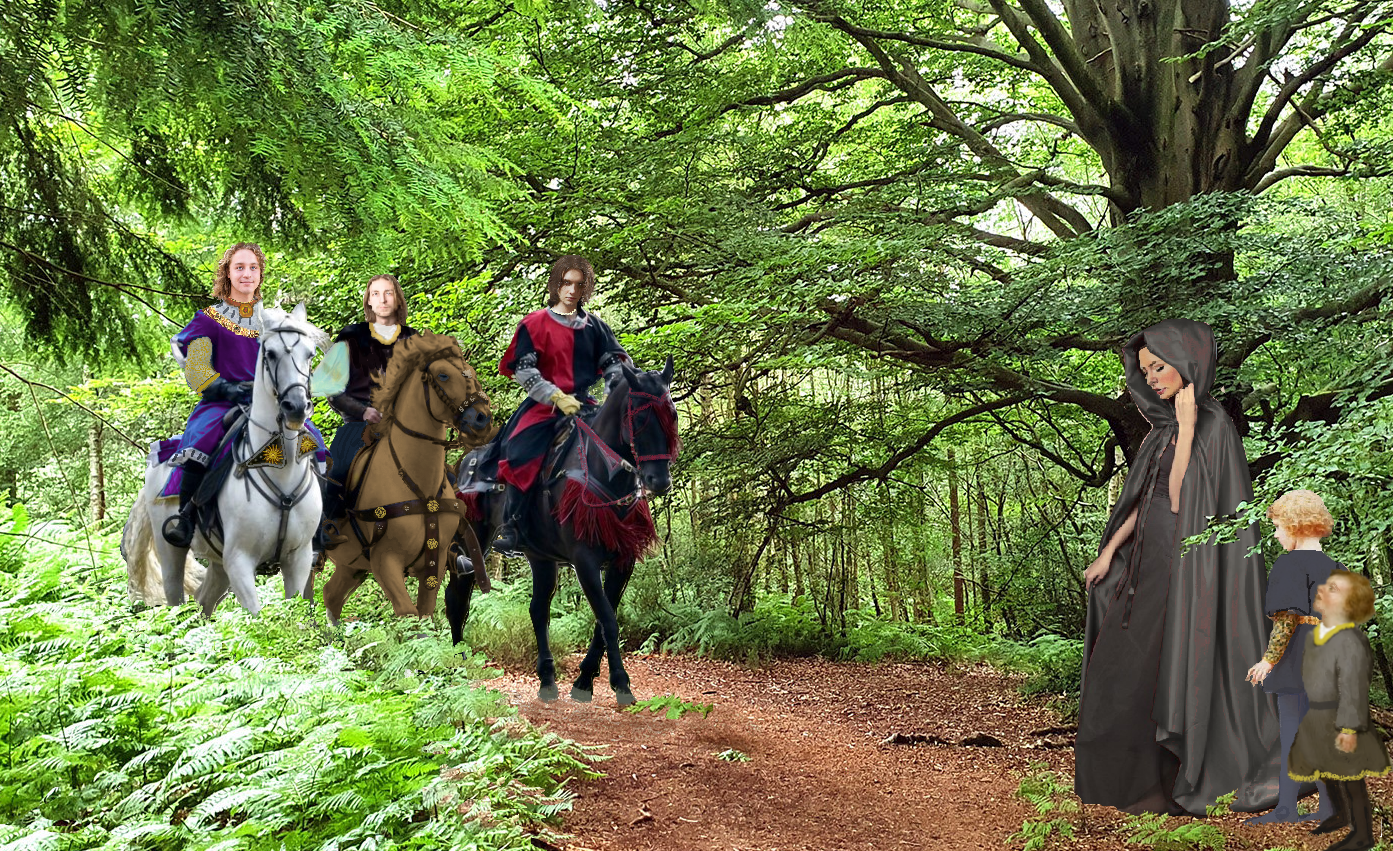
But this time a very different ambush lay in wait for the trio. Not a mysterious cloaked figure against the sunset, but a graceful cloaked lady with two small boys, all in black.
Seeing the odd group waiting beneath the tree ahead, the trio of riders drew to a halt. As urged by Gervase, Elizabeth was careful to adjust her hood, allowing a good glimpse of her loveliness. Edward’s interest quickened immediately, but William was dismayed. It was bad enough that—as he now knew—Edward had already undergone two fake marriages, but the libidinous glint in the royal eyes hinted at a probable third! Gervase, of course, supposedly only knew about Lady Eleanor.
“Who is she?” Edward asked, feasting his gazing on the delightfully alluring lady ahead.
Gervase identified her promptly.
“Really?” Edward continued to gaze at her.
William became uneasy. “Be careful, Ned. You don’t need further complications. You must be truly settled on the throne before—”
Gervase interrupted. “Don’t be such a Job’s comforter, Will.”
“Maybe it isn’t what you want to hear, Gervase, but we all three know—”
Edward’s raised hand silenced him. “Enough, Will. Come now, the odds are in my favour.”
For the space of a heartbeat Gervase’s smile became a little fixed, before resuming its former amused grin. But William had seen that moment and realised at last that Elaine’s brother knew of the whole sordid business at Castell Du!
But then a horrifying shriek carried through the trees, but only Edward heard it…and recognised it. He twisted in the saddle and saw a familiar fluttering between the trunks. Then came to awful scratching of the wraith’s long claws.
The horses were unsettled and danced around. Even Elizabeth, further along the track, heard the sounds and looked toward them. But she would, Gervase thought, because she was part of that other world.
William turned to look as well yet saw and heard nothing, but Edward’s face had drained of colour, and Will was concerned.
“Ned?”
The brief appearance was already at an end, and there was now nothing at all among the trees. Edward took a huge breath to steady himself.
William looked accusingly at Gervase. “You saw whatever it was!”
“Me?” Gervase was lily-white innocent. “I don’t know what you mean.”
William so longed the drag the fellow from his horse that it was all he could do to keep his hands tight upon his reins. He looked at Edward again. “Let’s be gone from here, Ned. Ignore everything, including the Widow Grey, and let’s go back to sanity!”
Gervase urged the opposite. “For pity’s sake, Will, don’t be such an old woman. Why should Ned not proceed? It’s an amusing pastime. Just imagine how many Lancastrian beauties there are whose names begin thus? And who are first encountered at midsummer?”
Edward had recovered enough to snort with laughter.
But William saw no humour in the situation. “These things are only amusing if one’s luck holds. Ned, just imagine your marital dealings becoming common knowledge. It would do your cause no good.”
Edward’s smile faded. “You’re becoming tiresome, Will. I told you to speak to Lady Eleanor. Did she or did she not deny any form of marriage with me?”
“Yes, but—”
“No buts, damn it! You heard the denial from her own sweet lips.” He moved his horse on, and smiled warmly as Elizabeth, Dame Grey, sank into a wondrously graceful curtsey and then turned her hood back completely to reveal her pale, flawless blonde beauty.
King Edward IV of England spent a private hour talking to Dame Grey…and being fascinated by her. She was no innocent and was only too well versed in the art of subtle flirtation. Her voice was low and soft, her eyes an eloquent blue and her sensitive lips alive to every nuance of emotion. Oh, she conveyed a promise of exquisite romps between the sheets, but over the coming days at Groby Edward progressed no further with her than he had with Elaine or Eleanor. Perhaps even less because Elizabeth didn’t part with more than a single kiss.
It fell to Will and Gervase to amuse her two sons while she was preoccupied. The elder boy, Thomas Grey, was seven, strong and good-looking, and very interested in Gervase’s pendant. Indeed, he was interested in all baubles and fine things. Richard Grey, the younger boy, however, was a plump, pugnacious five-year-old, pointing here there and everywhere, demanding answers to a never-ending stream of questions. He had a voice like a horn in fog, William muttered, having endured more than enough of Dame Grey’s offspring. He made little secret of his relief when the cosy conversation á deux beneath the tree can to an end.
Elizabeth knew exactly how to be ever more alluring to a man like Edward and had been so well primed by Gervase that a whole year passed with the King of England dancing attendance on her. He was so accustomed to having his own way that it was frustrating in the extreme to be refused. Now it had happened three times in a row! Clearly he was choosing the wrong women! But at the same time, being refused was such a flame to his desires that he couldn’t leave Elizabeth and go elsewhere. As William feared, eventually the king’s mind turned to another fake marriage.
When Elizabeth consulted Gervase about the seemingly honest marriage offer he was less than honest in return, saying nothing about Elaine and Eleanor and advising her that if Edward offered marriage then she should only decline if she had no desire to be queen. No desire? It was a role to which Elizabeth considered herself eminently suited. So on May Day 1464, Edward entered yet another false marriage from which he fully intended to move on when the next charmer came his way. Elizabeth, of course, believed she was now his true queen, but she agreed to wait until he found the correct moment to inform his council, the three estates—and the people—of his connubial bliss. Or so she imagined. And so her very large not-particularly-wealthy Woodville family hoped.
Gervase whispered morsels of the marriage very discreetly into well-chosen ears, and then stepped back to observe the ripples spreading through the court. Edward found himself in an awkward position. He’d allowed the great Earl of Warwick to commence arrangements for a royal European marriage that would advance England’s prospects—and fill her coffers—but whispers of there already being a queen brought all such negotiations to a halt that was very embarrassing for the earl. Embarrassing to the extent of bringing him to the edge of rebellion. Edward was hoist with his own petard. He hadn’t wanted to let Warwick negotiate anything but had dithered. Now he had on his hands a wife he didn’t want and an important magnate who felt he’d been humiliated deliberately and wasn’t about to take it lying down.
Gervase, of course, was most pleased with the chaos. Such long slow revenge was exquisite, and whenever he returned to Castell Du he concentrated on the education of his nephew and protégé, John la Vallée, now aged four and proving very adept at several very minor spells and curses. He was a sharp boy, strong and fair-haired, with Edward’s eyes, and his uncle’s subtle intelligence. He knew when to speak and when to hold his own counsel, which was quite remarkable in so young a child. The boy’s interest had been intense when he was taken to observe his first bonfire meeting of the coven. Gervase was confident that when John was older he’d be an exquisitely painful thorn in his royal father’s side.
**********
Wednesday, 23 June 1473, St John’s Eve, or Midsummer Eve
Edward now had children by his supposed Queen Elizabeth, including a son and heir of two-and-a-half, for whom arrangements were already being made at Ludlow Castle to set up his own household as the Prince of Wales. But Edward himself was no longer the matchless figure he’d presented in years past. He was becoming plump and a little out of condition and was inclined to run out of energy if he did too much. Hunting was sometimes too strenuous. He preferred to lounge about eating and drinking….and bedding what women he could….although they were often required to do the more boisterous work! In past years they’d have had to make great efforts to keep up with him!
But now he was at Ludlow again, another great midsummer hunt was arranged. Once again the most select huntsmen in England sallied forth from the castle and down through the town toward the river, but this time only Edward himself and William were at the head of the cavalcade. There was no sign of Gervase, who was supposed to join them.
William was unchanged physically and was as watchful as ever as he made sure to stay with the king when the latter had endured enough and after gesturing to all his men except William, chose to peel away from the hunt into the depths of the forest. The two riders only halted when they reached an isolated glade from where the now distant hunt could no longer be heard, except on the occasional snatch of summer breeze.
Edward’s brow drew together. “Where is Gervase? It’s most unlike him not to even send an explanation for his absence. I trust all is well.”
William’s lips twitched. As far as he was concerned it was infinitely better without Gervase la Vallée. It would suit William Hastings, now Baron Hastings, very well indeed if the plaguey fellow was never seen again. So he diverted the subject to that previous hunt when they—Gervase included—had seen the oddly transparent figure. “You remember the incident?”
“Of course. I could hardly forget it.”
“Well I’ve solved a little mystery about the wretched Blithe One and his cohorts. You know we’ve always thought ‘blithe’ was a very unlikely adjective for someone with a wolf’s head who leads a coven of witches?”
“Indeed.” Edward chuckled.
“Well, it seems that it’s a mistake for the Welsh word, blaidd, which sounds like blithe and means wolf. So the fellow is, more appropriately, the Wolf Lord.”
“That’s more like it,” Edward agreed. Then he shivered. “Dear God above, it’s cold for this time of the year.”
William looked all around, and—incredibly—it seemed the leaves were changing colour! “Look at that oak tree, Ned. Is it or is it not turning as if it’s autumn?” He pointed.
“Eh? Well, yes, it’s—” Edward broke off because the rich green of midsummer was turning visibly to the red, gold and bronze of fall. “That’s impossible,” he declared bluntly.
“Exactly, but it’s happening. All the trees are changing.”
The men’s mood changed too as they continued to observe the surrounding forest. Suddenly there was an encroaching air of menace and gloom, and autumn seemed to be past because the leaves were falling now, and the air became even colder, with a chill breeze playing through the new autumn carpet on the floor.
William gathered his reins. “Let’s get away from here, Ned. There’s something very wrong.”
But as they both prepared to go back the way they’d come, they found their way barred by a cloaked figure wearing a wolf’s head mask. The Blithe Lord!
William didn’t hesitate but prepared one of his famous blue-coloured bolts in his crossbow. The figure remained where it was, even though it must have seen the crossbow and knew what was about to happen.
Edward called out. “Identify yourself, damn you!”
The only response was a low laugh.
Goaded, William loosed the bolt. It struck the figure in what must have been its collar bone.
Only then did the Blithe Lord move, taking to his heels into the dense trees. That was when autumn turned to deepest winter, and very heavy snow began to fall, large white flakes that already carpeted the ground.
As Edward and William gave pursuit they were soon able to follow the Blithe Lord’s footprints, which gradually became stained with blood.
How the fellow could have outrun them for as long as he did was a mystery….but then they found him. He had slumped against a tree, the wolf’s head mask discarded in the snow. As they approached he turned back his hood and they saw that it was Gervase.
Shocked to the core, they reined in some yards away, staring at the unearthly scene that more resembled midwinter than midsummer. They saw a wolf’s head mask discarded in the bloodstained snow….and a black-hooded figure slumped against a tree. It was Gervase la Vallée, with William’s blue bolt protruding from the crook of his neck. In his hand he held a pink rose.
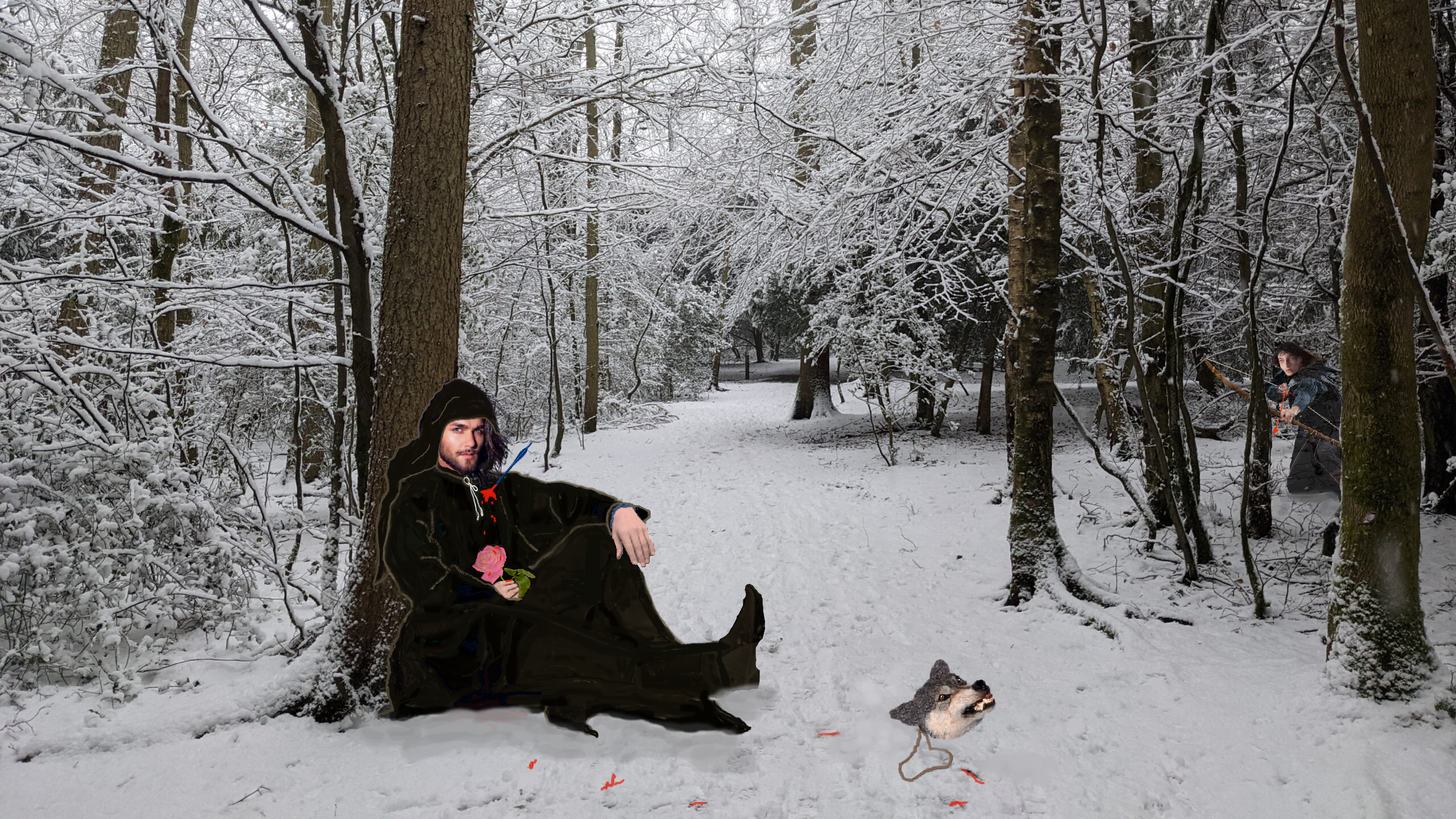
Seeing their immobility, Gervase smiled. “Are you afraid, my lords? When you are both armed, whereas I am not? Physically, at least.”
Slowly they dismounted and ventured closer. Edward spread his hands. “What is this, Gervase? A rather unfunny joke?”
“No joke.”
William feared repercussions for wounding someone who might yet remain the king’s friend. “We should take you to some help—” he began.
“There’s no point. My time has come,” Gervase interrupted, trying to twirl the rose between his bloodied fingers, but weakness made him clumsy.
“That wound isn’t fatal!”
“It makes no difference. I must go now. My fifteen years are over.”
Edward frowned. “Fifteen years? What in God’s own name are you talking about?”
But William knew. “So, Gervase, it seem that you arethe Blithe Lord!”
“One of them.”
Edward’s lips parted. “One of them? What does that mean?”
“We are many, Ned. You’ll find others like me all over your realm. England is a land of witchcraft and magic. Many of your highest aristocracy kneel to a God other than yours, and we all serve our fifteen years and die at the hands of our successors, who serve fifteen years….and so on. Our aim is to restore the old ways, and we will.”
William was angry. “Damn it, you’ll survive if the bolt is removed with care, and you receive the correct attention!”
Gervase smiled. “Don’t fret so, William, you old woman. Although I confess to being pleasantly flattered by your unexpected concern. Rest assured that you will not be the instrument of my death.” Gervase tried to clear his throat, but it was too painful and he closed his eyes for a moment.
Edward was more concerned about threats to his realm. “You’re saying that my enemy is not France, but comes from within? From men like you?”
Gervase smiled. “No, Ned. France is also your enemy.”
“I trusted you, but you’ve been aping friendship all this time?” Edward breathed, choking with bitterness.
“Oh, I’ve done much much more than that, Ned, for I’ve set myself against you are every turn.” Gervase’s lips curved with cool humour. “It’s taken you since midsummer 1459 to finally see the real me, and in all that time I’ve wreaked as much damage and misery upon you as I could without actually revealing myself. Why do you think you suffer all those sudden excruciating pains? As for you, William, I’ve amused myself by conjuring mermaids, manticores and ghostly figures in this very forest.”
By now Edward was acutely wary. “What do you mean? Damage and misery?”
“The tragedies that have befallen your family were all the result of my enchantments. I will begin with the battle at Wakefield. I had your father’s old broken seal, with his falcon and fetterlock badge, and the midsummer page from your brother Edmund’s book of hours. I influenced them both, but you most of all on that occasion. It was no unfortunate timing that made you so unwell on your way to Sandal Castle. I had the hair from your lost ivory comb, and I made sure you puked your guts up. It was because of me that your father and brother left Sandal Castle before you arrived; my fault that they were hacked down and beheaded.”
Edward stared at him, finding it difficult to accept what he was hearing.
Gervase went on. “Oh, there were other things. I had Warwick’s ring and forced him to turn upon you….which, incidentally, you fully deserved. You did make a fool of him with your final ‘marriage’. Of course you weren’t really married at all, but you decided to hold your tongue and pretend you were. Oh, and I had your brother George’s embroidered leather glove. You remember that pair? Emerald green leather with pearls and golden stitchery. Very handsome. Well, I used it to make him cleave ever closer to Warwick, now his father-in-law. Oh, incidentally, George will soon be a widower, and that will tip him over the edge. But then, he’s never been the most level and sensible fellow.”
Edward was riveted, unable to say or do anything.
William couldn’t move at all. It seemed to him that Gervase wasn’t quite as distinct as he had been. But that was foolish, because he was there, talking to them, bleeding into the snow.
“I also made sure Dame Grey said her vows with you,” Gervase continued. “Not that she has ever realised she was tricked. The poor creature still thinks she really is your queen and that her children by you are all sweet legitimate little things. But I fear not. That was your final matrimonial foolishness. Once again you were too smart for yourself and engaged in a third fake marriage, only to then find yourself stuck with her because you’d alienated Warwick. Then you compounded the felony by promoting her multitudinous family, inserting Woodvilles and Greys into the old nobility and causing immense resentment. You’ve unsettled a realm that might have been loyal and supportive if you’d conducted yourself with honour and chivalry.”
“Why commit such abominable crimes, Gervase?” Edward whispered. “Why in God’s own name turn upon me? Have I not befriended and rewarded you and—?”
“I’ve done it all because you brought about Elaine’s death!”
There was such open hatred in the response that Edward recoiled. “No!”
“But yes, and when she died I secured her wraith and have sent her after you. Oh, what a different Elaine came to shriek and howl through your nights, reducing you to a terrified wet-the-bed boy.”
“You claim responsibility for that?” Edward turned away, feeling almost faint as he remembered the terrors. “But why? Why use her poor soul so cruelly?”
“Because you maltreated her and had to be punished. You see, you really were married to her.”
“That can’t be so!”
“Why? Because you so cleverly hired an actor to be the priest? Well, the actor was too unwell and asked his own twin brother to replace him….and the twin brother really was a priest.”
“I don’t believe you!”
“Oh, I have his written confession and the signatures and marks of those others who witnessed the so-called secret ceremony. The document is very safe, its existence know only to— Well, it doesn’t matter to whom. You could never have been legally married to Lady Eleanor, of course, because Elaine was still alive then. But even if that second marriage had been true, Lady Eleanor was still alive when you were supposedly wed to Dame Grey. Three wives, but only the first was your rightful wife. Your children by Dame Grey are therefore baseborn. But then, you’ve always known that, haven’t you? You pretend your offspring are legitimate and have every intention of allowing your by-blow son to be your successor. That’s very naughty, Ned.” Gervase wagged a stern, blood-stained finger.
Edward didn’t deny anything, but a thousand and one conflicting emotions fled through his mind. Then something occurred to him. “How have I been responsible for Elaine’s death?”
“Because she died in childbed bringing your son into the world.” Gervase savoured the credulity on Edward’s face. “A legitimate son, Ned! He’s now tall and strong for his age and can handle a longbow as deftly as he can other weapons. You’ve sired a true warrior.”
Edward was speechless.
Gervase gazed at him coldly. “You stole my sister, Ned, and then stole her very life. Well you may be sure I have raised my nephew to hate the very sound of your name. And when the last breath leaves me now, he will be the new Blithe Lord. He knows exactly how you treated his mother, and he intends to punish you as I have done. You will die before your time, Ned Plantagenet, and you’ll be a slurred, stinking, bloated parody of the great prince you once were. You’ll disgust all who see you, including Dame Grey and her army of kin. Even your own bastards will shrink from your bedside.”
Edward was as white as the surrounding snow. “Who is he? What is his name?”
“That is for you to try to find out. But he’s already close, ready and waiting. Oh, how close….”
A bright red longbow arrow whined through the air and found a mark deep in Gervase’s heart. The wind was jolted from his lungs, but he managed to speak. “And now he has found me, as he was bound to.”
William glanced urgently around in the direction from which the arrow had come, and was in time to see a teenaged boy with a longbow straighten from a crouching position and dash away through the trees. Reacting immediately, William remounted and gave chase, believing he’d have tracks to follow, as there had been minutes earlier with Gervase. But this time there were none. Even though he’d seen where the boy had been, and the direction in which he’d fled, there wasn’t a single footprint in the carpet of white beneath the trees. A new unease, deep and penetrating, engulfed William. If it weren’t for the bright red arrow in Gervase’s chest the boy with the longbow could have been imagination.
He rode back to Edward, who was so fixed upon learning all he could from Gervase that he’d hardly noticed William’s brief departure. Edward seized the dying man by the collar and shook him violently. “Tell me who he is, damn you! Who is he?”
Barely audibly, Gervase whispered a taunting response. “Ned, your true son is now the Blithe Lord, and you’ll never find….” His voice trailed away, for he no longer had the strength to even whisper. He felt cold and clammy and thought he heard Elaine’s sweet voice calling him. His once shining eyes lost their spark as his very self slipped away and he sank against the tree like a bundle of black cloth.
As they looked, it wasn’t only his life that departed, for his body departed too, fading into such transparency that it too disappeared. Then the snow melted all around and spring arrived, bringing with it the fleeting scent of bluebells. It became midsummer again, green and lush, without any sign of anything that had just gone before.
Edward crossed himself with dread. “Did all this really happen, William?”
“If it didn’t, somehow we both managed to witness it.” William fingered his beads.
Stricken, Edward was consumed with dread and utter confusion. Was what Gervase had said the truth? Did he, Edward of England, really have a trueborn son who was the new Blithe Lord? Most of all, was that son in fact the rightful Prince of Wales and future King John II?
But even as the questions poured wildly through his mind he knew it was true. Every last word of it.


 The New Murrey and Blue blog
Leave a reply to What did Chaucer think of the Somerset countryside….? – murreyandblue Cancel reply