Reblogged from a Medieval Potpourri @ sparkypus.com
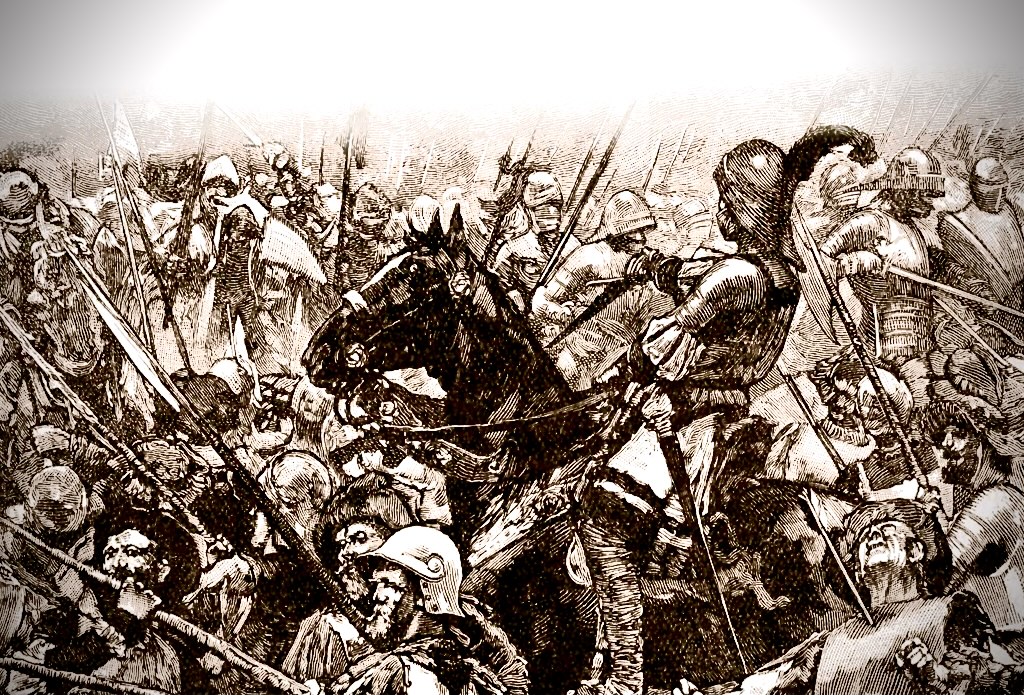
The Last Stand of Martin Schwartz and his German Mercenaries at the Battle of Stoke Field 16th June 1487. Unknown artist Cassell’s Century Edition History of England c.1901.
The battle of Stoke Field fought on the 16th June 1487 has been discussed elsewhere extensively so there is no need for me to go into it here. I would recommend for those who have not already done so, to read Lambert Simnel and the Battle of Stoke by Michael Bennett and Stoke Field The Last Battle of the Wars of the Roses by David Baldwin should they wish to delve more into the story. I want instead to focus on the aftermath of that awful day with its tragic outcome – the final fall of the House of York and the destruction of its last leaders – but mostly the lost burial place of John de la Pole, Earl of Lincoln (c.1460-1487) whose parents were John de La Pole, Duke of Suffolk and Elizabeth Plantagenet, sister to two kings. At the end of the battle, as per usual, the vast majority of the dead would have been buried in huge pits not far from where they fell. It is believed because of the elevated levels of parts of the churchyard of St Oswald’s, East Stoke, that some of the more fortunate, if that is the right word, may have been taken there for burial in consecrated ground where they lie today. Let us hope so.
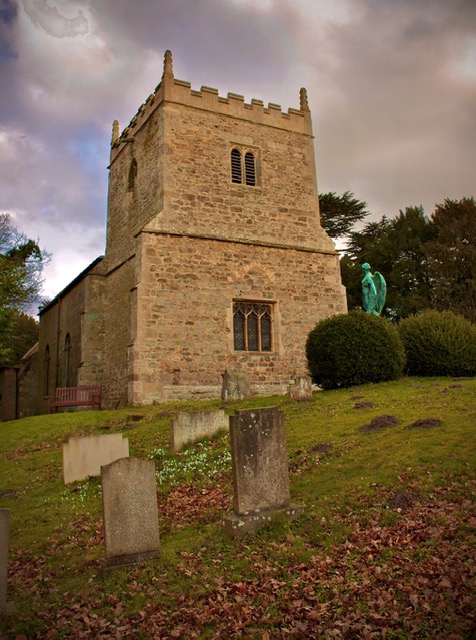
St Oswald’s East Stoke. Because of the elevated areas in the churchyard its believed that some of the dead were brought from the battle field for burial here. Could Lincoln have been among these..? Photo Viona Fearn @flikr.
Quite often though, the families of the higher status dead would somehow be able to retrieve their dead, take them home and give them honourable burial. I will return to this point later. As an example the body of John Howard, Duke of Norfolk, slain at Bosworth in 1485, was laid to rest at Thetford Priory while the bodies of Richard Neville, Earl of Warwick aka The Kingmaker and his brother John Neville, Marquess of Montague were both retrieved after Barnet in 1471 to be entombed with their ancestors at Bisham Abbey. These names are the ones that spring to mind but there are many others including those returned to England after dying abroad such as Edward, Duke of York who fell at Agincourt and was brought home for burial in the family mausoleum at Fotheringhay. However we do know, thanks to Vergil, that the terminally suspicious Henry, taken aback at the ferocity and resolution of the smaller rebel army, assumed that there ‘must be yet further members of the conspiracy who at an opportune time and place would join with them’ gave instructions that Lincoln was to be taken alive to enable Henry to get to the bottom of things. No doubt he was peeved when his plan went awry, Lincoln falling in the midst of the battle, and did this, in turn, lead to him in a fit of pique, to order the burial of Lincoln in a common burial pit? In any event it is reported by some historians that the dead Yorkist leader was buried there and then on the battlefield (1) If so what the thoughts of his parents were on an already tragic situation made even worse by the totally unacceptable burial place of their eldest son are unrecorded. The callousness of the treatment of Lincoln’s body is on a par with that of the dishonourable treatment we know was meted out to the slain Richard III with many wounds to his body dealt after he was dead and long past harm. But finally Richard was handed over to the friars of Greyfriars in Leicester, who were then able to give him a decent if hasty burial with the usual funeral rites of the time. With hindsight is it possible that the dead king narrowly missed being buried unceremoniously on Bosworth battlefield because it been necessary to have his remains displayed as proof that he was indeed dead? Because sadly Henry’s callous treatment of his fallen enemy two years later, if true, leads me to conclude that he was indeed capable of making these quite shocking and at the very least spiteful decisions. Let’s make no mistake about it by 15th standards the burial of a fallen leader of high status on unconsecrated ground at a time when it was fully expected for all Christian people to be buried on hallowed ground would have been considered heinous and it’s inconceivable that the burial of Lincoln would have taken place on the battlefield without the authority of Henry VII. These were the days when to conform to the strong Christian beliefs of the times strenuous efforts were made, as much as humanly possible, to return the dead to their homes for burial by their family and even the poorest of people would have hoped to be buried in their own communities where the prayers of their families and friends could assist them through purgatory (2). Of course in a battlefield situation with many thousands of men dying in one day it would be difficult to conform to these ideals in the immediate aftermath of battle for the rank and file but certainly in cases of those of high status, being easily recognisable, it would have been achievable to return them to their homes and families even if this entailed moving them great distances. Should you want to read more on this subject I recommend Where are the dead of Medieval Battles? A preliminary survey written by Anne Curry and Glenn Foard where the matter is covered in detail.
So we can see how abhorrent this act would have been considered even in those brutal days. Now here’s a thing – oddly enough the unorthodox, inappropriate burial place of Lincoln was not recorded in any of the contemporary accounts of the battle, such as the Heralds Account, which is exactly where you would expect to find it. For example the city of York’s account of the rebellion written in June 1487 does not single out Lincoln for mention other than he was present with Lovell and that ‘ther was a soore batell, in the which therl of Lincolne and many othre aswell Ynglisshmen as Irissh to the nombre of 5000 wer slain and murdered….’ The Heralds Report written 1488/89 recorded ‘…and there was slain the Earl of Lincoln, John, and diverse other gentleman….’ The French Chronicler Jean Molinet writing c.1490 wrote ‘There died the Earl of Lincoln, most noble and renowned in arms, Sir Martin Schwartz, a most enterprising knight and of greatest courage. ‘ How about the judgemental Bernard André who penned the Life of Henry VII? He wrote ‘the Earl of Lincoln, moreover, came to an end worthy of his deeds, for he was slain in the field… ‘ You would have thought he, after writing so fulsomely about the Tudor king, would have delighted in spreading the whereabouts of the ignoble burial place of the fallen Yorkist leader who had had the sheer gall to challenge Henry VII!.
To continue reading click here.

 The New Murrey and Blue blog
Leave a comment