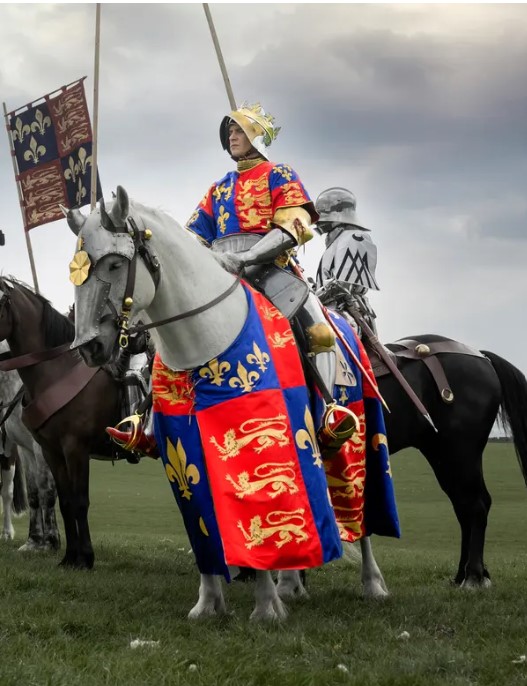
Richard III from The Lost King

I don’t know which five of our medieval monarchs you’d choose as the most fearsome warriors, but according to this article it seems the Fearsome Five are (in chronological order) William I, Edward I, Robert the Bruce, Henry V and … Richard III. Now, I’m not saying Richard wasn’t a fearsome warrior, because he was, but unlike the other four he didn’t go out of his way to find trouble. He only sallied forth at the head of an army when (a) his brother Edward IV instructed him, (b) when he had to put down a rebellion, or (c) when some impudent Welsh Weasel or other fancied pinching the throne when Richard was still sitting on it.

Richard was indeed fearsome…and fearless. And but for the treachery at Bosworth there’s no doubt he would have crushed the Weasel and we’d have been blessedly free of the exceedingly grim and bloodthirsty House of Tudor. But sigh and wish as we may, the treachery took place and Richard was cruelly murdered. If there was any justice at all his ghost would have been fearsome as well, and those who’d turned upon him should have had sleepless nights for the rest of their miserable lives.

There, that’s my rabidly Ricardian spleen vented for a while. 😊


Subscribe to my newsletter

  1. 😀 A vented spleen always makes me feel better.

    Liked by 3 people

  2. But Robert the Bruce wasn’t a King or English?

    Liked by 1 person

    1. He was king of Scotland, now part of the UK, from 1306-29, making him an ancestor of Charles III.

      Like

  3. True, thanks

    Like

  4. amma19542019 Avatar
    amma19542019

    There’s never much meat on the bone with History mag articles (online or print) (in my snobby opinion) but they are right here even when they are using the wrong examples – hear me out – most of us, myself included, often forget Richard’s adult career as lord of the north, in particular Warden of the West March, considerably more frantic and irksome than what Harry Percy had to deal with on the East March (the middle March was also Percy’s venue but trouble always seems to have been on the edges of both Marches; ie. Angus raiding and burning Bamburgh in 1480 but note that it was Richard who had to cut short his visit with his sister Margaret to dash back north to retaliate with his troops).
    Being a marcher lord was no light duty and before the 1483 Parliament handed over the goods (as scholars would see it) with Edward’s blessing to grab and keep anything over on the Debatable Lands that Richard could seize he had already laid waste to much of the areas he wanted over the border, clearing out (illegal) settlements and issues with the fishing rights that had been going on long before Edward had sent him north. Law came first and establishing those areas where the fishing rights were to be enforced may sound trivial to us centuries later but were highly significant in the 1480’s and even more so once Berwick was retaken and made the counterpoint of trade to Carlisle – the negotiations to keep those lands as his turf, under his rule, by force if necessary, may not be the stuff of Agincourt but if you know the career of Henry V he instigated much the same procedure, what is usually called the reverse conquest of Normandy. By establishing Englishmen (his own favored soldiers at first, then merchants, even garrison soldiers and retired troops) in land grants, manors, towns, across Normandy, with the purpose of not fighting every battle but intermarriage (it happened where a wealthy French heiress was available) and through trade, H5 intended NOT to have to fight it out continuously.
    I doubt Richard intended to need to fight it out continuously either, which is why he wisely did not go rogue at Edinburgh with 20K troops and make himself king there, or worse, stick the Scots with that buffoon Albany! Crowland, who knew nothing about the north, other than they were pond scum and beneath his consideration, also knew nothing of military tactics and reality, expecting Richard to have burned Edinburgh to the ground and looted the place blind.
    His Scottish career, on the borders, and what he had planned for the Debatable lands, is covered in the literature, I would just advise not starting with Pollard first!
    As for the History mag swipe about the sons of Edward, tiresome yes, no one ever considers that Richard DID live at the same time that saw so many personal tragedies in his family, right? We are to assume he would willfully do to his brother’s sons what Clifford did to Edmund? As the youngest son of a large family he was left with a horde of nephews, and nieces and assorted kin to protect, not just the two sons of Edward, Wiltshire was taken on almost as a son of his own, as was young Warwick, which sadly was the last time he would be treated with decency and as if he had a future, as if he was someone.

    Liked by 1 person

  5. Would have thought Richard I instead of Richard III, but still.

    Like

  6. There is a story that the Weasel was not Welsh – see John Ashdown Hill’s Royal Marriage Secrets.

    Liked by 2 people

  7. Indeed there is, and I for one believe it. He was a Beaufort through and through!

    Liked by 1 person

    1. I have to say I agree with you completely. It would be great if we could open Edmund Tudor’s grave and find his DNA.

      Like

      1. It was moved from Carmarthen at the Reformation, if I remember RMS correctly, whilst Owain is still in Hereford.

        Liked by 1 person

Leave a reply to mry4441 Cancel reply