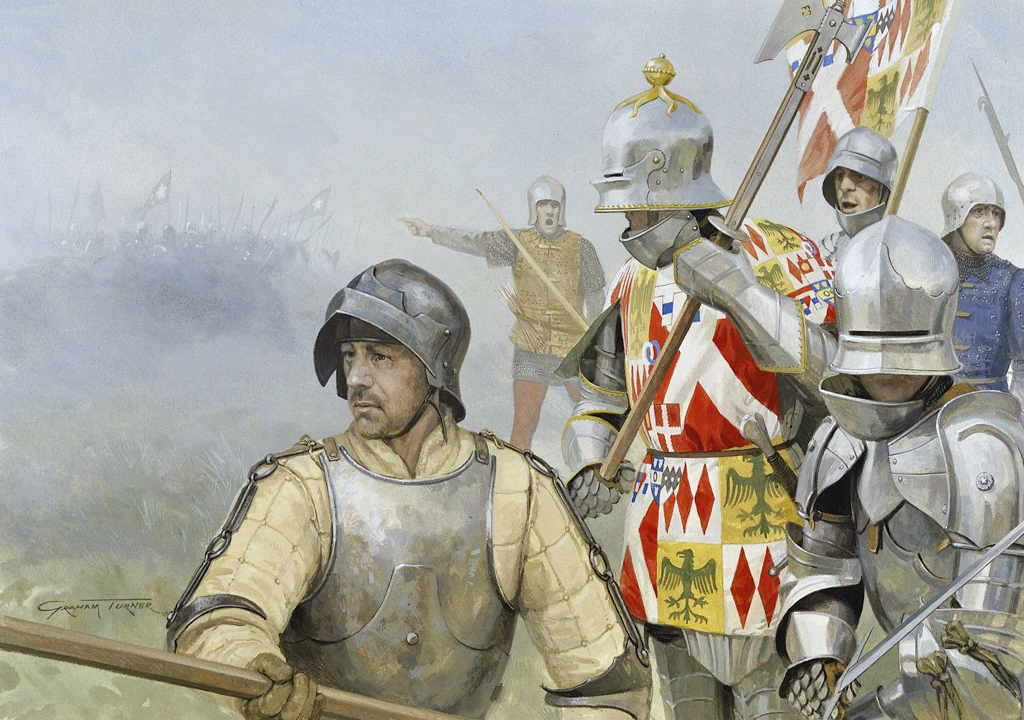
 On 14th April 1471, Easter Sunday, in thick fog, was fought one of the pivotal battles of the Wars of the Roses, when the Yorkist Edward IV took on and defeated the by-then-Lancastrian Earl of Warwick, who was killed in the aftermath while trying to escape. His brother Montagu was killed as well. The fog was the key factor; because of it the Lancastrians muddled two similar badges and mistakenly fired upon their own side.
The death of the “Kingmaker” was a tragedy for the Lancastrians, but also for Edward, to whom Warwick had once been close. A tragedy too for Edward’s brothers, George, Duke of Clarence, and Richard, Duke of Gloucester, the latter only eighteen when he commanded Edward’s right wing. As boys, both had been brought up in Warwick’s household….and each had married one of the earl’s daughters. The rift between Warwick and Edward was due to Warwick’s grievance about being made to look a fool when he was negotiating a French marriage for Edward….only to learn that Edward had already married an insignificant Lancastrian widow named Elizabeth Woodville, who seemed to have an army of hungry relatives. Edward set about promoting them all, at the expense of the older aristocracy, including Warwick’s family. Thus a wedge was driven through established alliances, and for Warwick it culminated in the Battle of Barnet.
The location of the battlefield has long been debated, and if one follows old accounts and maps, it seems to have wandered all around the neighourhood of Barnet in Hertfordshire. Places were named that had never existed, and all accounts seem to differ, so the business of really pinpointing it all is very complicated indeed.

given and which appear spurious, such as the hedge and Wrotham Wood, and others which are misplaced, notably Dead
Mans Bottom.
The Barnet Battlefield Project was set up between 2015-2018 and its research and conclusions can be viewed here. The site bulges with interesting information and downloadable PDFs, and almost a surfeit of sources and old maps. If you want to know all about the Battle of Barnet, this is the site to visit. Thoroughly recommended.


 The New Murrey and Blue blog
Leave a reply to Thomas Tresham – Lancastrian and Speaker of the Commons. – murreyandblue Cancel reply