from catholicireland.net
It would be true to say that Ireland often confounds this floundering English/Welsh writer. Because of the politics? No. Because of the weather? No. Because of the trouble past? No. Because of the religious complexities? No, although religion is at the heart of it. The point that is taxing my grey cells is to do with somewhere called St Patrick’s Purgatory on Station Island in the waters of Lough Derg, County Donegal. Or should it be Saints Island in the same lough?
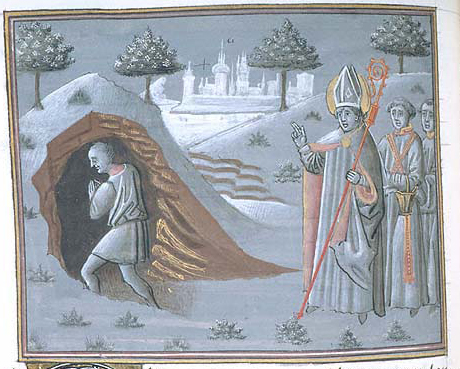
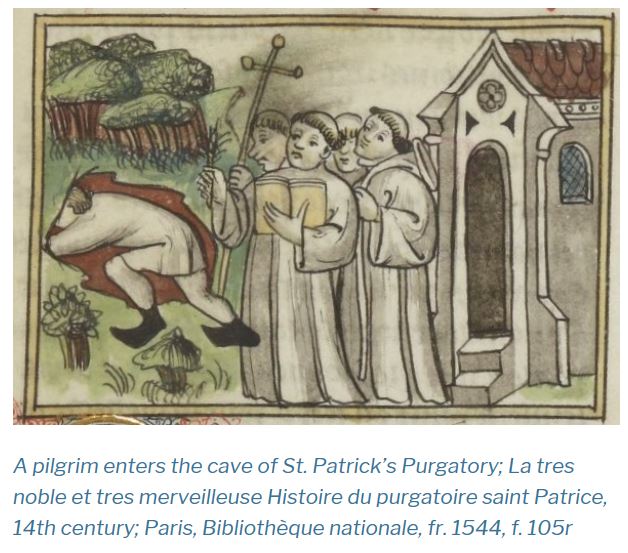
Why am I confused? Because the more accounts I read, the less certain I am of exactly what was where. Briefly, the story of the Purgatory is that St Patrick needed to convert the pagan Irish to Christianity and so was shown (by God) a cave on an island in the lough, in which was to be found the gateway to the Otherworld, guarded by all manner of terrible demons. Surviving time spent there ensured the forgiveness of all sins hitherto committed, and that salvation was assured provided one did not sin again. This would show the pagans the wonders of Christianity. Thus the island became a place of Holy pilgrimage.
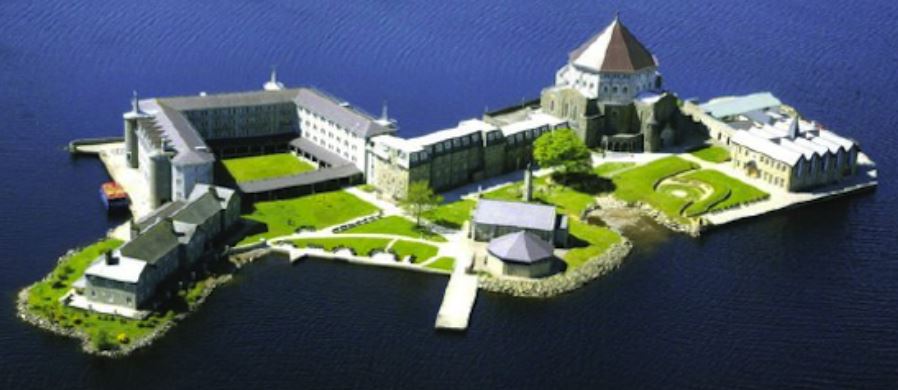
The fame of the island spread far and wide, so that soon pilgrims from all over Europe flocked to go there. Today they cross from the lough shore opposite Station Island, but what did they do way back in the early centuries?
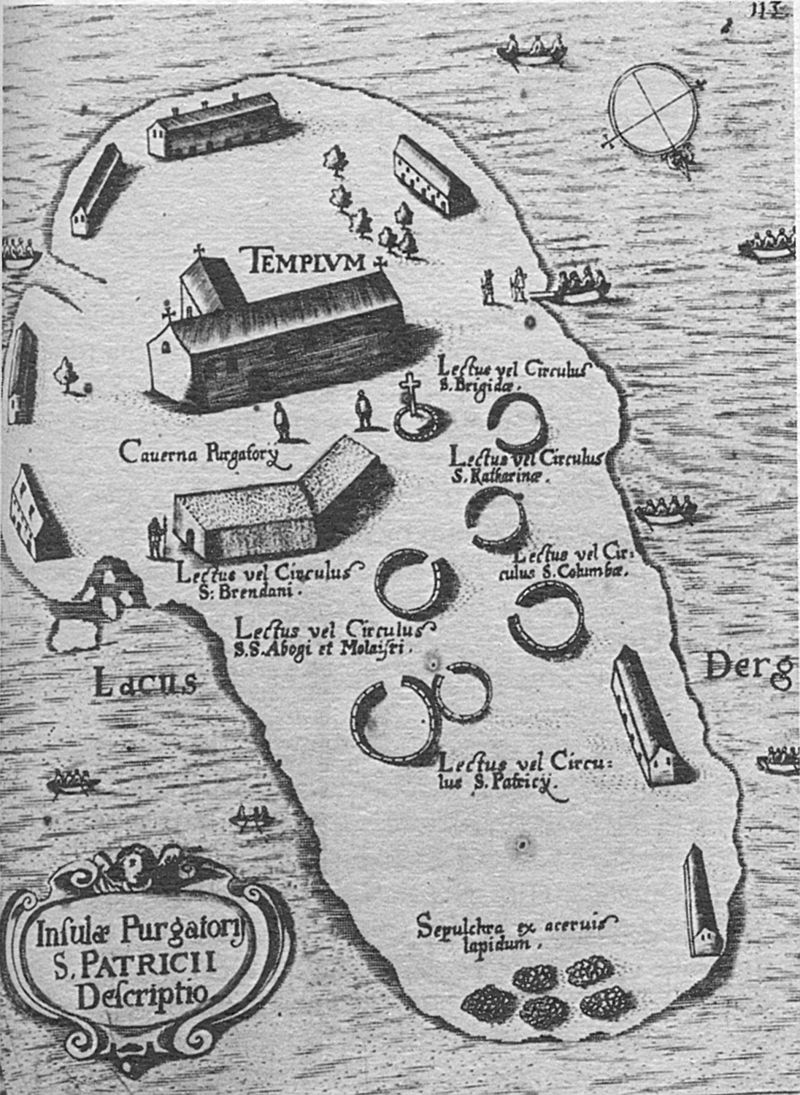
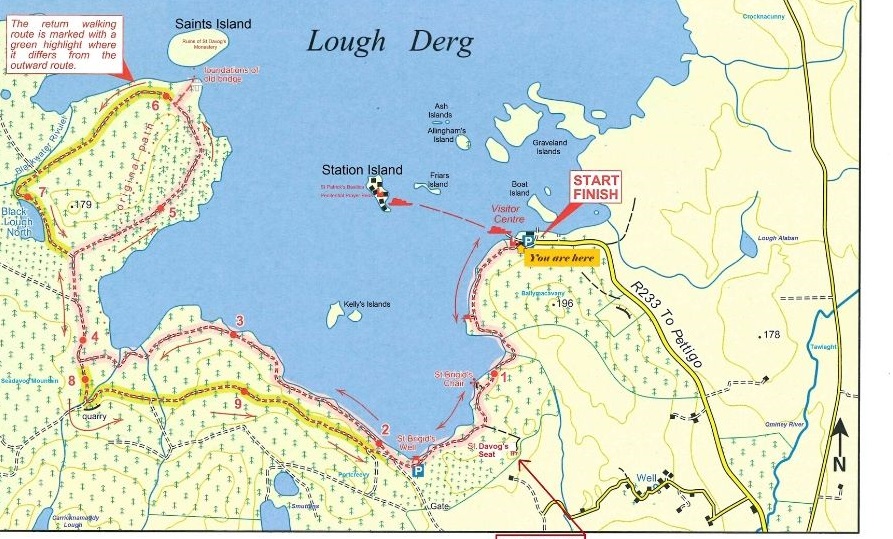
The origin of the Purgatory seems clear enough…until one comes to the matter of the exact island, and how one crossed the water to the cave. There are variations in routes and exact locations. A sanctuary (tearmann) is mentioned, but there were two, one on Saints Island and one of Station Island, so that doesn’t help.
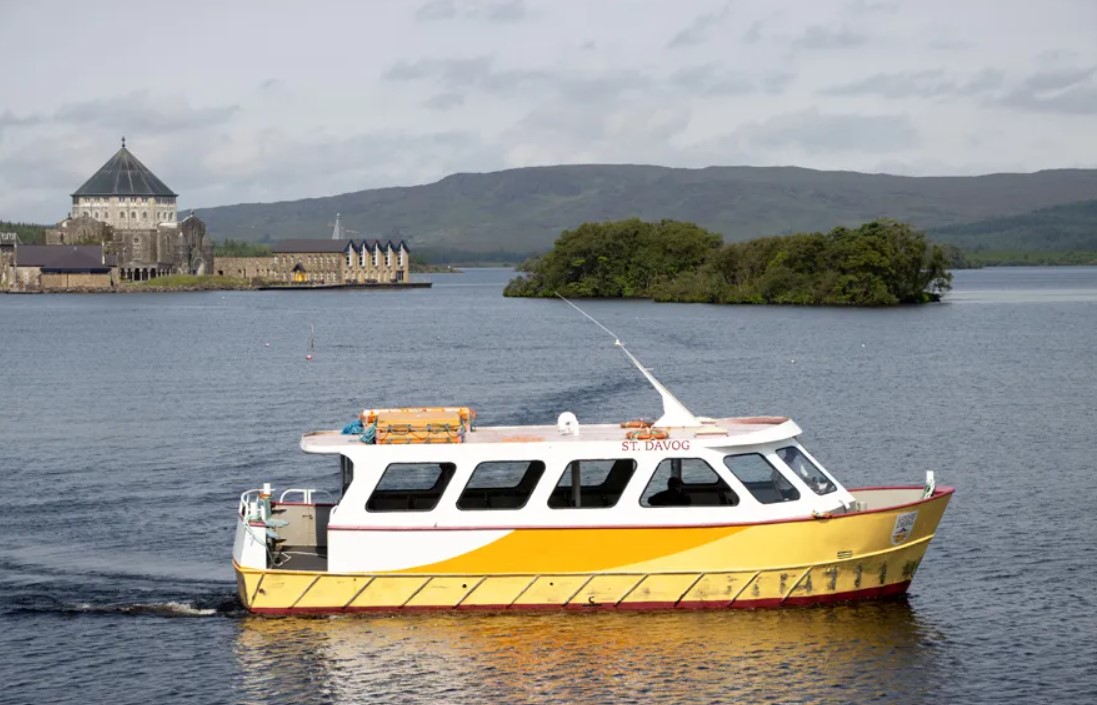
One route was the present one from the shore of the lough straight to Station Island.
from https://i0.wp.com/lvbmag.wpcomstaging.com/wp-content/uploads/2022/07/St-Davog-Boat-St-Patricks-Purgatory-Lough-Derg-Donegal-%C2%A9-Lavenders-Blue-Stuart-Blakley.jpg?ssl=1
But another says the original Purgatory was on nearby Saints Island, where the remains of an Augustian settlement are still to be found. The modern pilgrims’ path does indeed lead to the shore opposite the latter island and can be followed on Google Maps. The track goes right down to the edge of Lough Derg and disappears. Clearly there had to have been a bridge across the narrow channel.
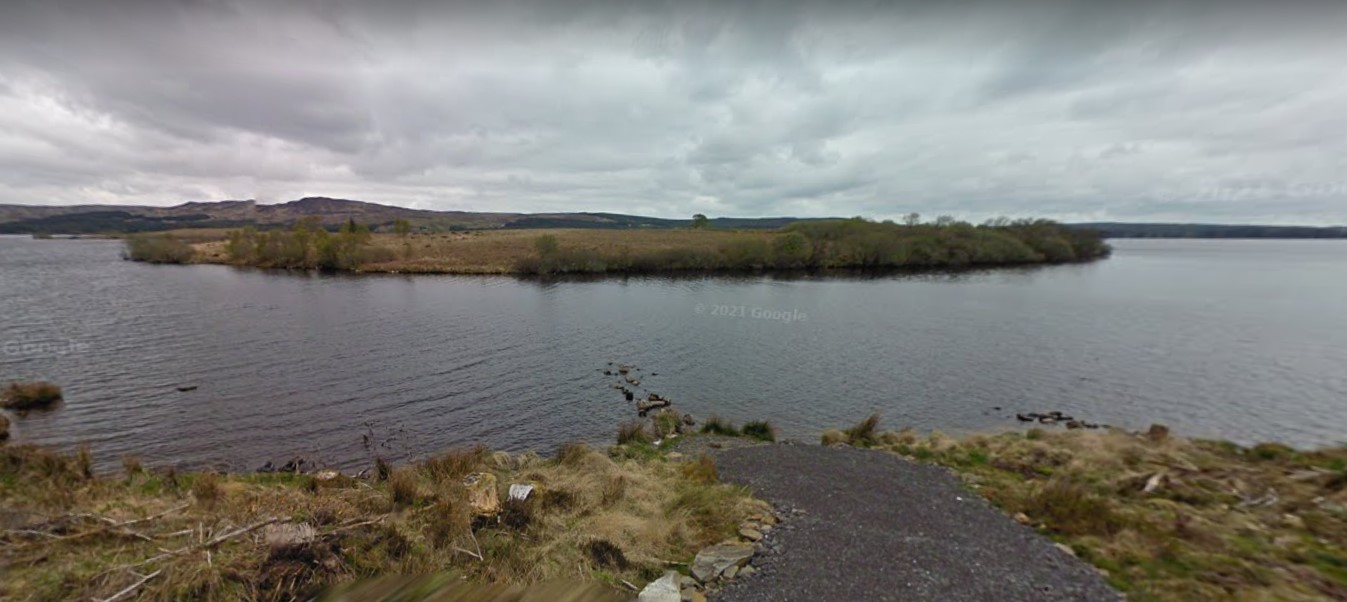
Although there is no bridge today, the suggestion is that centuries ago one did indeed cross the channel. It was said that once a pilgrim had convinced the prior there of his sincere desire to enter the cave, he would be taken to the cave…was he rowed across to Station Island? Wherever it was, he’d be locked in, generally overnight.
So, was the cave on Saints Island all along? There’s a suggestion that the real cave (on Saints Island?) was filled in on order of the Borgia Pope because the whole pilgrimage business on the lough had become too mercenary (and being a Borgia, he should know about that!) Yet again, other accounts say that the cave that was filled in was the one at the present day Purgatory on Station Island…and remains filled to this day.
Was there ever a cave on Saints Island? Or is that an error? Did the boat that carried the medieval pilgrims to Station Island leave from Saints Island….or from the shore of the lough directly to Station Island which it does today?
Why do I want to know? Because I want to write (as accurately as possible) about a visit in the island in 1394 by an Englishman called Sir William de Lisle, a chamber knight to Richard II. Froissart relates the story, but doesn’t include any details. I want to get Sir William from Dublin to the Purgatory and then back again, but Froissart only says that he [Sir William] and either some knights or one other knight rode there. Then, as soon as Sir William has Lough Derg in his sights, the mystery kicks in of how he crosses to Station Island…if it was indeed Station Island. What if it was Saints Island first and then Station Island? Or never Station Island at all?
Then, finally, I came upon the following. According to the Saints Island Graveyard Archaeological Survey :-
“….It is traditionally believed that a monastic settlement was founded here [Saints Island] in the fifth century by St. Patrick who installed Dabheoc as the first abbot. There are forty-six islands in Lough Derg but only two of them are of archaeological interest. ….The original monastic settlement is believed to have been located on Saint’s (formerly St. Dabheog’s) Island. This became a priory dependant on the Augustinian Abbey of SS Peter and Paul, Armagh in the 1130’s and was suppressed and abandoned towards the end of the sixteenth century. The chief concern of the monastery was to minister to the needs of the pilgrimages to the cave, known as St. Patrick’s Purgatory, on nearby Station Island. Some sources suggest that the original cave had been located on Saint’s Island and that the pilgrimage was later transferred to its present location (Leslie 1961, 9-10)….
….The Lough Derg pilgrimage was famous throughout Europe in the middle ages and a large literature grew up around it (Curtayne 1962, 160-62). An ancient roadway to the pilgrimage site from the village of Pettigo passes Rathnacross ringfort (DG105-002-) and Templecarn old church and burial ground (DG105-003; DG105-015-). The roadway continues to a point on the SW shore of the lake where a wooden bridge (DG101-002-) connected it to Saint’s Island. Natural boulders projecting from the lake may be the remains of the supports for this bridge….”
Right, that clinches it. Doesn’t it? They followed the pilgrims’ way around the lough shore to the wooden bridge that crossed to Saints Island, and from there went by boat to Station Island. But can I use this with the certainty that it’s the answer? And what about the suggestion in some accounts that the cave on Station Island is/was an imposter, created for money-making purposes? So which cave did the Pope order to be destroyed? Only the one? Or both?


 The New Murrey and Blue blog

Leave a reply to viscountessw Cancel reply