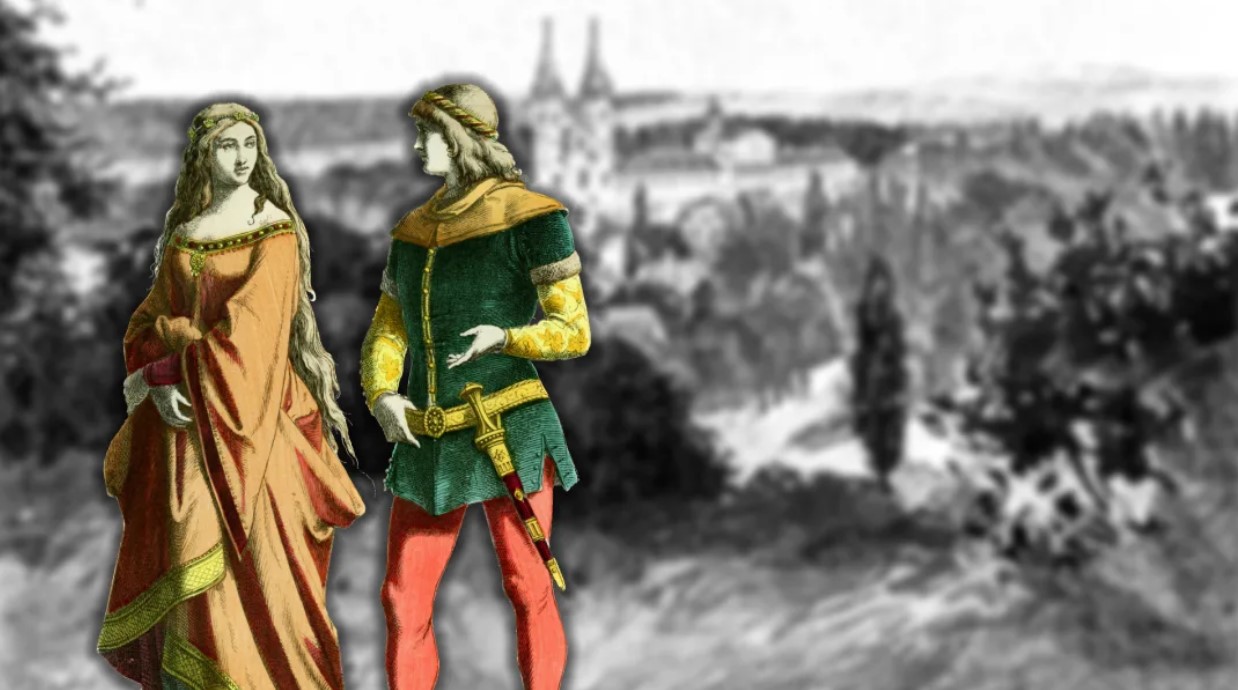
We all know the story of John of Gaunt and Katherine Swynford/de Roët. It was a wonderful, passionate love affair that ended with Gaunt, a prince of the realm, making the relatively lowly Katherine his third duchess. Yes, a great romance, and it was fact, not fiction.

However, historically speaking, both of them had a profound effect on English history. Gaunt fathered the thieving House of Lancaster, and the (originally illegitimate) children he had with Katherine became the House of Beaufort.

So I’m afraid I’m not enamoured of these renowned lovers! 🙄 And yes, I’m aware that Richard III had a Beaufort in his ancestry. As far as I’m concerned Lancaster/Beaufort equals the murder of Richard II, the Wars of the Roses and Richard III’s betrayal and death. Culminating in the usurpation of Henry Tudor. So thank you, John of Gaunt and Katherine.

If you go here you can read all about the famous romance.


Subscribe to my newsletter

  1. Roberta E Fagan Avatar
    Roberta E Fagan

    Anya Seton’s novel seems to be behind a lot of the current fascination with the Lancastrians.

    Liked by 2 people

  2. That Anya Seton novel must be the same one I read and went all romantic over when I was a goofy teenager. My friends loved it, too. I don’t know what their problem was.

    Liked by 2 people

  3. If it is any consolation Viscountessw, Richard had rather alot of ‘people’ coursing through his blood and DNA!

    During a friendly conversation with a devoted advocate of Henry VII the recurring theme was his love for Henry’s alleged Welshness. Now, how could I let that pass? Not wanting to segue into a conversation about Edmund Beaufort (which would be torture for this guy) I just noted that Richard probably had considerably more Welsh blood than Harry did. Well, not to let this detail get in his way he insisted that it “doesn’t matter, under the Tudors England was all for the better, in every way.”
    I countered with all the legal reforms Richard initiated, many of which he established, and not necessarily through Parliament (he wasn’t going ‘to rule through Parliament,’ I think that is how Kleineke made that point a couple years back, which btw, annoys more British law purists than I would have imagined) but Richard, with his perceived odious and slandered reputation has never been given the credit, it was all granted to the glorious Tudor achievement.

    (Not my genius commentary, the Tennessee Bar Association has a lawblog, on the occasion of Richard’s rediscovery Fowler to the legal record straight, he’s no Ricardian however, or he feared blowback from the tolerant mini-minds in his office; I’ve included the link below, he highlights what an excellent, comprehensive grasp of what legal reforms Richard began, and where Henry opportunistically continued, and got the credit!)

    https://www.tba.org/index.cfm?pg=LawBlog&blAction=showEntry&blogEntry=14001

    Liked by 1 person

    1. More Royal Welsh descent, definitely. He was descended from Llewellyn the Great, the Tudors ostensibly from his steward.

      Liked by 2 people

      1. Of all the Mortimers in Richard’s lineage it is the sad story of Catrin verch GlynDwr that I find so compelling, married to Edmund, they had several children before he died at the siege of Harlech and she found herself and the young children bundled off to the Tower as prisoners pf Henry IV, along with Owain’s wife I believe. To my knowledge none of the children survived the Tower, where they were buried I don’t know, assuming they ever left the Tower.

        Liked by 2 people

  4. Henry VII seems to have always had Lady Luck on his side. It’s SO unjust because he was an opportunist. He didn’t DESERVE anything, but acquired everything. AND he died in his bed. Damn him! 😠

    Liked by 3 people

    1. You know I research using a big net, and I too have wondered how Mr Teflon has pulled this off. It may have something to do with 1) timeline, they are literally smack in the middle of a scrolling timeline (especially if you were a Victorian digging up every garden and poking thru dusty papers in attics untouched even by antiquarians) and to them the blessed Tudors sweep away all the jumbled “Athelstans’ and lost French ie. Hundred Years War which devolved into the civil wars of the “roses” until finally, sanity ensued with the angelic one saving them – read Crowland again, that’s how Crowland saw Harry – and 2) the Tudors ubiquitous, they were voracious, there was not one farm, town, abbey, manor, muddy patch along a ditch that they didn’t ‘acquire’ and stamp their name and patronage onto – if not granted to Mother Beaufort and one of her acolytes then uncle Jasper or one of the other minions.
      It comes down to this – there was, to historians and movie producers and writers, NO English anything before the Tudors, and everything after them they created, influenced, modified, improved, you know, they are even credited with the Renaissance in England!
      At the moment I am plodding through the Calendar of Patent Rolls (only 1477-85 mind you) and from the execution of Clarence on for some years, Edward has a slush fund of patronage to dispense, and my goodness he was a busy boy, name anyone in the southern counties, many of whom were George’s own retainers (!) but mostly Edward’s inner clique who profited mightily by the duke’s demise. The Tudors under Henry VIII had a similar – no much larger – slush fund when he decided he was not only the head of the government but head of the church and all ecclesiastic properties and foundations were his to dispense with (‘dissolve’ – is that like Putin dissolving Ukraine?) anyway, that my dear Viscountessw is how the Tudors bought their way into rebranding every park, farm, manor, town and ditch across all of England …

      Liked by 1 person

  5. It always amazes me when people class the Tudors as a sort of ‘golden age’. They were mass murderers just for starters. The only reasonably competent one among them was Elizabeth I, although Henry VII – looked at objectively – balanced the books and kept out of war, albeit at the expense of tyranny and excessive taxation. They not only handled religious discord badly, they started it up, not for reasons of belief but for sheer selfishness. How many martyrs were created – on both sides? Many hundreds if not thousands. There was a mass destruction of English art, literature and architecture that makes the Blitz look like Bonfire Night. For one thing, how many tombs, including royal tombs, were lost forever? Talk about the triumph of PR over reality!

    Liked by 1 person

    1. I reserve judgment on Elizabeth. Her counselors were, if the plots to set up and ruin Mary Queen of Scots, are accurate, wretched manipulators and she by extension, easily manipulated, (despite of her own often duplicitous nature she didn’t see all the scoundrels around her, or if she did, she was no better than they were). Another issue I have with Elizabeth is her pettiness, jealousy, meanness towards other women, especially among those closest to her, family (what was left of it) and her ladies. Perhaps compared to the ever present toll of executions and those interminable Tower imprisonments such character flaws by Elizabeth seem minor but recognizing her character is a device by which her ‘faithful’ leeches, the counselors, would use to maneuver and gauge her actions that they wanted to happen. Am I sympathetic to her? I’ll get back to you on that one.

      Like

  6. Anya Seton’s novel is certainly extremely influential. Arguably more so than SKP’s Sunne in Splendor as the latter has novels in direct opposition to it. It has led (among other things) to a widespread belief that Bolingbroke was a put-upon innocent, not the ‘vile politician’ as Shakespeare names him.

    Liked by 1 person

    1. A put-upon innocent? BOLINGBROKE????? The creep was a scheming, murdering usurper! More and more PR…..

      Liked by 1 person

      1. Viscountessw, after I read Ian Mortimer’s bio on H4 I was convinced that he was the most amazing and truly abused king ever! My heart was bleeding for him! Of course that was some time ago …
        I have since read up on Harry 4 and delved deeper into his nemesis Owain GlynDwr, and what would have been a real trifecta with Hotspur and Edmund Mortimer replacing Harry4 – but politics aside on that one, the points I took away was H4 was under constant barrage of assassination attempts, plots to overthrow him, and on top of it all his own father undermined him with those Beaufort bastards! Can we say “why did he even bother?” His erstwhile son H5 restarted the (lost) French wars just to redirect the animus against their House! Karma is a you know what, daddy left 4 healthy adult sons, only one of them had legitimate issue, the annoying Beauforts left oodles. Apparently Richard II wasn’t the ‘one’ that Bolingbroke should have seen as his enemy?

        Liked by 1 person

    2. And, of course, Shakespeare otherwise never vilified anyone…

      Liked by 1 person

      1. Shakespeare puts those words into the mouth of Henry’s enemy. His general painting of him is quite sympathetic and he makes his son practically a saint. (Of course, had Henry lost at Shrewsbury Shakespeare would probably have called him a hunch-backed murderer or something!) But in the real world, Shakespeare’s sympathies were clearly Lancastrian.

        Liked by 1 person

  7. The South Australian branch did talks on change one thing in history. I chose John of Gaunt not meeting Katherine Swynford. Boy would history be different!

    Liked by 2 people

    1. Fine with meeting and bedding her, just don’t bribe the Pope and strongarm your nephew into legitimizing all the bastards! Cut your own son and legitimate grandsons a break!

      Like

      1. I cannot begin to fathom what it is you are trying to say. He “bribed” the pope? He “strong-arm”-ed his nephew into the legitimation of the Beauforts? Do show us that proof! And whatever do you mean by saying he should have “Cut your own son and legitimate grandsons a break”??? Have you read his will in its entirety? Gaunt very assiduously ensured that the interests of his descendant’s by first wife Blanche of Lancaster were not threatened by the advancement and interests of his children by his third wife, Katherine Swynford.

        Richard’s actions following the death of his first wife Anne of Bohemia became increasingly erratic and vindictive, and John of Gaunt largely was forced into supporting all that, including executing possibly innocent persons. Richard had John of Gaunt’s brother executed or murdered and Gaunt still supported him, though likely not willingly.

        John of Gaunt was certainly no saint; but guess what? Neither was Richard II. But John of Gaunt most definitely DID look out after the interests of his son by his first wife while Richard banished him and seized his patrimony.

        Like

  8. If John of Gaunt took SO much care to safeguard his children by Blanche, why did Henry Bolingbroke feel it was necessary to ensure the Beauforts couldn’t ascend the throne?

    The Pope never did anything without being paid handsomely. He was bribed. And Gaunt did lean on Richard about the Beauforts. Richard certainly didn’t oblige off his own bat. Nor did he eventually seize Bolingbroke’s patrimony to pocket it for himself, but had every intention of returning it. In the end Bolingbroke murdered him at Pontefract, but I suppose as wronged Gaunt’s wronged son, he had every justification? Invasion, murder and usurpation?

    And come on now, are you saying Thomas of Woodstock was an innocent angel who was wrongly killed by his vile nephew? Yes, Richard executed him summarily, but he’d had to take a LOT of grief from that scheming uncle. Maybe the way Richard finally went about it was dubious, but Thomas of Woodstock definitely asked for it. He was a nasty piece of work.

    Maybe Richard did have faults, but from childhood he’d been pushed from pillar to post by domineering uncles who sought to hold on to power for themselves. Well, except Edmund of Langley, who was the only calming influence among them. Richard was of age but had to seize control of his own kingdom, for heaven’s sake. He was damaged goods because of how he’d been overruled and belittled all his life.

    And why haven’t you mentioned Gaunt’s bullying of old Edward III to ensure his, Gaunt’s, line was Richard’s heir (unless and until Richard produced an heir of his own—if he lived that long)? Gaunt wanted to exclude the Mortimers, who actually had a better claim than he did because they were Lionel of Clarence’s line, but oh dear, it was an “inferior” female line. And Gaunt conveniently overlooked that he himself was claiming Castile through his wife! Even old Edward III was guilty of finding female lines useful when it suited him – he claimed France through his mother! Double standards all over the place.

    Yes, I’m a Ricardian twice over – Richards II AND III!

    Liked by 1 person

    1. Viscountessw, didn’t H7 claim thru his mother Beaufort? I think H4 did so as well – hazy as to why, perhaps to bypass the Mortimers?

      Like

      1. Oh yes, Edmund “Tudor” was officially a commoner or the illegitimate son of a Duke, whereas Margaret Beaufort was the legitimate daughter of a Duke.

        Liked by 1 person

  9. heh, I agree with GL Harriss on this one as per Edmund…

    Like

    1. That would have made Henry illegitimate if his parents knew they were undispensed first cousins.

      Liked by 1 person

      1. No doubt, but proving the dalliance between Queen Catherine of Valois and Edmund Beaufort resulting in her 2nd son, Edmund, would require efforts far beyond the interest of anyone in the Tudor camp
        Harriss’ comment wasn’t said in a flippant way, he was from that staid generation where loose remarks were not condoned. That the government was moved to address what to do with their king’s young, fetching widowed mother – literal catnip for all the ambitious Edmund Beauforts at court – is enough smoke to indicate the fire was already lit by the time they got around to official Acts in Parliament.
        If there was a love story my vote is not Edmund and Catherine (he would have many many children so his heart was not broken when their paths diverted) but instead probably Owen and Catherine, especially if he did have to protect her and her son by another man and in strictest secrecy – and live in that same nether world outside legal marriage.
        Forget Gaunt, he flaunted every convention and rule, Owen would not have been so lucky, nor was he in the end.

        Like

      2. We have the Beaufort Y-chromosome from 2012, as five out of six comparisons were the same. Edmund, Henry VII, Henry VIII, Edward VI, Henry Fitzroy in Framlingham and probably the Carey male line might share it, even though the Y- is less certain than mtDNA.

        Liked by 1 person

      3. Superblue, I was not aware of this info, that sounds extraordinary – as biology is not one of my strengths I checked an online site: https://www.genealogyexplained.com/dna-testing/y-dna-test/
        because it had very simple charts for me to follow where and how the Y-chromosome can follow several generations intact
        call me crazy but if the Beaufort Y-chromosome from 2012 is relevant to Edmund than that beats the Act of Parliament’s insinuations

        Liked by 1 person

      4. The main issue is that the Y-chromosome can be more fragile than mtDNA over a long period, although patrilineal surname descent makes it easier in many cases. However, mater certa est, pater non certa est.

        Liked by 1 person

Leave a reply to Roberta E Fagan Cancel reply