A number of film critics have now viewed the new Steve Coogan movie, THE LOST KING, about the finding of Richard III’s remains. Reviews have been mixed but generally quite positive; I imagine it might be one of those ‘marmite’ films, which viewers either love or loathe. A exhibition in The Wallace Collection had also been arranged to coincide with the upcoming general release of the film.
However, this review in The Guardian about The Wallace Collection’s display made me roll my eyes in utter frustration…
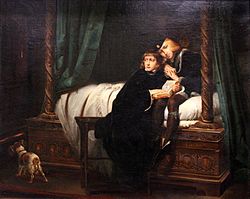
The reviewer, Jonathan Jones, seems weirdly obsessed with the maudlin Victorian painting of ‘The Princes in the Tower’ by Paul Delaroche (his comments on it form the bulk of the review) and thinks this is a good depiction of the reality in 1483. In the melodramatic painting, the boy are depicted sitting fearfully on a bed in a darkened room, clutching each other and staring, pale-faced around them. A dog is added for extra pathos; he looks at the door, no doubt hearing the heavy tread of ‘Black Will Slaughter’ and his not-so-merry troupe of killers. It is pure fantasy and conjecture and doesn’t even take into account (as few do!) that the two boys would not even be terribly familiar with each other, as they were living in separate households until that time. As for Mr Jones quoting Dr Argentine‘s supposed words about Edward V fearing death, this is hardly proof of anything. I am sure the young boys, Edmund and Roger Mortimer, the elder only aged 8, who were held captive by Henry IV owing to their better claim to the throne, must have felt much the same at times. The only difference is–we KNOW what happened to the Mortimer boys in the end. As for the reviewer referring to the princes being in a ‘cell’–pure fantasy.
The reviewer goes on to ask– ‘Were the two skeletons found at the tower in 1674 those of the princes? What is the evidence and what do historians – as opposed to the Richard III Society – really make of it all?’
Well, firstly, this is a massively insulting assumption on his part–that no one in the Society has any kind of academic accreditation whatsoever, another nonsensical statement. Secondly, from a purely archaeological perspective, the identification of the skeletons as the princes is extremely shaky. Remains found at that depth (10 feet) are more likely to be from an earlier period. They are also not the only skeletons found in the Tower grounds; there was a nearby Roman cemetery (there are loads of Roman grave goods displayed at the Church of All Hallows, just outside the Tower walls), an Iron Age child found in the 70’s, and some medieval burials unearthed in the last few years. The 1674 bones were last examined in the 1930’s and neither sex nor date has ever been verified- juveniles under 16 are difficult to sex without DNA even today, and pretty much impossible back then, and carbon-dating did not exist. The two doctors that examined the remains called them ‘Edward and Richard’ purely on an assumption.
So much about Richard’s reign and motives is built on assumption…and a certain play, of course. It is unfortunate that ‘the Princes’ have become the sole focus of anything to do with Richard–after all, look how many movies/TV series are made about Henry VIII, and I cannot remember a single reviewer moaning because he was portrayed as too much of a ‘nice guy,’ although most of these productions gloss over Henry’s tyranny and make him out to be just a ‘bit of a lad’ whose later actions took place only because he was desperate for a son (so that’s ok then, apparently.)


 The New Murrey and Blue blog
Leave a reply to A film review that praises the real Richard III…. – murreyandblue Cancel reply