Reblogged from A Medieval Potpourri sparkypus.com

Fotheringhay Church and Yorkist Mausoleum 1804. Watercolour by unknown artist. Described by Simon Jenkins as ‘the church that seems to float on its hill above the River Nene, a galleon of Perpendicular on a sea of corn…’
Edmund, son of Richard Duke of York and Cicely Neville was born on the 17th May 1443 at Rouen, France and would die at the Battle of Wakefield, just outside Sandal Castle, with his father on the 30 December 1460. A short life…
Had he lived longer Edmund may well have become a commendable and significant member of the Plantagenets and his early death, at the age of 17, leads to a poignant ‘what if?’ It goes without saying that had Edmund not lost his life that day historical events would have evolved very differently and perhaps, for the family, less tragically. But it was not to be and it’s easy to imagine the grief that must have overwhelmed his mother when the news reached her of the terrible outcome of Wakefield on 2 January – ‘cam hevy word and tidings …. that the duke of york, the Erle Rutland his sone and the Erle Salesbury wer trayterously and ageinst lawe of armes be taking of Tretys graunted, mordred and slain in the north beside pountfreite in a feld called wakefield’. (1). Not only had she lost Edmund but her husband, who had been her rock and mainstay throughout most of her life. However Cicely was to carry on and was destined to suffer even more tragedy later including the judicial murder of another son, George duke of Clarence, and the violent death of her youngest surviving son Richard III at Bosworth. But that is another story.
To focus back on Edmund – he shared much of his childhood with his older brother, Edward, Earl of March, as can be seen by delightful letters written by the pair of them while at Ludlow to their father, which always make me smile. The date of this letter is June 1454:
‘Also we thonke your noblesse and good ffadurhod of our grene gownes nowe late sende unto us to our grete comfort; beseching your good lordeschip to remembre our porteux, and that we myght have summe fyne bonetts sende un to us by the next seure messig, for necessite so requireth. Overe this, ryght noble lord and ffadur, please hit your highnesse to witte that we have charged your servant William Smyth berer of thees for to declare un to your nobley certayne things on our behalf, namely coicernyng and touching the odieux reule and demenyng of Richard Crofte and of his brother. Wherefore we beseche your graciouse lordeschip and full noble ffadurhood to here him in exposicion of the same, and to his relacion to yeve ful feith and credence. Ryght hiegh and ryght myghty Prince, our ful redoubted and ryght noble lorde and ffadur, we beseche almyghty Jhu yeve yowe as good lyfe and long with as muche contenual perfite prosperite as your princely hert con best desir. Writen at your Castill of Lodelowe on Setursday in the Astur Woke.
I wonder if their little plan succeeded and the ‘odious’ Richard Crofte was removed? It would not be the last time they would complain about ‘staff’ and attempt some type of swop. A second letter exists assuring their ‘Lorde and Fader‘ of their ‘wilfare‘ at the writing of the letter, they tell him ‘We were in good helth of bodis thonked be God‘ and‘beseche your good Lordeschip that hit may plaese yowe to sende us Harry Lovedeyne grome of your kechyn whose svice is to us ryght agreable And we will sende yowe John Boyes to wayte on your good Lordeschip‘ Nice try boys!..sadly we don’t know they were successful (2).
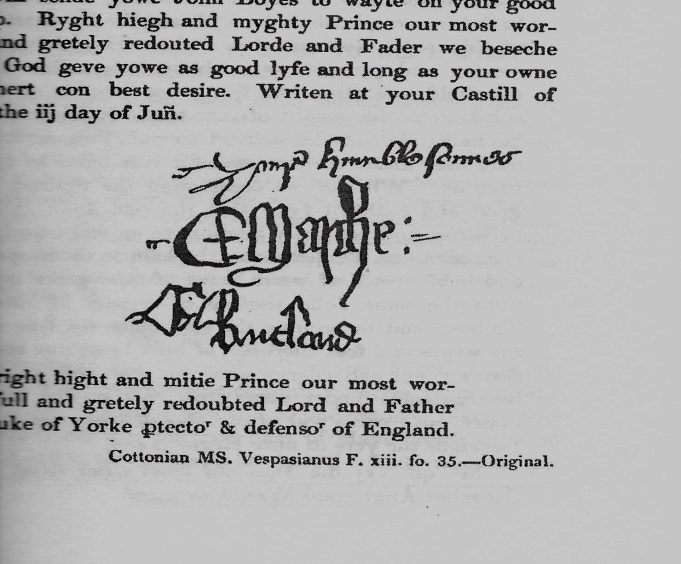
Edmund and Edward’s signatures on a letter to their father c. 1454.
But the madness that become known as the Wars of the Roses was to end Edmund’s life in the cruellest way. Edmund, at 17 considered old enough to go into battle, fought alongside his father and his maternal uncle, Richard Neville, Earl of Salisbury, at the battle of Wakefield on the 30 December 1460 and it’s sad to contemplate how different things would have evolved had he instead chosen to travel east with his brother Edward. But stay, and die, with his father he did. Lurid tradition says after Edmund made a failed attempt to flee, the death blow was dealt by Lord Clifford in vengeance for his father’s death at St Albans or at the very least on his orders. We will never know. After the battle their bodies were taken the short distance to Pontefract. It is not known for certain where their remains were buried but it was probably at the Cluniac Priory of St John the Evangelist although the Croyland Chronicler stated that it was the House of the Mendicant Friars.

Micklegate Bar, York. The heads of Edmund, his father, Richard Duke of York and his uncle Richard Neville, Earl of Salisbury were displayed on spikes on top of this gate until the Yorkist victory at Towton three months later. Thanks to Jon Ward for this atmospheric photo of the gate.
To continue reading click here.


 The New Murrey and Blue blog
Leave a reply to THE ‘PRINCESS’ OF COLYTON – murreyandblue Cancel reply