REBLOGGED FROM A Medieval Potpourri @ sparkypus.com

Ralph Neville Earl of Westmorland and his two wives. Staindrop Church, Durham. Ralph Neville by his wife Joan Beaufort, was the father of Cicely Neville, mother of two kings – Edward IV and Richard III. This drawing was made by Charles A Stothard c.1811 and shows them minus the graffiti.
In the village of Staindrop, Durham, you can find the church of St Mary’s, originally known as St Gregory’s, which being the church of the nearby Neville fortress of Raby Castle, it’s scarcely surprising that it has an abundance of Neville tombs therein. One of the earliest monuments is that of Euphemia de Clavering – what a delicious name! Euphemia c.1267-1320 was the daughter of Robert fitz Roger of Clavering, Essex, and Warkworth, Northumberland (1). She was the first wife of Ralph/Ranulph Nevill, (who served both Edward I and Edward II in Scotland) third Lord Neville c.1262-1331 by whom she had several children the most well known being Ralph Neville, fourth Lord Neville c.1291-1367. This son would be described by chroniclers as a ‘powerful man, brave, cunning, and much to be feared, fought so fiercely that his enemies bore the imprint of his blows after the battle‘ and was one of the victors of the Battle of Neville’s Cross, 1346. Known to be ‘great with the king‘ Ralph would rebuild the south aisle of Staindrop church to house his mother’s tomb.
 Euphemia de Clavering, her of the lovesome name, angels gently stroke her face – died c.1320. First wife of Ralph Neville, third Lord Neville. Photo jmc4 Church Explorer
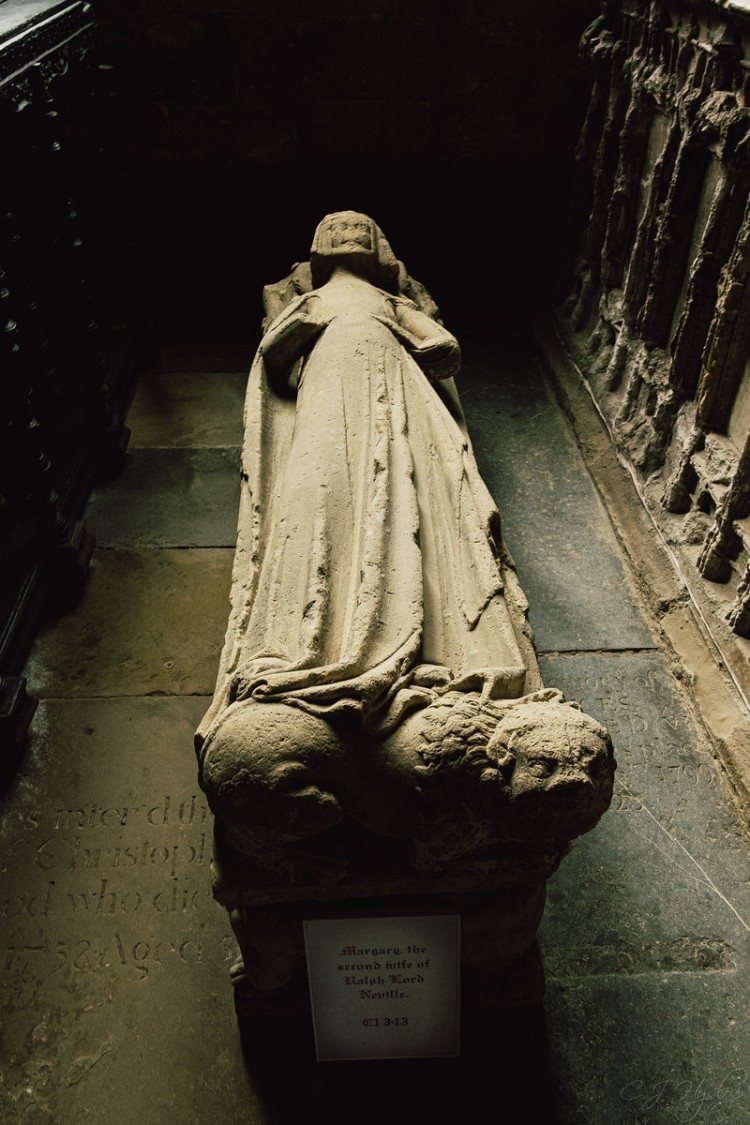
Marjorie Neville nee Thwenge, second wife to Ralph, third Lord Neville. Marjorie and Ralph were childless. Unusually for a lady her feet rests on a lion. Photo thanks tofragglerocking.

An effigy of an unknown Neville child with the Neville saltire symbol on both sides of his pillow. Next to the child an effigy thought to be that of Isobel Neville who died c.1260. Photo thanks to fragglerocking.
An effigy of a lady, possibly Isobel Neville, who died in 1260 and whose marriage to Robert fitz Maldred/Meldred, Lord of Raby brought the Neville family to Raby after their son, Geoffrey fitz Robert, adopted his mother’s surname ‘Neville’
The child is unknown and has the Neville saltire symbol on both sides of the pillow supporting his head. It must have seemed to the parents that no sooner was this child here than he was gone…..
RALPH NEVILLE, FIRST EARL OF WESTMORLAND c.1364-1425
The pièce de résistance of the Neville monuments is surely that of Ralph Neville, first Earl of Westmorland and his two wives. This Ralph Neville was eldest son of John Neville, fifth Baron Neville, c.1330-1388 and grandson of the above Ralph Neville, fourth Lord Neville, victor of Neville’s Cross…. please keep up at the back dear reader…. The monument was created from alabaster that came from the quarries of John of Gaunt, duke of Lancaster, at Tutbury. All three wear collars of Lancastrian SSs and it’s unusual in that the small bedesmen carved at Ralph’s feet kneel at lecterns rather than counting rosaries. Ralph died on 21 October 1425, and was buried in the choir of his collegiate church at Staindrop. In his will he stated his wish to be buried either in Durham Cathedral or at Staindrop but Staindrop it was. Although effigies of both his wives lay either side of his on the monument neither were buried with him. His first wife Margaret Stafford was buried at Brancepeth, his second, Joan Beaufort d.1440, daughter of John of Gaunt, was buried in Lincoln Cathedral close to the tomb of her mother Katherine Swynford (2).

The large alabaster monument of Ralph Neville Earl of Westmorland, Margaret Stafford and Joan Beaufort. Photo richardiiiworcs.co.uk Note the bedesmen, now sadly headless, kneeling at lecturns.
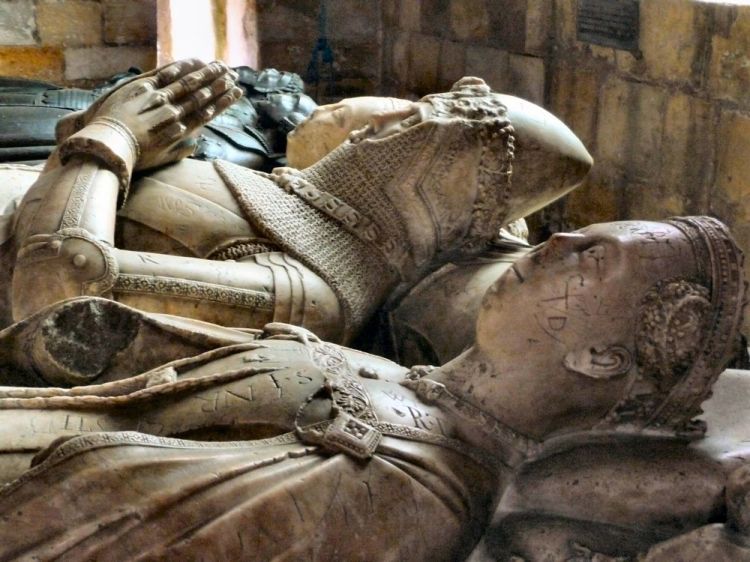
Photo richardiiiworcs.co.uk
 Watchful lion on which Ralph rests his feet. Multilated but still loyally fierce. Photo thanks to fragglerocking.

Profile and details of headdress of one of Ralph’s wives. Drawn c.1811 by Charles A Stothard.
Westmorland led a most interesting life which is well worth delving into. His monument was originally in the chancel but later removed to its present position. However his remains were found, with what was presumably his favourite greyhound (greyhounds being supporters on the earl’s seal) in the chancel during excavations. The skeleton was of a very tall man with a diseased leg (3). Ralph fathered a total of 22 (some say 23) children from his two marriages which led to many bitter problems caused by what has been described as ‘an ambitious family feud’ (4). His will made at Raby on 18 October 1424, is described as ‘niggardly to the children of his first marriage‘ largely disinheriting the sons from that marriage and written to settle the greater part of his inheritance on his children from his second marriage to Joan. As J L Laynesmith puts it in her biography of Cicely Neville this injustice would ‘inevitably set generations of Nevilles at odds with one another and contributed to the baronial infighting of the Wars of the Roses’. I will leave it to W E Hampton to summarise what were the end results of the life of Ralph Neville, first earl of Westmorland.
To continue reading click here.
 The New Murrey and Blue blog
Leave a reply to The Granddaughters of Edward III – murreyandblue Cancel reply