My latest A Medieval Potpourri @sparkypus.com post
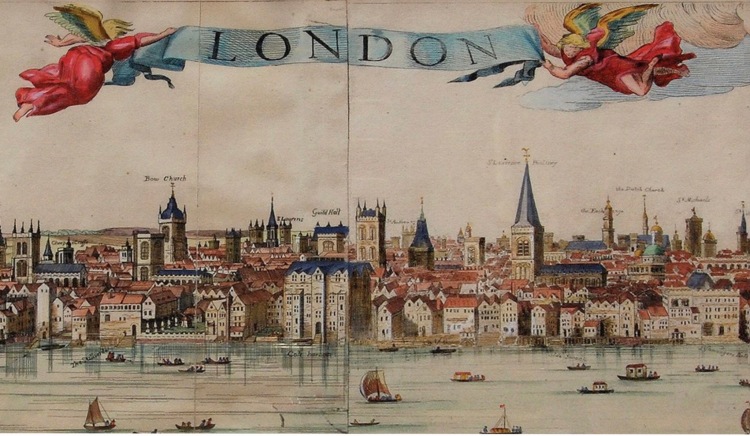
London before the Great Fire and much as Richard Neville ‘The Kingmaker’ and his family would have known it… L’Erber stood slightly to the north west of Coldharbour which is the large house seen here in middle of the picture and facing the Thames. No depiction of L’Erber has come down to us. Part of the The Visscher Panorama of London, 1616. Image Peter Harrington Rare Books.
L’Erber numbered amongst the most important houses in Medieval London. It gets regularly confused, even by one well known historian, with that other great house, Coldharbour, which confusingly was known for a while as Le Toure. If searching old maps for these once magnificent houses it might be helpful to remember that L’Erber stood on the east side of Dowgate Hill which was situated to the north of Thames Street, while Coldharbour was to the south of Thames street and fronted onto the River Thames.

The oblong area within the red lines was the site of L’Erber. Entrance was via the main gate which was approached from Dowgate Hill. Bordered to the south by Carter Lane later known as Chequers Yard/Lane and from the east by Bush Lane where there was a back entrance. Immediately to the north of L’Erber was the church of St Mary Bothawe. This church was destroyed in the Great Fire and rebuilt. Chequers Lane now gone but Bush Lane has survived the centuries. The area is now covered by Cannon Street Station. From Strype’s edition of Stow’s Survey c.1720.
Both these houses have been covered in depth by C L Kingsford’s article ‘On Some London Houses of the Early Tudor Period’ (1) This excellent article which gives the best and most accurate description of L’Erber available to us is now very difficult to get hold of but I was kindly sent a copy by someone from the Richard III Society. Frustratingly no depictions were ever made of L’Erber but we know exactly where it stood. Basically it was massive covering just slightly under three quarters of an acre. Along with the house itself were two gardens, a large garden known as the Great garden and a smaller one known as the ‘Lytell’ garden. There were also tenements, which were rented out, and a brew house known as the ‘Cheker’ (remembered in the name Checkers Yard), stables and also an area for carts. Situated immediately south of the church of St Mary Bothawe it was an irregular quadrilateral, having street frontages on three sides opening up on Dowgate, Carter Lane, later known as Chequer Lane/Checkers Yard, and Bush Lane and having two large gates referred to in the houses accounts as simply the fore gate and back gate. Built in the 14th century as a merchants house it would develop into one of the finest noblemans houses of London.
L’Erber’s most interesting period was during the Wars of the Roses when it was owned by Richard Neville, later known as Warwick the Kingmaker, and later through his daughter, Isobel, passed into the possession of her husband, George Duke of Clarence. Stow tells us of Warwick’s largesse and that at his other house situated down nearby Warwick Lane ‘were oftentimes six oxen eaten at a breakfast and every tavern was full of his meat; for he that had any acquaintance in that house might have there so much of sodden and roast meat as he could prick and carry upon a long dagger’ (2). Perhaps the same generosity could be found at L’Erber. In 1457 Richard the Earl of Salisbury , Warwick’s father, was housed at L’Erber along with 500 of his men while Warwick stayed at his house in Warwick Lane with his equally large entourage.
To continue reading please click here.
 The New Murrey and Blue blog
Leave a reply to JOHN DE LA POLE EARL OF LINCOLN AND ELSTON CHAPEL – A POSSIBLE BURIAL PLACE? – murreyandblue Cancel reply