
“….‘Payne puff’ appears on the menu for a feast held for King Richard II and John of Gaunt, the Duke of Lancaster, by John Fordham, Bishop of Durham, at Durham House [see here] in London, on September 23rd 1387. It was served on the third course which also included pottages (an almond broth and a stew in the Lombardy style), roasted meats (from venison to larks), as well as a dish of jelly and one of ‘long fritters’ [see Austin, p. 68]….”
I must point out that the diners at Durham House can’t have included John of Gaunt in 1387, because he was in Iberia, fighting for the throne of Castile. He left England in July 1386 and didn’t return until 1389. So either his presence is a mistake, or the dinner in question was some other year. John Fordham was translated to Ely on 3 April 1388, so he couldnt have been the host bishop in that year. Which means we have to go back to 1382-1385 for Fordham. Before then the bishop was Thomas Hatfield. Not important, I know, but it is an error for 1387, one that’s repeated all over.
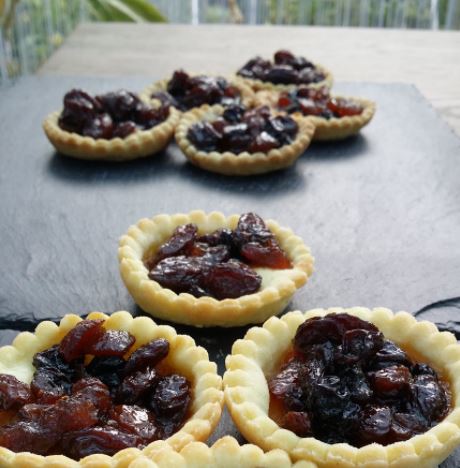
When I saw illustrations of these little pastry tarts, they looked exactly like mince pies to me, and I could certainly imagine Richard II and the Bishop of Durham tucking into them. Containing raisins, chopped dates, egg, saffron, ginger, sugar and salt, they can’t have tasted that far removed from our modern mince pies.

Monk’s Modern Medieval Cuisine is a very interesting site that I’ve recommended before. See Medieval food that looks awful but apparently tastes divine…! June 6th 2020


 The New Murrey and Blue blog
Leave a comment