
I find myself needing to research the sort of accommodation a weary medieval traveller might expect to find at an inn or hospice. Today we look at our picturesque 14th/15th16th century inns and have no trouble at all booking ourselves into handsome panelled rooms with low beams, latticed bay windows, fine four-posters etc. Oh yes, it gives us a romantic notion of our past. Except, of course, the past was nothing like this!

Hospices were, of course, rather different then from the hospices we think of today. They were established mainly along pilgrim routes to accommodate those travelling to a holy destination. Later they accommodated other travellers as well.
Travelling in England or Europe at that time entailed putting up with whatever one could find. The reality was more likely to be something along the lines of this next illustration. Often with medieval bunkbeds too.
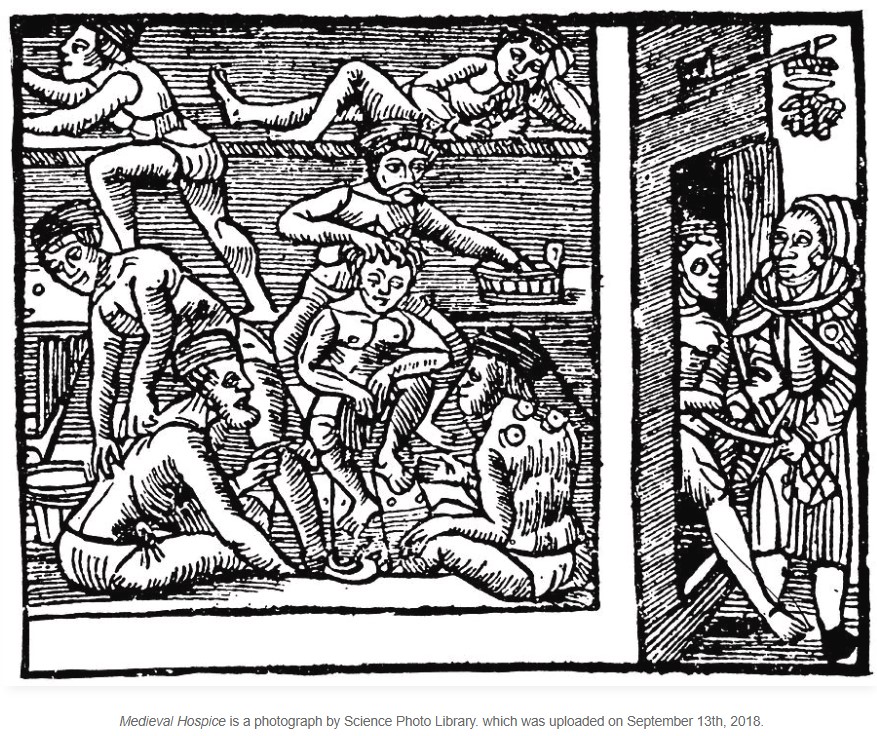
And all this with the added joy of bedbugs, bedding seldom changed and so on. Having read somewhere that even the poshest inns provided large bedchambers with up to three beds (each one 7’ x 6’ to accommodate up to three people) I knew I could certainly kiss goodbye to grandiose idea such as provided by Hever Castle at the beginning of this article.
Next I came to the picture below, which is definitely luxurious while still being rather public. Yes, the curtains did much to spare embarrassment, but in truth our medieval forebears weren’t easily embarrassed about such things as nakedness, as will be seen by the illustration of bunkbeds above!

Strangely, all this stirred a memory of my past. In 1953/4, when I was about 8, I was fortunate enough to live in the then West Germany with my RAF parents. We had a live-in maid named Ruth, who took me here, there and everywhere and was my very best friend. I adpred her and wept buckets when we had to come home to the UK. We’d go on buses, trains or her bicycle, with me sitting behind her, legs dangling, hanging on like mad. One day she took me on the train to the nearby town of Cloppenburg to see the folk museum, which is still there to this day and much bigger and better now.
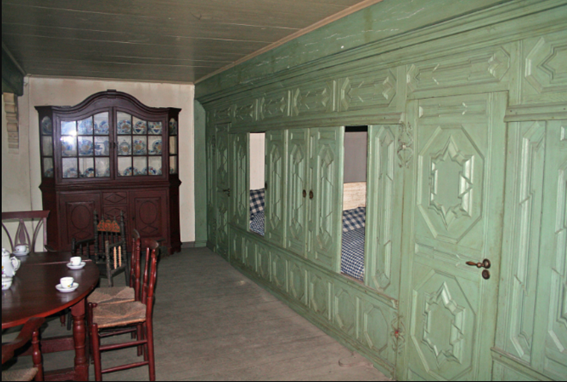
I distinctly remember going into one of the houses and seeing alcove beds. You can see them in the photograph below, with sliding doors that reveal blue and white bedding. I recall Ruth sliding the door back to show me the bed. I was horrified. Being a child of overactive imagination (too many books even then!) and thinking that I could be asleep inside when someone came along to kill me! I wouldn’t be able to escape from that cupboard!
Cloppenbury Museum is said to have houses and other buildings dating from the 16th century, but was that when such bed first came into use? I wonder if such alcove beds were also to be found in medieval houses and inns as well? But then, for an innkeeper, the number of customers you could squeeze into such small beds wouldn’t be very cost effective.
 The New Murrey and Blue blog
Leave a reply to Would you like to sleep in a cupboard bed….? – murreyandblue Cancel reply