 Thanks to this Daily Telegraph article last December, the world is now far more aware of the distinct possibility that the former Edward V lived on as “John Evans” at Coldridge in Devon into the reign of Henry VIII, his nephew, as a parker minding deer for his half-brother Thomas Grey, Marquess of Dorset. In addition, “Evans” became Lord of the Manor, with no other explanation.
The most obvious pieces of evidence are the windows at the Evans Chantry of St. Matthew’s Church in the village. One of them shows the “sunne in splendour”, the badge 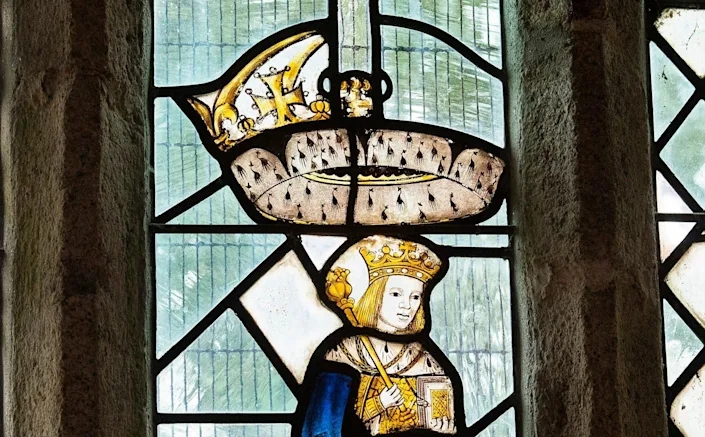 of Edward IV and another (left) shows a tall blond boy with an open crown and a partial larger one not
 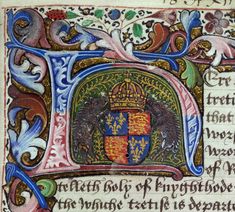 worn but poised over him, together with the falcon and fetterlock and some carved Yorkist roses. This is image 2 in The Mythology of the “Princes in the Tower” (Ashdown-Hill), although illness allowed the author no time to investigate further. Here is Richard III’s crown for comparison.
 This substantial artistic evidence, in the windows and carvings, begins to point us towards the conclusion that John Evans was Edward V, whose father was
  exceptionally tall for his era. Of course, the usual suspects and other groupthinkers are trying to confuse the issue by questioning the identity of the image and the popularity of the name “John Evans”, but there is some corroborating evidence that they singularly fail to address:
1. Richard III sent Robert Markynfield to Coldridge just two days after the emergence of Elizabeth Wydeville from sanctuary (1 March 1483-4), as she wrote to Dorset to invite him to return to England. Markynfield left Coldridge after Bosworth to be associated with Sir John Speke, later a “Perkin” supporter, who was related by marriage to Sir James Tyrrell.
2. Richard granted Coldridge to Sir Henry Bodrugan, a Devon man, who then turned up at the Dublin coronation after escaping being arrested by “Tudor’s” men. He and his son were accused of causing great trouble in Devon.
3. Coldridge was a property belonging to Dorset, through his wife Cecily Bonville.
4. The herald’s account describes how, after the battle of Stoke, the young lad hitherto claiming to be Edward V was found, except that his real name was apparently ‘John’.
5. At the outset of the “Simnel” rebellion, following a council meeting at Sheen, Dorset was arrested and sent to the Tower whilst Elizabeth Woodville was retired to Bermondsey Abbey.
6. The 41 deer on the ermine part of the crown signify Edward V’s age in late 1511.
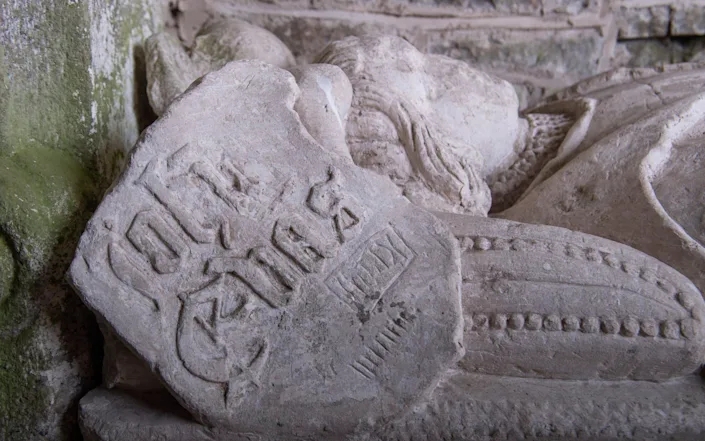
7. The Latin partial inscription “AS” on the tomb, an abbreviation for “asa” (in sanctuary) – hence EVAS.
8. Nine carved lines below this indicate the year of Henry VII’s death (1509), shortly before Evans first appeared.
9. Far from being unfinished, the windows and other insignia were damaged during Edward VI’s reign but restored by the Evans family.
10. Edward V is already wearing a small open crown. The larger one seems to be from a different window, where the royal arms once were? Martin Cherry, in the Journal of Stained Glass, vol. XXVI, has often viewed the Coldridge window, but never seen a halo.
I wonder what the Missing “Princes” Team can add to this, as time goes by, to make it clearer?


 The New Murrey and Blue blog
Leave a reply to Some progress in Cairo, but not enough yet – murreyandblue Cancel reply